
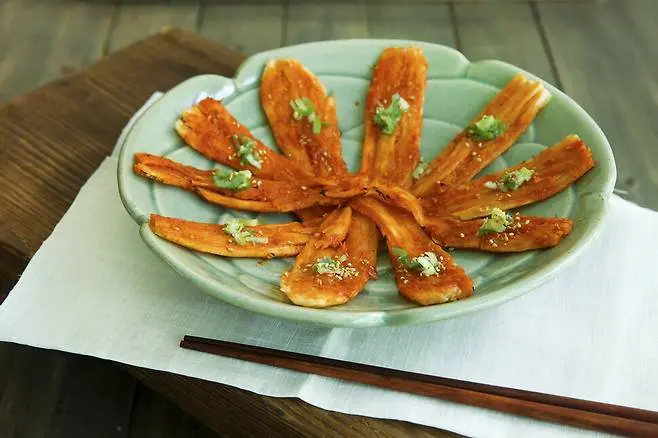
Deodeok is a food with a long cultivation history in our country. Our ancestors enjoyed it since before the Goryeo Dynasty. There is a saying that it is called 'Deodeok' because small, bumpy lumps stick to its root, making it look like 'Deodeok Deodeok'. Deodeok is an alkaline food that has the advantage of neutralizing the acidic components of meat when eaten together. It is also a health food that gradually raises blood sugar levels. Let's learn more about Deodeok.
Deodeok, when eaten with pork and beef...Neutralizes the acidic components of meat
According to the book 'Haedong History', which records the history from Dangun to the Goryeo Dynasty, there is a record that Deodeok was made into a vegetable dish during the Goryeo Dynasty. Although it has been consumed since before the Goryeo period, it was particularly a representative vegetable enjoyed during the Goryeo Dynasty (National Institute of Crop Science data). It seems that many people sought it, leading to its cultivation by farmers. Deodeok is an alkaline food rich in minerals such as potassium, iron, calcium, and phosphorus. Eating it with pork, beef, etc., helps neutralize the acidic components of meat, which is beneficial for health. Protein-rich meat contributes to muscle maintenance.
The component of Deodeok that helps control blood sugar...Gradually raises post-meal blood sugar
One of the main components of Deodeok, inulin, is known as 'natural insulin' that helps control blood sugar. When eaten with carbohydrates like rice, it gradually raises blood sugar levels. It has the effect of suppressing sudden spikes in blood sugar. The abundant dietary fiber also plays a significant role in blood sugar control. However, when preparing Deodeok dishes, sugars such as sugar and syrup should not be added. A spoonful of sugar can raise blood sugar by about 50 mg/dL within 15 minutes of consumption. The leaves of Deodeok contain antioxidant components such as phenols and flavonoids, which help slow down aging.
Saponins good for respiratory health...Also contribute to vascular health
The unique smell of Deodeok is due to the saponin component, which is abundant in ginseng. Saponins significantly increase mucus secretion in the airways (the passage through which air flows during breathing), helping with respiratory health by alleviating coughs and phlegm. They also assist in vascular health, helping to prevent vascular diseases such as arteriosclerosis and cancer. The saponins in Deodeok have properties that dissolve well in water. It is advisable not to soak Deodeok in water for a long time before cooking. Peeling the skin and briefly soaking it in saltwater can reduce bitterness while protecting the saponin components.
If you eat Deodeok like 'medicine'..."Absolutely do not add sugar or syrup"
Deodeok has a fibrous (dietary fiber) characteristic. Before cooking, pounding it with a rolling pin or pressing it can soften it, making it easier to eat. Adding it to bulgogi or pairing it with nuts can capture both flavor and nutrition. It is emphasized again not to add sugar to Deodeok dishes. This can reduce the health benefits of Deodeok, which helps control blood sugar. Even those who are not fond of Deodeok should eat it frequently for health. There is a saying that tasteless vegetables should be eaten like 'medicine'. Let's try eating Deodeok like medicine.