Positive late-stage clinical results for a personalized messenger RNA (mRNA) cancer vaccine developed by Moderna and Merck are raising expectations that related technologies held by South Korean biopharmaceutical companies could see a significant revaluation.
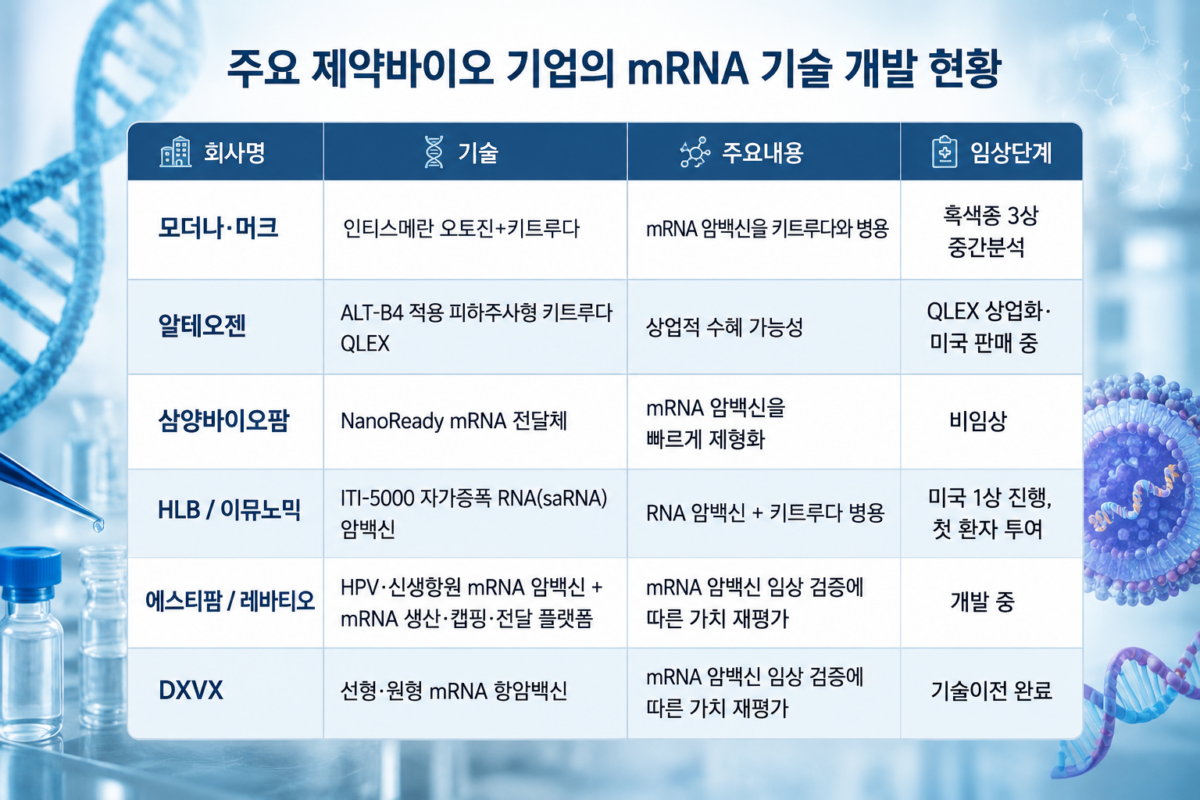
Moderna and Merck announced on the 20th that they met the primary endpoints in an interim analysis of their Phase 3 melanoma trial, "INTerpath-001." The study evaluated a combination regimen of "intismeran autogene" (mRNA-4157), an individualized neoantigen mRNA cancer vaccine, paired with Merck’s anti-PD-1 therapy, Keytruda.
The trial evaluated 1,137 melanoma patients at high risk of recurrence following surgical resection, comparing the intismeran-Keytruda combination against Keytruda monotherapy. The combination group demonstrated statistically significant improvements in both recurrence-free survival (RFS) and distant metastasis-free survival (DMFS). This marks the first time a personalized neoantigen mRNA cancer vaccine has successfully generated positive Phase 3 results, with detailed clinical data slated for presentation at an upcoming medical congress.
Beyond its immediate impact on melanoma treatment, the milestone validates the broader potential of mRNA technology to transition from infectious disease prevention into therapeutic oncology. Analysts at Mirae Asset Securities noted that the study proves a personalized treatment platform can be executed at Phase 3 scale despite a complex supply chain requiring individual tumor sequencing and custom manufacturing for each patient. They added that demonstrating efficacy across other tumor types will be key to gauging the platform's long-term scalability.
The breakthrough is expected to ripple through South Korea's biopharmaceutical sector. From a commercial standpoint, attention is focused on Alteogen, which is closely tied to Keytruda. Because the intismeran-Keytruda combination outperformed Keytruda alone, broader adoption of Keytruda-based combination therapies could expand overall drug usage. Alteogen’s proprietary recombinant human hyaluronidase technology, "ALT-B4," enables the subcutaneous (SC) formulation of Keytruda, marketed in the United States as "Keytruda QLEX." Under its agreement with Merck, Alteogen is eligible to receive up to $1 billion in commercial sales milestones. Increased adoption of Keytruda SC in future combination regimens could boost QLEX sales and accelerate milestone payments for the firm.
The emergence of a personalized mRNA cancer vaccine market is also drawing interest to Samyang Biopharm’s proprietary gene delivery platform, "NanoReady." Engineered to rapidly formulate patient-specific mRNA, NanoReady utilizes a nanoparticle composed of proprietary lipids and biodegradable polymers to selectively target dendritic cells in the spleen, triggering a robust T-cell response against cancer antigens. Featuring a unique multilayered structure, NanoReady can load approximately 20 times more mRNA per particle than conventional lipid nanoparticles (LNPs).
Other South Korean firms advancing RNA-based cancer therapies stand to gain momentum as well. Immunomic Therapeutics, a U.S. subsidiary of HLB, is conducting a U.S. Phase 1 trial of "ITI-5000," a self-amplifying RNA (saRNA) cancer vaccine evaluated both as a monotherapy and in combination with Keytruda—mirroring the combination strategy validated by Moderna. Meanwhile, ST Pharm is pursuing mRNA cancer vaccines through its U.S. subsidiary, Levatio Therapeutics, targeting HPV E6/E7 antigens and neoantigens while leveraging its internal mRNA production, capping, and delivery platforms. Additionally, DXVX previously executed a $220 million global licensing agreement for an mRNA cancer vaccine with an undisclosed U.S. biotech firm in July 2025; renewed global interest in mRNA oncology could bring its preclinical assets back into focus.
Despite heightened expectations, industry observers caution that most South Korean RNA cancer vaccines and delivery platforms remain in early clinical or preclinical development. The extent to which domestic platforms are revalued will ultimately depend on detailed safety and efficacy data from the intismeran trial, upcoming regulatory approvals, and whether the platform can replicate its success in other cancer indications.