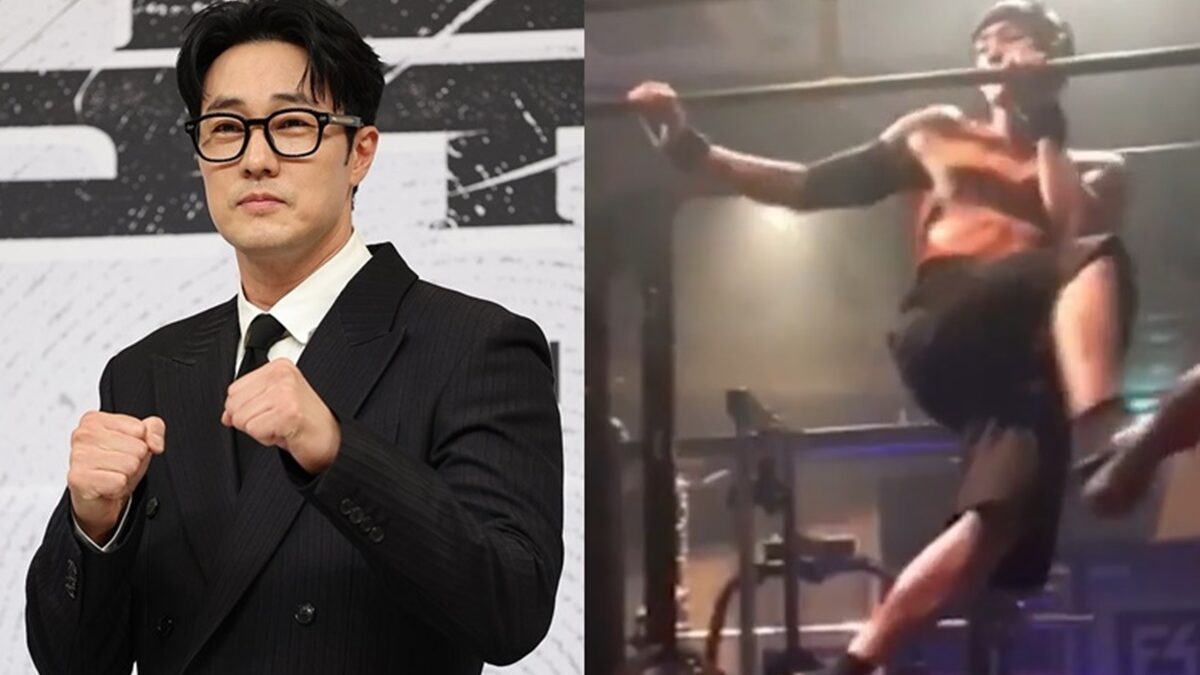
Actor So Ji-sub, 49, is back in the spotlight after a clip showing him perform a high-difficulty pull-up variation went viral across social media.
The widely shared video, taken from an earlier drama, shows So Ji-sub demonstrating a solidly muscular physique while executing the advanced "archer pull-up." The scene features his actual training footage rather than computer-generated graphics (CG).
So Ji-sub recently gained widespread acclaim for his role in the SBS drama Agent Kim Reactivated, which aired its final episode on the 25th. Playing Agent Kim, a former North Korean operative who steps in to save his daughter, he delivered hard-hitting action sequences as a sharp-shooting "uncle in glasses."
A former competitive swimmer and water polo player, So Ji-sub has consistently maintained his physical condition through weight training and boxing. Here is a closer look at the science behind the training that powers his standout action performance well into his 40s.
The Archer Pull-Up: Shifting Body Weight to One Arm at a Time
The archer pull-up is an advanced pull-up variation designed to bridge the gap toward a one-arm pull-up. Mimicking an archer drawing a bowstring, the athlete shifts their body to one side so that one arm performs the primary pull while the opposite arm remains extended almost straight along the bar. Because a single arm bears the majority of the load, the exercise demands exceptional upper-body strength, balance, and core stability.
The movement primarily targets key back muscles—including the latissimus dorsi, trapezius, rhomboids, and teres major—while heavily engaging the biceps and forearms. Because one side carries most of the weight, it helps correct left-right strength imbalances. Meanwhile, the abdominal and lower-back muscles contract strongly to prevent the torso from swaying, providing an intense core workout. Compared with standard pull-ups, the heightened mechanical load offers a superior stimulus for both strength gains and muscle hypertrophy.
Although primarily a strength exercise, the archer pull-up is a multi-joint compound movement that consumes considerable energy. By expanding muscle mass, it helps elevate the body's basal metabolic rate (BMR), supporting long-term body-fat management when paired with proper nutrition and cardiovascular conditioning.

How to Perform the Move—and Key Precautions
To perform an archer pull-up, grip the pull-up bar slightly wider than shoulder-width apart. As you pull your body upward, shift your chest toward one hand, bending that elbow while keeping the opposite arm extended straight out to the side. Once your chin clears bar height, lower yourself with control, then alternate to the opposite side. A standard set typically consists of three to five alternating repetitions per side for about three sets.
Because of the high stress placed on the shoulders and elbows, beginners should avoid attempting the move prematurely. Individuals should be able to perform at least 10 standard pull-ups with strict form before progressing to archer pull-ups. Momentum or body twisting increases the risk of injury. Practitioners should keep their scapulae (shoulder blades) depressed rather than shrugging, and those with existing shoulder pain or rotator cuff issues should avoid the movement altogether.
Even standard pull-ups remain the undisputed "king of back exercises." As a foundational bodyweight compound exercise, the basic pull-up engages the latissimus dorsi, trapezius, rhomboids, biceps, forearms, and core simultaneously, efficiently building upper-body strength and boosting metabolic output.
Why "Morning Boxing, Afternoon Weights" Delivers Results
So Ji-sub’s personal training regimen—combining morning boxing sessions with afternoon weight training—is a classic example of concurrent training aimed at maximizing both cardiovascular endurance and muscular strength.
Boxing serves as high-intensity interval training (HIIT), burning significant calories while boosting cardiopulmonary capacity. Following adequate rest and nutritional intake, afternoon weight training provides the mechanical tension needed for muscle building. Research confirms that combining aerobic exercise and resistance training helps maintain or increase muscle mass while simultaneously reducing body fat and improving cardiovascular fitness.
However, training twice a day places heavy demands on physical recovery. Anyone attempting a double-session routine must prioritize adequate carbohydrate and protein intake alongside sufficient sleep to prevent overtraining.