Daewoong Pharmaceutical has completed patient enrollment for the global Phase 2 clinical trial of bersiporosin (DWN12088), its first-in-class candidate for idiopathic pulmonary fibrosis (IPF), and is entering the study's final stage. With 104 patients enrolled across South Korea and the United States, the company expects to announce top-line trial results in the first half of 2027.
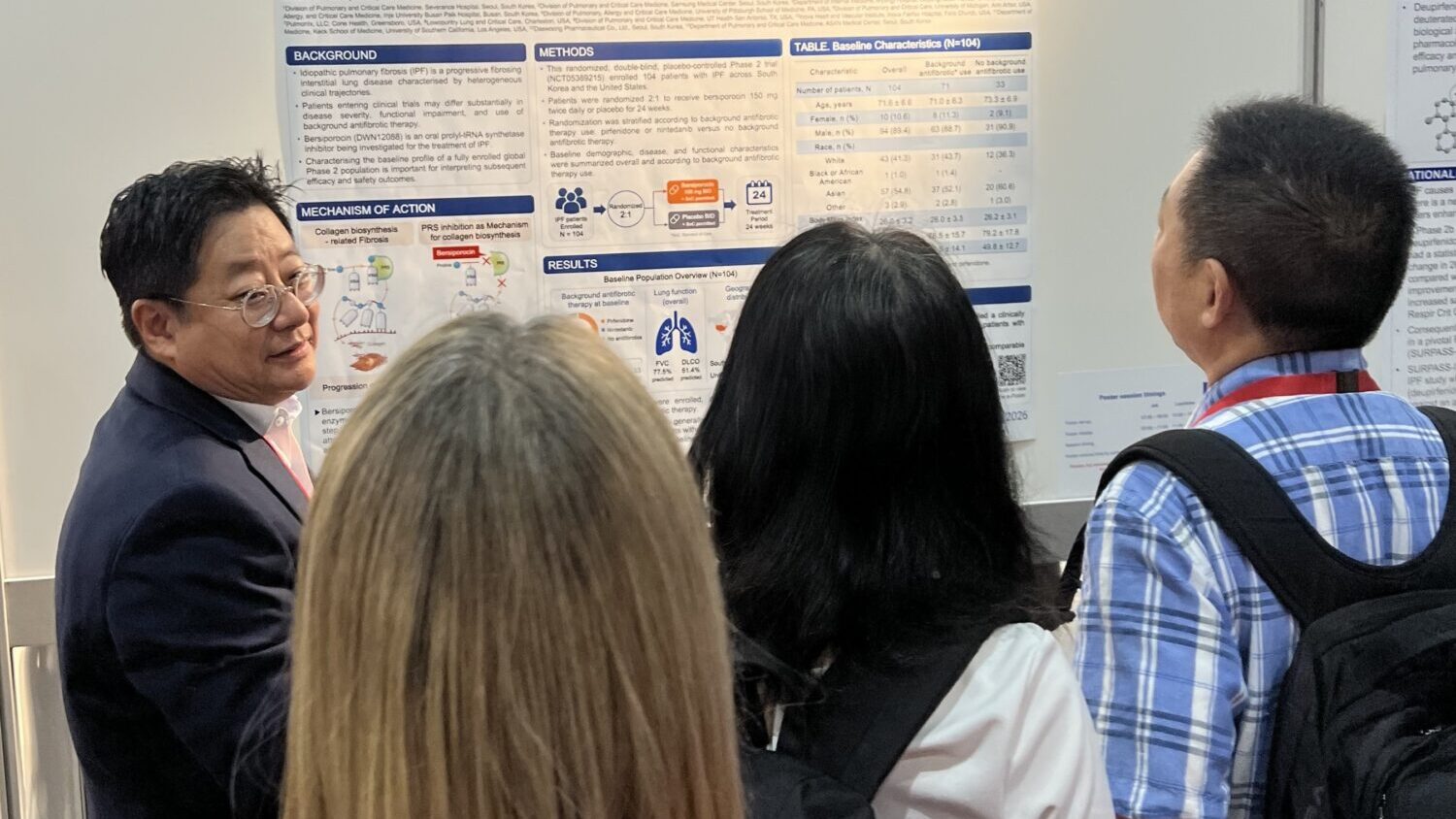
On Sept. 21, Daewoong Pharmaceutical announced that it presented baseline demographic and clinical characteristics for all 104 trial participants during a poster session at the European Respiratory Society Congress (ERS 2026), held on Sept. 6 in Barcelona, Spain. The presentation focused exclusively on baseline patient profiles, with efficacy and safety outcomes reserved for the top-line readout next year.
Idiopathic pulmonary fibrosis is a chronic, progressive lung disease characterized by irreversible scarring and stiffening of lung tissue, which progressively restricts respiratory function. In IPF, abnormal inflammatory and fibrotic signaling drives the excessive production and accumulation of collagen in the lungs. Developed in-house by Daewoong Pharmaceutical, bersiporosin selectively inhibits prolyl-tRNA synthetase (PRS)—an enzyme essential for incorporating the amino acid proline into collagen synthesis. By acting directly at the collagen synthesis stage where multiple fibrotic signaling pathways converge, bersiporosin aims to halt fibrosis at its source, offering potential as both a standalone therapy and a combination treatment alongside existing standard-of-care antifibrotics.
Among the 104 enrolled participants, 55 patients (52.9%) were recruited in South Korea and 49 (47.1%) in the United States. A total of 71 patients (68.3%) were receiving background therapy with standard antifibrotic agents, while 33 patients (31.7%) were antifibrotic-naive. Baseline clinical characteristics were well-balanced between the two groups. The overall study population presented a mean forced vital capacity (FVC) of approximately 77% of predicted normal values and a mean diffusing capacity of the lung for carbon monoxide (DLCO) of roughly 51%. FVC measures the total volume of air forcefully exhaled after maximum inhalation, while DLCO evaluates gas exchange efficiency between alveolar air and the pulmonary capillaries.
The 24-week, randomized, double-blind, placebo-controlled Phase 2 trial evaluates bersiporosin or placebo administered twice daily, with permitted concomitant use of standard antifibrotics pirfenidone or nintedanib. Stratified by background antifibrotic use prior to randomization, the study design enables clinicians to evaluate bersiporosin’s therapeutic profile across real-world clinical settings.
"Because the study enrolled a diverse cohort reflecting real-world clinical practice, including patients with and without background antifibrotic treatment, these baseline data provide an essential foundation for evaluating bersiporosin’s efficacy and safety going forward," said Prof. Park Moo-seok of the Division of Pulmonology at Severance Hospital, who participated in the trial.
Park Sung-soo, CEO of Daewoong Pharmaceutical, added, "With Phase 2 top-line results expected in the first half of 2027, we remain fully committed to advancing global development and commercialization without delay, accelerating our efforts to provide a novel therapeutic option to IPF patients worldwide."