

<Executive Summary>
An MRI scan may show both a herniated disk and spinal stenosis, but imaging alone does not dictate treatment. The true cause of pain must be confirmed through a physical examination matching specific symptoms to nerve pathways.
Selective nerve block injections serve two purposes: providing immediate anti-inflammatory pain relief and helping clinicians isolate the specific nerve root driving a patient's discomfort.
Surgical intervention is decided by weighing clinical symptoms—such as motor weakness, walking limitation, and failure of conservative treatment—rather than MRI appearance alone. Emergency red flags like cauda equina syndrome require immediate surgical evaluation.
For months, 73-year-old Kim, a resident of Saha-gu, Busan, found himself increasingly reluctant to go on his usual mountain walks. After taking just a few dozen steps, his right calf would turn numb and tight, followed by a deep, aching pain. He was forced to squat on the trail repeatedly to catch his breath and rest his legs. On several occasions, his leg suddenly buckled beneath him while walking, causing him to stagger.
Assuming it was simple muscle fatigue or poor circulation, Kim spent months applying over-the-counter pain-relief patches and massaging his legs every night. When the symptoms persisted, his adult children brought him to Busan Bon Hospital for a thorough examination.
There, he received an unexpected diagnosis: "The problem isn't in your legs—it's in your lower back."
An MRI revealed both lumbar spinal stenosis and early-stage intervertebral disk degeneration. Yet, despite the dual diagnosis, his physician did not immediately recommend surgery.
"Let’s start with targeted injection therapy while closely monitoring how your symptoms respond," the doctor advised.
When Back Nerves Strike the Legs: Disk Herniation vs. Spinal Stenosis
Patients are often baffled when lower back nerve compression causes pain, numbness, or weakness in the legs without producing any back pain at all. The two most common spinal conditions responsible for this phenomenon are lumbar disk herniation and lumbar spinal stenosis.
A herniated disk occurs when the soft inner gel of a spinal disk pushes through its outer ring, pressing directly against adjacent nerve roots. In contrast, spinal stenosis is a gradual, age-related degenerative condition in which thickened spinal ligaments and bony overgrowths (bone spurs) narrow the central spinal canal or neural foramina, crowding the nerves passing through.
While these conditions differ structurally, their clinical presentations often overlap:
Lumbar Disk Herniation: Pain typically worsens when sitting or bending forward at the waist, as these positions increase pressure within the disk space. Symptoms tend to ease when standing straight or walking.
Lumbar Spinal Stenosis: Pain and numbness worsen during standing or upright walking, as extending the spine narrows the canal further. Symptoms improve noticeably when leaning forward or crouching—a classic sign often called the "shopping cart posture."
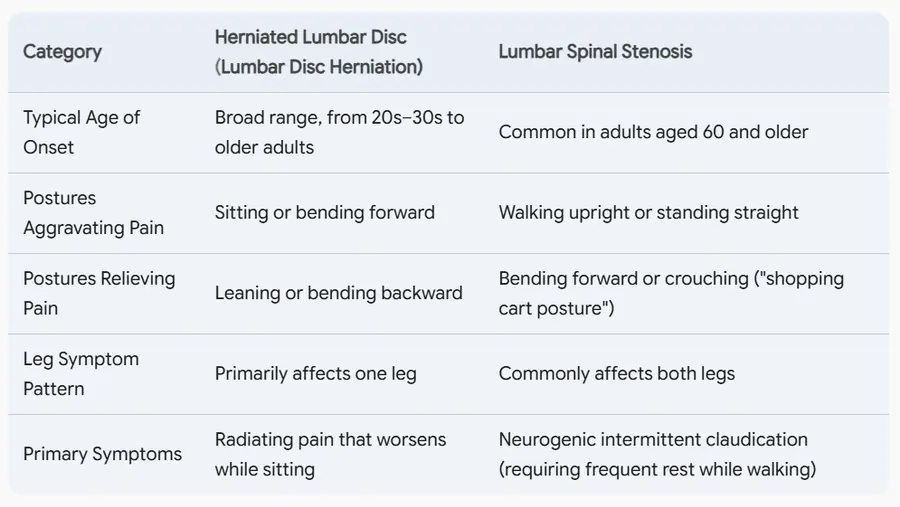
In everyday practice, particularly among older adults, these two conditions frequently coexist across multiple spinal levels.
"In real-world clinical practice, spinal conditions are rarely as neatly separated as they are in medical textbooks," explains Dr. Huh Dae-seok, Director of Orthopedic Surgery at Busan Bon Hospital. "We very often see patients presenting with a complex combination of disk degeneration and canal narrowing occurring simultaneously."
Treating the Patient, Not the Image: Finding the 'Culprit' Nerve
The presence of abnormalities on an MRI does not automatically mean those specific lesions require treatment. Some individuals exhibit severe structural nerve compression on imaging while experiencing minimal discomfort. Conversely, others suffer from debilitating pain despite having relatively mild MRI findings.
To avoid unnecessary procedures, physicians focus on identifying the specific "culprit" lesion that accurately matches the patient’s clinical symptoms. This begins with a meticulous neurological examination mapping motor strength, reflexes, and sensory changes:
L5 Nerve Root: Evaluated by testing the patient's ability to lift the big toe or ankle upward (dorsiflexion).
S1 Nerve Root: Assessed by testing the patient's ability to stand on tiptoes (plantarflexion) and evaluating the Achilles tendon reflex.
Clinicians correlate these neurological findings directly with the MRI scans. If a patient experiences right leg pain, the care team checks whether a corresponding lesion compresses the right-sided nerve root at the exact anatomical level matching the sensory or motor deficit.
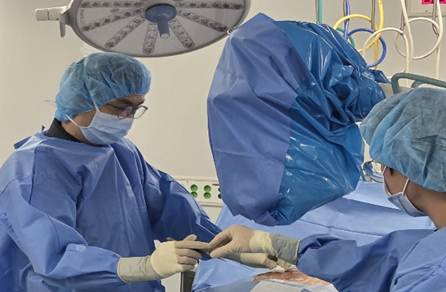
When imaging shows compression across multiple spinal levels, physicians may perform a selective nerve root block. By injecting a small amount of local anesthetic directly around a suspected nerve root, doctors can observe whether the patient experiences immediate, significant pain relief. If symptoms subside right after the injection, it strongly points to that specific nerve root as a primary pain generator.
Beyond its diagnostic utility, a nerve block serves a therapeutic purpose. By delivering a combination of local anesthetics and anti-inflammatory corticosteroids around the irritated nerve space, the injection calms tissue inflammation and breaks the pain cycle. While a nerve block does not shrink a herniated disk or widen a narrowed canal, it relieves severe pain, creating a vital therapeutic window for patients to walk, engage in physical therapy, and undergo rehabilitation.
Knowing the Red Flags: When Surgery Is Essential
When deciding between conservative management and surgery, orthopedic specialists weigh several factors beyond MRI scans: the severity of daily pain, functional walking distance, progressive motor deficits, and how well the patient responds to non-surgical care.
Even when an MRI reveals pronounced spinal stenosis, conservative treatment and regular observation are preferred if the patient's symptoms remain mild and motor strength is intact. However, if neurological function deteriorates or walking becomes severely impaired, surgical interventions—such as minimally invasive decompressive surgery—must be evaluated.
Specialists emphasize that patients should never ignore critical neurological warning signs. Signs that require immediate reassessment include:
Foot Drop: Weakness in the ankle or toes causing the front of the foot to drag while walking.
Progressive Motor Weakness: Steadily declining leg strength that leads to frequent stumbling or instability.
Cauda Equina Syndrome: A medical emergency caused by severe compression of the nerve bundle at the base of the spinal cord. Symptoms include sudden loss of bowel or bladder control, difficulty urinating, or numbness in the buttocks, inner thighs, and saddle area.
"If severe pain fails to respond to medication or injection therapy, or if progressive paralysis or loss of bowel and bladder control begins, immediate surgical evaluation is critical," warns Dr. Huh Dae-seok.
For patient Kim, the dual diagnosis of stenosis and disk disease was initially daunting. However, understanding that his leg numbness stemmed from his spine—and that treatment should target his active symptoms rather than every visible flaw on an MRI—allowed him to pursue a structured, non-surgical recovery plan with confidence.
Frequently Asked Questions (FAQ)
Q. My lower back doesn't hurt, but my calf is numb. Could it still be a spinal issue?
A. Yes. Compression of a lumbar nerve root frequently causes leg pain, tingling, or numbness without causing any localized back pain. However, because peripheral neuropathy or vascular circulation issues can produce similar leg symptoms, a thorough clinical evaluation is required to establish the correct diagnosis.
Q. If my MRI shows both a herniated disk and spinal stenosis, do both need to be surgically repaired?
A. No. Treatment focuses exclusively on the specific lesion responsible for your active clinical symptoms. Asymptomatic structural changes found incidentally on an MRI do not require intervention.
Q. My leg pain improved significantly after a nerve block injection. Does this mean I am fully cured and won't need surgery?
A. A nerve block reduces inflammation and relieves pain, allowing you to resume daily activities and physical rehabilitation. If your relief is sustained and functional mobility returns, non-surgical management can be continued. However, if severe pain recurs or motor weakness develops, a medical re-evaluation is necessary.
Q. My legs feel numb and heavy after walking short distances, but the feeling goes away when I sit down. Can I keep pushing myself to walk?
A. This symptom is known as neurogenic intermittent claudication, a hallmark sign of lumbar spinal stenosis. Pushing through severe pain is not recommended. You should remain active within a comfortable range that does not aggravate symptoms. If your comfortable walking distance grows progressively shorter, consult a spine specialist.
Q. What symptoms constitute a medical emergency requiring an immediate visit to the emergency room?
A. Seek emergency medical care immediately if you experience sudden difficulty urinating, loss of bowel or bladder control, numbness in the saddle area (perineum and buttocks), or rapidly worsening weakness in your legs or feet. These are signs of cauda equina syndrome or acute neurological compromise.
Medical Reviewer & Expert Profile:
Dr. Huh Dae-seok is a Director of Orthopedic Surgery at Busan Bon Hospital, a Ministry of Health and Welfare-designated specialty hospital for joint and spinal disorders led by Chief Director Ha Sang-hoon. Dr. Huh graduated from Kyung Hee University College of Medicine, completed his residency at Kyung Hee University Hospital, and served as a spine fellow at Kyung Hee University Hospital at Gangdong. He specializes in the minimally invasive treatment of complex spinal conditions, including lumbar disk herniation and spinal stenosis, and is a full member of the Pacific and Asian Society for Minimally Invasive Spine Surgery (PASMISS).