Is myopia management complete once a new pair of glasses restores crisp, clear vision? The Korean Ophthalmological Society firmly warns that it is not. Far beyond causing temporary blurred vision, myopia progressively alters the structural anatomy of the eye, significantly elevating the lifetime risk of sight-threatening retinal and optic nerve disorders.
Research cited by the society reveals that every 1-diopter worsening of myopia is associated with a 20% increase in the risk of glaucoma and a 67% increase in the risk of myopic macular degeneration. A 67% rise means the patient's existing risk multiplies by 1.67—for instance, escalating a baseline 1% risk to 1.67%.
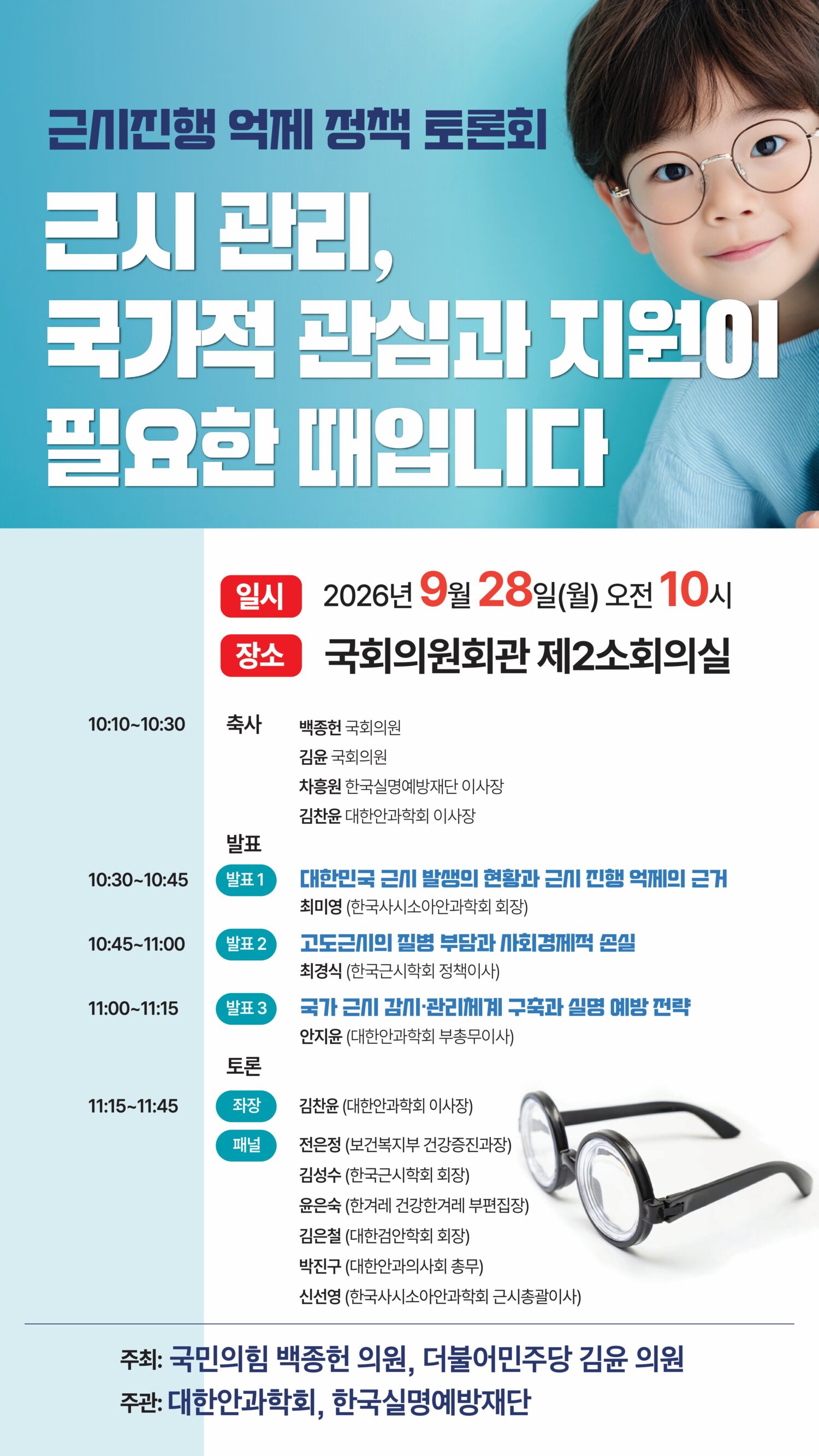
To address this growing public health concern, the Korean Ophthalmological Society and the Korea Foundation for the Prevention of Blindness will host a policy forum on slowing myopia progression at 10 a.m. on the 28th in Meeting Room No. 2 of the National Assembly Members’ Office Building. Themed "Myopia Management: Time for National Attention and Support," the event is co-hosted by Rep. Baek Jong-heon of the People Power Party and Rep. Kim Yun of the Democratic Party of Korea.
A Fivefold Generational Divide and Surging Youth Prevalence
The forum's opening presentation by Choi Mi-young, president of the Korean Association for Pediatric Ophthalmology and Strabismus, will detail the state of youth myopia in South Korea, international response strategies, and clinical evidence for progression-slowing interventions.
Data from the Korea National Health and Nutrition Examination Survey shows that myopia prevalence among adolescents aged 12 to 19 stands at 77.8%, with high myopia accounting for 9.4%. A separate study analyzing 23,616 19-year-old male recruits in Seoul recorded a myopia rate of 96.5% and a high myopia rate of 21.6%—though health authorities emphasize these two figures represent distinct study cohorts and timeframes.
Research highlighted by Choi Kyung-sik, policy director of the Korean Society of Myopia and director of legislation at the Korean Ophthalmological Society, underscores a stark generational gap: myopia prevalence reaches 78.9% among Koreans in their 20s compared to just 16.1% among those in their 60s, representing a nearly fivefold difference.
In educational settings, vision abnormalities climb steadily with grade level. According to the 2025 student health screening, approximately 30% of first-grade elementary students and 75% of first-year high school students were classified as having abnormal vision. Furthermore, a predictive model tracking Seoul military recruits from 2013 to 2022 projects that by 2050, myopia prevalence among 19-year-old men in Seoul could reach 90.9%, with high myopia reaching 31.3%.
Structural Changes Persist Even After LASIK or LASEK
As myopia advances, the physiological transformation extends far beyond requiring thicker lenses. Ahn Ji-yoon, deputy secretary-general of the Korean Ophthalmological Society, explains that progressive myopia causes the eyeball to stretch longitudinally—a measurement known as axial length. While refractive procedures such as LASIK and LASEK reshapes the cornea to eliminate the need for corrective lenses, they do not shorten an elongated eyeball back to its original dimensions.
"Even after successful refractive surgery, the elongated axial length remains unchanged, meaning the underlying risks to the retina and optic nerve persist," Ahn noted. "Myopia is not merely a matter of a lens prescription; it involves irreversible structural changes to the eyeball and a lifelong risk of severe complications. Myopia is a disease."
Consequently, clinical management must extend beyond fitting corrective eyewear. Clinicians stress the importance of tracking ocular changes from early childhood, initiating therapeutic interventions when necessary, and maintaining long-term monitoring for complications well into adulthood.
The global economic toll is equally formidable. International studies project that direct global costs linked to myopia will surge from $358.7 billion in 2019 to $870.0 billion by 2050. South Korea currently lacks national statistics tracking the comprehensive economic burden of myopia—encompassing corrective eyewear, progression-slowing therapies, refractive surgeries, complication treatments, and lost workplace productivity.
Establishing National Safety Oversight and Preventive Infrastructure
Even when patients begin treatments to slow myopia progression, continuous medical supervision remains vital. Choi Mi-young emphasized that clinicians must tailor therapies based on a patient's age and baseline progression rate, evaluating efficacy through periodic measurements of refractive power and axial length. For patients wearing specialty contact lenses, routine corneal health checks are imperative.
Choi cited a clinical case involving a 10-year-old girl using orthokeratology (ortho-K) lenses who contracted Pseudomonas keratitis. After experiencing right eye pain and vision loss for four days, she received treatment but was left with permanent corneal opacity, reducing her best-corrected visual acuity to 0.2. While an isolated case, it highlights why pediatric lens wearers experiencing pain, redness, or reduced vision require immediate ophthalmic care.
Sponsors and leaders at the upcoming forum emphasize that family efforts alone cannot manage this public health challenge. Rep. Baek Jong-heon stated in advance remarks that children's eye health requires a national-level surveillance and management system, while Rep. Kim Yun proposed a "life-course eye health medical coverage roadmap" to bridge income-based disparities in accessing non-covered treatments.
Kim Chan-yun, chair of the Korean Ophthalmological Society, highlighted the need for rigorous safety oversight to prevent unverified treatments from spreading, while Cha Heung-won, chair of the Korea Foundation for the Prevention of Blindness, noted that "blindness prevention must begin in childhood by mitigating risk factors long before vision loss occurs."
The society’s legislative proposal outlines four core national strategies:
Implementation of school-based eye health prevention programs.
Mandatory annual student vision checks linked directly to professional ophthalmic care.
Rigorous safety oversight for treatments designed to slow myopia progression.
Construction of long-term registry data to manage adult ocular complications.
Following the main presentations, Kim Chan-yun will moderate a panel discussion featuring Jeon Eun-jung, director of the Health Promotion Division at the Ministry of Health and Welfare; Kim Sung-soo, president of the Korean Society of Myopia; Yoon Eun-sook, deputy editor at Hankyoreh; Kim Eun-chul, president of the Korean Optometry Association; Park Jin-gu, secretary-general of the Korean Ophthalmologists Association; and Shin Sun-young, director of myopia at the Korean Association for Pediatric Ophthalmology and Strabismus.