A 34-year-old office worker surnamed Kim in Busan and a 37-year-old member of his running crew surnamed Lee both developed knee pain during the same week in May. In both cases, the discomfort began after an evening run along the Nakdong River.
At an orthopedic clinic, Kim was told, “You can keep running as long as you build more strength.” Lee, by contrast, received starkly different advice: “From now on, you need to stop running completely.”
Same area, similar pain—yet the medical guidance could not have been more contradictory. Lee’s reaction—“If it hurts, shouldn’t you rest?”—clashed with Kim’s confusion: “They say it’s better to keep moving even if it hurts, so why am I the only one being told to stop?” Both men were left with the same question: What, exactly, accounts for a 180-degree shift in medical advice?
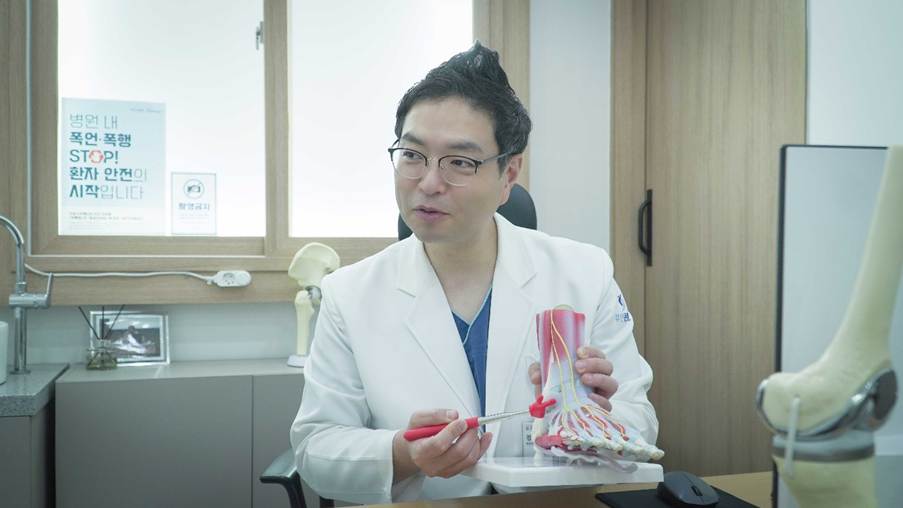
Jung Ju-seon, director of Busan Big Hospital and an orthopedic surgeon, explains it this way: “With the knee, you have to look first at the root cause of the pain, not how severe it feels.” Pain driven by muscle weakness or faulty movement patterns can improve with targeted strengthening exercises and load management. But when cartilage or the meniscus is structurally damaged, repeatedly running at the same intensity will only aggravate the injury.
The Dividing Line: What Does the Doctor Look at First?
Dr. Jung calls walking and running “the most fundamental forms of exercise,” but stresses that “overdoing it is absolutely off-limits.” When pain strikes, he says, rest should come first. If symptoms improve with rest, there is a strong chance the underlying issue is minor.
“Even professional athletes rest when they are injured,” Dr. Jung notes. “If symptoms resolve, you can resume at a low intensity and gradually build back up. But if pain persists despite rest, that is when you need a formal hospital evaluation.”
This makes response to rest the first diagnostic yardstick. Pain that eases with rest is more likely tied to reduced strength or posture issues, whereas pain that persists despite rest raises suspicion of structural damage.
The second yardstick is the location and pattern of the pain. If the entire knee aches in a vague, diffuse way—without swelling, point tenderness, or difficulty bending and straightening—it is often not a major issue. On the other hand, if a specific spot hurts sharply, or if there is visible swelling, clear tenderness to pressure, or restricted joint movement, the likelihood of structural damage is significantly higher. In short, diffuse pain is often manageable, while localized pain signals a need for clinical evaluation.
Swelling, Locking, and Giving Way: Why You Shouldn’t Ignore These Signals
As South Korea’s running population surges past 10 million according to a 2025 Gallup Korea survey—with a particularly steep rise among people in their 20s and 30s—Dr. Jung points to three warning signs that mean you should stop running immediately:
First, recurring swelling often indicates overtraining. In such cases, runners should rest and apply ice.
Second, joint “locking”—when the knee suddenly will not straighten or feels physically caught—indicates a restricted range of motion caused by cartilage or meniscal damage, requiring immediate medical evaluation.
Third, a sensation that the knee is giving way or feeling wobbly suggests an injury to the anterior cruciate ligament (ACL) or collateral ligaments, which also warrants a prompt hospital visit.
Is Surgery Inevitable for Worn Cartilage? When to Observe and When to Act
Cartilage degeneration progresses in distinct stages. It begins at Grade I with superficial softening, moves to Grade II when damage remains under 50% of cartilage thickness, and advances to Grade III when defects exceed 50%. If left unchecked, it progresses to end-stage Grade IV, where underlying subchondral bone is exposed, ultimately leading to degenerative osteoarthritis.
[International Cartilage Regeneration & Joint Preservation Society (ICRS) cartilage injury classification]
Grade | Findings | Clinical significance |
Grade I | Softening and swelling of the cartilage surface | Early change; a stage that can recover with conservative treatment |
Grade II | Less than 50% cartilage-thickness damage | Partial-thickness injury; candidate for observation or conservative treatment |
Grade III | 50% or more cartilage-thickness damage | Progresses close to the subchondral bone; begin considering surgical treatment |
Grade IV | Exposure of subchondral bone | End stage; progresses to degenerative arthritis |
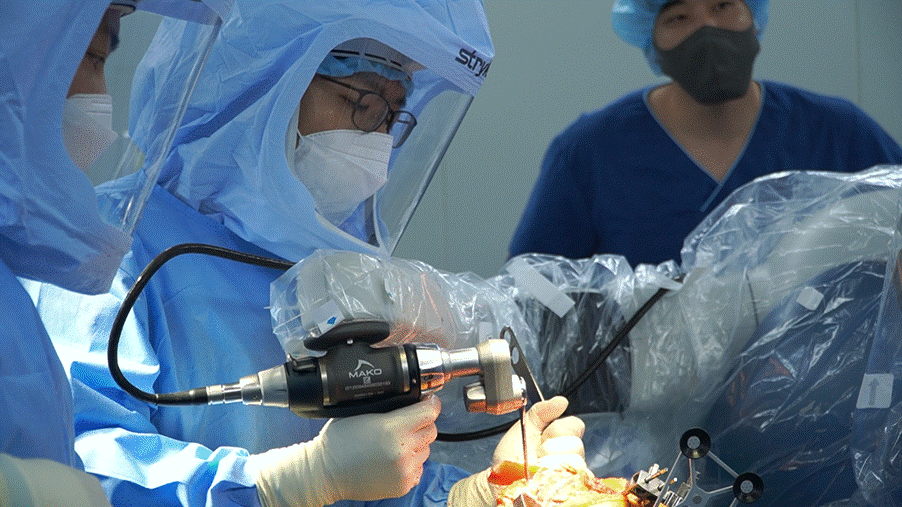
Meniscal tears are confirmed using MRI. Mild tears can be monitored conservatively, but extensive damage requires surgical intervention to perform a partial meniscectomy or repair the tissue with sutures. When cartilage or meniscal damage is diagnosed, patients should avoid weight-bearing activities such as walking, running, and hiking, maintaining cardiovascular fitness instead through non-weight-bearing exercises like cycling or swimming.
Even after surgery, patients should refrain from walking, hiking, running on treadmills, and prolonged standing or walking. Deep knee flexion—including squatting, full bowing, kneeling, and sitting cross-legged—must also be strictly avoided.
Why Doctors Must Evaluate Leg Alignment and Ligaments
Identical knee pain can result in vastly different medical prescriptions due to individual leg alignment and ligament stability. In individuals with bowlegs (genu varum), load concentrates on the inner (medial) knee compartment, wearing down medial cartilage and tearing the meniscus. Conversely, knock-knees (genu valgum) shift mechanical stress to the outer (lateral) knee.
If the joint becomes unstable due to an anterior cruciate ligament or collateral ligament injury, the risk of secondary cartilage wear and meniscal tears increases substantially. Furthermore, inadequate muscle strength places greater physical pressure on the knee joint itself.
For these reasons, orthopedic specialists do not focus solely on the painful site. They evaluate overall leg alignment, ligament stability, and muscle strength together to prescribe appropriate exercises or select the correct surgical approach.
Frequently Asked Questions About Knee Pain
If my knee hurts, do I always need to rest?
No. If rest relieves the pain, the issue is more likely related to muscle weakness or movement habits. However, if pain persists despite rest, medical evaluation is necessary.
If I recover and feel no pain, can I run again?
Once symptoms have fully resolved, it is safest to resume exercising at a low intensity and gradually increase the workload over time.
My knee is swollen—can I just leave it alone?
Recurring swelling often signals overtraining, so rest and cold compresses should be applied first. If swelling recurs frequently or persists, seek a medical evaluation.
If my meniscus is damaged, do I automatically need surgery?
No. If an MRI confirms the tear is mild, it can be managed conservatively with monitoring. Surgery, such as partial removal or repair, is considered only when damage is extensive.
Can I keep exercising after cartilage damage?
Avoid weight-bearing exercises like walking, running, and hiking. Non-weight-bearing activities that preserve strength without stressing the joint, such as cycling or swimming, are recommended.
While hospital visits for knee pain remain disproportionately high among middle-aged and older adults—with Health Insurance Review & Assessment Service (HIRA) data showing 48.6% of the 67,197 meniscal tear patients in 2023 were in their 50s and 60s—clinicians report a steady rise in younger patients seeking treatment for sports-related injuries.
Expert Source: Jung Ju-seon, an orthopedic surgeon and director of Busan Big Hospital. A former clinical fellow at Samsung Medical Center, head of the Joint Center at Bumin Hospital, and associate professor at Catholic Kwandong University, he specializes in knee and ankle arthroscopy and joint replacement surgery.