South Korea’s five major legacy pharmaceutical companies largely extended their revenue growth in the second quarter, but their bottom lines diverged sharply based on product mix and licensing income. Hanmi Pharmaceutical and Yuhan Corp. booked substantial upfront and milestone fees, while Daewoong Pharmaceutical expanded operating profit through surging exports of its botulinum toxin, Nabota. Conversely, Chong Kun Dang saw operating profit fall due to higher cost ratios from in-licensed products, and GC Biopharma’s profit plunged as sales of high-margin products were deferred into the second half.
According to preliminary regulatory filings submitted on August 4, the five drugmakers posted a combined second-quarter revenue of approximately 2.378 trillion won and an operating profit of 291.0 billion won, representing year-over-year increases of 7.5% and 33.5%, respectively. Hanmi Pharmaceutical and GC Biopharma reported on a consolidated basis, whereas Yuhan Corp., Daewoong Pharmaceutical, and Chong Kun Dang reported on a separate basis.
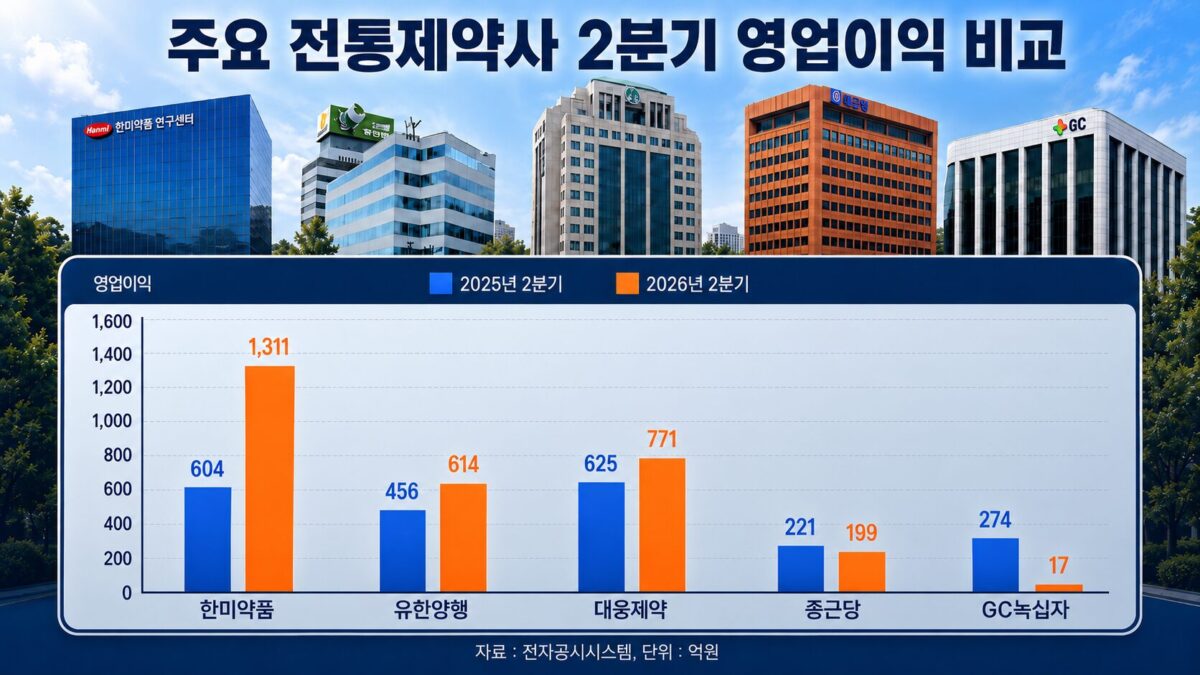
Hanmi Pharmaceutical delivered the strongest performance among the group. The company reported second-quarter revenue of 467.2 billion won and an operating profit of 131.1 billion won, surging 29.3% and 116.9%, respectively, from the same period last year. Its operating margin expanded by 11.4 percentage points to 28.1%. Profitability was primarily bolstered by an upfront payment in the 110 billion won range received after out-licensing its short bowel syndrome candidate, sonefpeglutide, to U.S. pharmaceutical giant Eli Lilly, alongside steady sales of core domestic products such as Rosuzet.
Daewoong Pharmaceutical posted second-quarter revenue of 400.2 billion won and an operating profit of 77.1 billion won, up 10.0% and 23.4% year-over-year, achieving an operating margin of 19.3%. Growth was led by Nabota, which surpassed 100 billion won in quarterly revenue for the first time at 103.4 billion won, with overseas exports accounting for 94.1 billion won (up 54.2%). Although shipments of its gastroesophageal reflux disease treatment, Fexuclue, temporarily slowed due to channel inventory adjustments, performance is expected to normalize in the second half.
Yuhan Corp. reported separate second-quarter revenue of 614.0 billion won and an operating profit of 61.4 billion won, up 10.4% and 34.7% year-over-year, lifting its operating margin to 10.0%. Results were boosted by a $30 million (approximately 45.0 billion won) milestone payment from Johnson & Johnson following the European commercialization of the lung cancer treatment Lazcluze in May.
In-Licensing Costs and Deferred Sales Weigh on Margins
Chong Kun Dang experienced margin compression despite top-line growth. Second-quarter revenue rose 10.7% to 475.4 billion won, but operating profit fell 10.1% to 19.9 billion won, slipping its operating margin to 4.2%. While expanded sales of externally in-licensed therapies like Wegovy drove revenue, higher product cost ratios alongside increased R&D and promotional expenses weighed on profitability. Following the release, Samsung Securities lowered its target price for Chong Kun Dang from 110,000 won to 80,000 won.
GC Biopharma posted the weakest results, recording revenue of 421.2 billion won and an operating profit of 1.7 billion won, down 15.8% and 93.8% year-over-year, respectively. Its operating margin dropped to 0.4%. Performance was impacted by the deconsolidation of GC Wellbeing following a stake sale, production delays for bulk influenza vaccines due to strain reference procurement issues, and export schedule shifts for Hunterase. Additionally, roughly 10.0 billion won in sales for its immune globulin treatment, Aliglo, rolled into the third quarter. In response, Korea Investment & Securities lowered its target price for GC Biopharma from 190,000 won to 160,000 won, while Shinyoung Securities reduced its target from 210,000 won to 180,000 won.
The second-quarter divergence highlights that operating profitability for traditional Korean drugmakers hinged less on total revenue volume than on high-margin product streams and licensing events. Companies securing overseas milestone payments and proprietary export items maintained double-digit margins, whereas those reliant on co-promoted foreign drugs or facing delayed product shipments saw earnings squeezed.