Patients suffering from conductive hearing loss caused by damaged middle ear bones may soon benefit from a new surgical innovation: a customizable artificial ear bone (ossicle) that surgeons can adjust in real time to match a patient's precise anatomical needs.
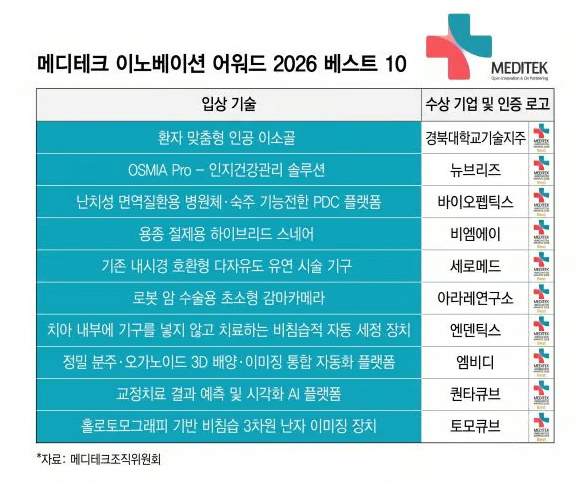
Kyungpook National University Hospital (KNUH) announced on September 8 that a research team led by Professor Lee Gyu-yeop and researcher Seong Gi-ung of the Department of Otolaryngology earned the top-tier "Best Award" at the 2026 Meditech Innovation Awards for their patient-specific titanium artificial ossicle.
The auditory ossicles are tiny bones in the middle ear that transmit sound vibrations from the eardrum to the cochlea. When these bones are damaged by chronic disease or trauma, sound transmission is disrupted, resulting in conductive hearing loss.
Historically, surgeons performing reconstructive ear procedures have relied on prefabricated artificial ossicles available only in a few fixed sizes. Because middle ear anatomy varies significantly from person to person, these standard implants have faced clear limitations in achieving a perfect fit.
To address this challenge, Professor Lee’s team developed a titanium prosthesis designed for micro-adjustments inside the operating room. Surgeons can evaluate the patient's inner ear structure during the procedure and adjust the implant’s length on the spot. By securing an optimal anatomical fit during surgery, the device significantly enhances reconstructive precision and improves overall hearing outcomes.
The panel recognized the technology for its clinical utility, engineering innovation, and strong commercialization potential. KNUH highlighted the project as a model success story for regional healthcare research, supported by Daegu Metropolitan City’s medical industry R&D initiative and the national research-driven hospital program, which helped translate an unmet clinical need into a viable medical device.
"It is deeply meaningful that a technology genuinely needed in clinical practice has advanced all the way to a functional medical device with regional R&D support," said Professor Lee Gyu-yeop. "We will continue developing practical medical tools that offer tangible benefits to patients while strengthening the global competitiveness of South Korea's medical device industry."
Building on this achievement, Kyungpook National University Hospital plans to provide comprehensive, one-stop support—spanning technology development, regulatory approval, and commercialization—to bring frontline clinical ideas to market.