
As people age, a frequent refrain is, “I’ve lost muscle.” They are not entirely wrong. When muscle mass and strength decline, everyday movements like rising from a chair or climbing stairs can become an uphill struggle. However, muscle loss alone fails to fully explain why so many older adults develop severe walking difficulties.
Walking is far more complex than it appears. Bones support the body's physical weight, while joints and the spine connect and articulate movements. Muscles serve as the engine to propel the body forward, and nerves control balance, coordination, and direction. If even a single component falters, a person’s gait changes—and when multiple functions weaken simultaneously, mobility can deteriorate at an accelerating rate.
This interconnected vulnerability is the core premise behind “Locomotive Syndrome.” The term describes a medical condition in which the entire mobility system—encompassing bones, joints, the spine, muscles, and nerves—weakens collectively, progressively reducing the ability to walk and move independently. In South Korea, it is formally referred to as exercise function decline syndrome.
Distinguishing Sarcopenia, Frailty, and Locomotive Syndrome
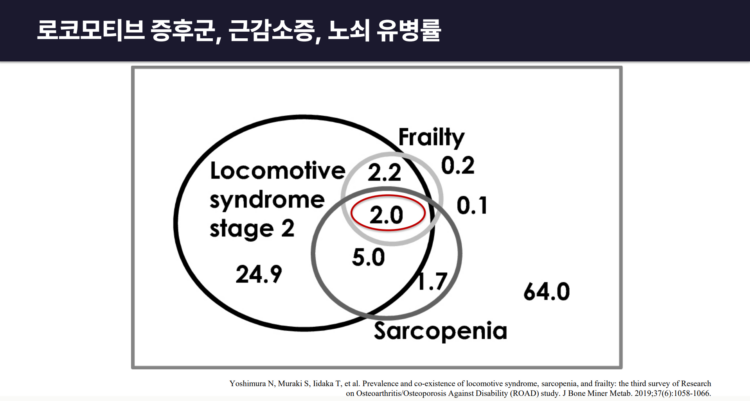
While these three medical concepts are frequently used interchangeably, they reflect fundamentally different clinical perspectives. Sarcopenia focuses strictly on the involuntary decline of muscle mass and physical strength. Frailty describes a broader, systemic state of vulnerability across the entire body, typically characterized by unintentional weight loss, chronic fatigue, reduced activity levels, slower walking speeds, and decreased strength. Locomotive syndrome, by contrast, focuses specifically on functional mobility—the practical ability to walk, stand, climb stairs, and avoid dangerous falls.
These three conditions do not exist in isolation. An individual with sarcopenia faces a significantly higher risk of developing locomotive syndrome, and as locomotive syndrome progresses, it frequently overlaps with systemic physical frailty.
Because they originate from different clinical standpoints, their diagnostic and treatment approaches vary as well. “Sarcopenia is diagnosed primarily using objective muscle indicators, but locomotive syndrome is assessed based on overall mobility and functional capacity,” said Kim Mi-ji, a professor at the Kyung Hee University College of Medicine's Department of Convergence Medical Science. “If a patient suffers from chronic lower back or joint conditions, their walking ability will naturally decline as well.” Consequently, reducing every mobility issue to a simple lack of muscle can lead to incomplete care.
Furthermore, localized orthopedic conditions create cascading effects throughout the entire mobility system. For instance, knee osteoarthritis often drives individuals to walk less due to chronic pain, which accelerates muscle wasting. Spinal stenosis can cause severe nerve compression, forcing someone to stop and rest after walking only a short distance. Meanwhile, osteoporosis can turn a routine slip or minor fall into a debilitating bone fracture. As these neurological, skeletal, and muscular functions decline, an individual's balance can collapse entirely.
Evaluating the Body's Supports, Connectors, and Engine Together
To better understand mobility in old age, it helps to view the human body much like a motor vehicle. Bones act as the structural frame supporting the vehicle's weight. Joints and the spine serve as the connectors that link movements together. Muscles function as the internal engine, while the nervous system operates as the steering mechanism and sensory array. Even if a vehicle boasts a highly powerful engine, it cannot be driven safely if its wheels are misaligned and the steering system is unstable.
The human body operates under the exact same principles. Even if an older adult retains decent thigh muscle mass, severe knee degradation can still render walking agonizingly difficult. If bone density is low, the risk of a catastrophic fracture rises exponentially the moment a fall occurs. Similarly, if lumbar spinal stenosis is severe, localized numbness and pain will halt a person long before their leg strength gives out.
“It is not uncommon to see cases where treating only the knee because it hurts, or addressing only the back because it hurts, fails to explain why a patient's overall walking function continues to steadily decline,” noted Yoo Jun-il, an orthopedic professor at Inha University Hospital.
Locomotive syndrome provides medical professionals with a holistic framework to connect these individual orthopedic problems into a comprehensive picture of a patient's mobility. Rather than treating the knee, lower back, muscles, and bones as isolated diseases, it recognizes them as interconnected parts of a unified system that dictates whether a person can walk.
True Mobility Demands a System-Wide Approach
At the heart of healthy aging is moving away from simply collecting isolated medical diagnoses. Instead, it begins with asking fundamental questions: Why has walking become difficult, what is actively blocking each step, and which component of the system must be rehabilitated first?
While protecting and building muscle remains a vital priority, it is not a cure-all on its own. Comprehensive senior mobility care requires an integrated approach that simultaneously manages joint pain, monitors spinal nerve symptoms, treats osteoporosis, and restores neurological balance.
Ultimately, the strength to walk energetically in later years does not depend on a single leg muscle. True independent mobility returns only when the body's entire mobility engine is maintained and working in perfect harmony.