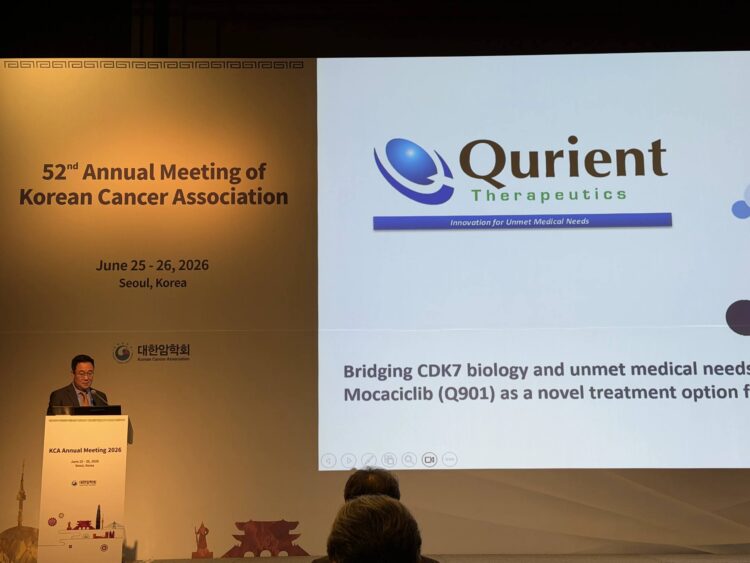
Qurient announced on June 29 that it presented key clinical data highlighting the mechanistic advantages of its CDK7-inhibiting oncology candidate, mocaciclib (Q901), at the annual academic conference of the Korean Cancer Association held from June 25 to 26. As a clinical-stage biotechnology company focused on novel drug development, Qurient originally grew by commercializing research discoveries from Institut Pasteur Korea, with mocaciclib and the immuno-oncology agent Q702 currently serving as its primary pipeline assets.
Mocaciclib is an intravenously administered drug candidate designed to arrest cancer cell growth by selectively blocking cyclin-dependent kinase 7 (CDK7). During the scientific sessions, the company outlined its strategy to develop mocaciclib beyond monotherapy, positioning it as a foundational backbone therapy capable of pairing with an array of other oncology drugs to form the core axis of combination regimens.
Synergistic Potential with Antibody-Drug Conjugates
To support this clinical direction, Qurient highlighted mocaciclib’s synergistic potential when paired with antibody-drug conjugates (ADCs). By inhibiting CDK7, mocaciclib downregulates genes responsible for DNA damage repair in malignant cells. This mechanism potentially compounds the efficacy of ADC therapies, which intentionally inflict targeted DNA destruction to eliminate tumors.
Citing reports from the American Society of Clinical Oncology (ASCO) and other prominent global forums, the company noted that a tumor's responsiveness to ADCs is inversely related to the activity of its DNA damage repair functions; if cancer cells can efficiently repair the damage inflicted by an ADC, the therapy becomes less effective. Notably, Phase 3 trials of leading ADCs, such as Enhertu and Trodelvy, have demonstrated that treatment responses surge in patients with impaired or mutated DNA repair pathways.
Qurient successfully validated this synergistic effect in preclinical tumor models. In models that had developed resistance and stopped responding to Enhertu after repeated exposure, the addition of mocaciclib successfully re-sensitized the tumors, halting their progression and driving them into complete remission.
Overcoming Resistance in Advanced Breast Cancer
Additionally, mocaciclib emerged as a promising subsequent-line option for patients with hormone receptor-positive, HER2-negative (HR+/HER2-) metastatic breast cancer who have developed resistance to current standard treatments. The company explained that CDK7 inhibition effectively shuts down the alternative cellular bypass pathways that tumors exploit once they grow resistant to standard CDK4/6 inhibitors. This dual mechanism holds therapeutic promise even for difficult-to-treat patient subgroups harboring PI3K/AKT mutations or PTEN loss.
Having finalized the recommended Phase 2 dose for mocaciclib earlier this year at 126 mg/m², Qurient is actively evaluating the drug in clinical settings. The company is currently running a Phase 2 trial combining mocaciclib with the endocrine therapy Faslodex in HR+/HER2- breast cancer patients who are refractory to prior CDK4/6 inhibitors. Concurrently, it is advancing a separate clinical track pairing the candidate with an ADC for patients battling triple-negative breast cancer.
“As the development of mocaciclib continues to clarify the pivotal role of CDK7 in tumor evolution and resistance, this protein is proving to be a highly viable target for addressing critical unmet medical needs in oncology,” Nam Ki-yeon, CEO of Qurient, said. “While our initial efficacy evaluations focus on HR+/HER2- breast cancer, we are highly optimistic that future expansions into multi-ADC combinations across various breast cancer indications will ultimately provide vital options for a broader population of patients.”