“It doesn’t end with lazertinib. Keep an eye out for the next candidate in line.”
Oscotec is aggressively channeling the revenue secured from the technology transfer of its non-small cell lung cancer treatment, lazertinib (sold in South Korea under the brand name Leclaza), into robust research and development (R&D) investments. This strategy aims to accelerate the acquisition and development of follow-on drug pipeline assets. In the market, attention is increasingly focused on OCT-648, a novel kidney fibrosis therapy positioned as the company's next premier candidate for a major out-licensing deal.
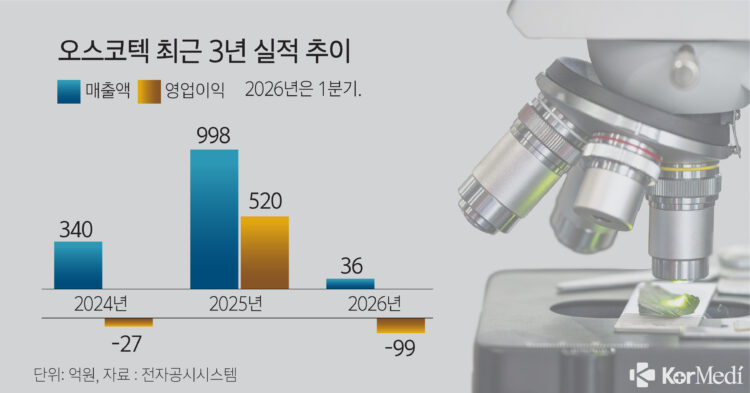
According to regulatory disclosures on May 15, Oscotec recorded first-quarter sales of 3.6 billion won and an operating loss of 9.9 billion won this year. Compared to the same period last year, which saw sales of 1.9 billion won and an operating loss of 8.3 billion won, first-quarter sales climbed by 88.4% even as the operating deficit persisted.
However, analysts interpret the expanding operating loss not as a sign of weakening performance, but as a reflection of strategic outlays, specifically heightened R&D spending and aggressive hiring. Oscotec’s first-quarter financial results show that as the cost of sales decreased, gross profit jumped to 3.1 billion won—marking a 1.5 billion won increase from the 1.6 billion won recorded in the same period last year. Consequently, the company's gross profit margin improved significantly, rising from 81.5% to 86.2%.
Nevertheless, selling, general, and administrative (SG&A) expenses rose substantially to 13.1 billion won from 9.9 billion won year-over-year, which ultimately widened the operating loss. Within SG&A expenses, salary-related costs increased by 1.5 billion won (climbing from 1.3 billion won to 2.8 billion won), R&D expenses grew by 0.9 billion won (from 5.5 billion won to 6.4 billion won), and paid fees rose by 1.1 billion won (from 0.8 billion won to 2.0 billion won).
“As we expanded our R&D investments last year, our workforce and organizational capabilities were heavily reinforced,” an Oscotec official explained. “Labor costs naturally increased due to a combination of headcount growth and salary hikes.” Reflecting this expansion, the number of dedicated R&D personnel rose to 36 in the first quarter, up by 7 from 29 during the same period last year, while the company's total headcount grew from 51 to 55.
Oscotec stands out as one of the few domestic biotech firms in South Korea capable of generating consistent cash flow through milestone achievements and sales royalties from technology transfers. The company is the original developer of lazertinib, a block-buster non-small cell lung cancer treatment that was out-licensed to Janssen, a Johnson & Johnson (J&J) company. Last year, Oscotec pulled in 96.6 billion won in technology transfer revenue, which included 89.1 billion won in milestone payments and 7.5 billion won in royalties. In the first quarter of this year, it secured 2.734 billion won in total licensing revenue, comprising 364 million won in milestones and 2.37 billion won in sales royalties.
While the current royalty inflow remains modest, substantial financial upside is expected to follow as global sales of lazertinib gain momentum. According to J&J’s first-quarter earnings report, global sales of the Rybrevant-lazertinib combination therapy reached approximately $257 million (380 billion won), representing a 1.8-fold increase from the $141 million recorded in the same period last year, and nearly a five-fold surge compared to two years ago.
Furthermore, Oscotec is poised to receive a milestone payment of 15.2 billion won ($10.2 million) in the second quarter tied to the European commercial launch of lazertinib, pointing to a strong probability of near-term financial improvement.
As the financial windfalls from lazertinib are systematically funneled back into the lab, anticipation surrounding the "next lazertinib" continues to build. The pipeline asset considered most likely to secure the next major technology transfer is OCT-648, a targeted therapy designed to treat kidney fibrosis and chronic kidney disease (CKD). OCT-648 works by selectively inhibiting the NUAK1 enzyme, a known driver of the renal fibrosis that underpins CKD pathology. When cellular structures face damage or physiological stress, NUAK1 is expressed as a defense mechanism; however, chronic over-signaling leads to pathological fibrosis, causing organs to harden. By suppressing NUAK1, OCT-648 offers a novel therapeutic strategy to slow the progression of CKD. Because the project is currently in the preclinical stage, it requires additional validation before definitive out-licensing outcomes materialize. The company has set a firm objective to advance the candidate into Phase 1 clinical trials and pursue an international technology transfer by next year.
Oscotec achieved a historic turnaround to profitability last year, posting annual sales of 99.8 billion won and an operating profit of 52 billion won. IBK Investment & Securities researcher Jeong Yisu commented, “With prescriptions for lazertinib projected to expand steadily moving forward, we expect Oscotec to establish a highly stable profit structure anchored by robust royalty income alone.” Jeong Yisu added, “Given their strategic goal of executing at least one additional technology transfer within the next one to two years, this is the ideal window for investors to lock their attention onto the company's next-generation pipeline.”