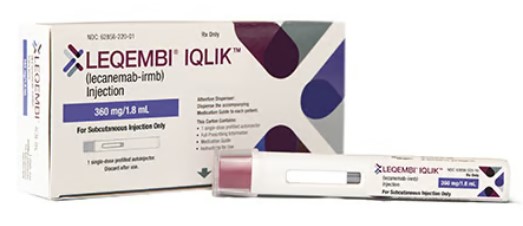
American Biogen and Japanese Eisai are moving quickly to change the formulation and dosage of the dementia treatment injection drug ‘Lecanemab (ingredient name Lecanemab)’. The two companies registered related approval applications in the U.S. and the European Union (EU) this month. This is interpreted as a strategy to solidify their competitive advantage in the global market, especially since the competing product, Eli Lilly's ‘Donanemab’, has not yet entered the EU.
As the options for using Lecanemab are expected to diversify, attention is being drawn to how this will affect the marketability of oral dementia drugs being developed by domestic Aribio and French Sanofi.
According to the pharmaceutical and biotech industry on the 29th, on the 25th (local time), an application for approval of the initial treatment regimen of ‘Lecanemab Iclick’ with a once-weekly dosing method was submitted to the U.S. Food and Drug Administration (FDA). Lecanemab Iclick is the subcutaneous injection (SC) formulation of Lecanemab. The next day, on the 26th, an application for approval of the monthly maintenance therapy of the intravenous (IV) formulation of Lecanemab was submitted to the European Medicines Agency (EMA). The initial treatment aims to quickly raise the drug concentration to the target level during the early stages of treatment, while the maintenance therapy is to manage the effects after reaching the target state for a long time.
Lecanemab (ingredient name Lecanemab) is an antibody drug targeting amyloid beta (Aβ) and was originally developed for IV administration every two weeks. This drug received accelerated approval in the U.S. in January 2023 and obtained formal approval in July of the same year. In April of last year, the EMA also conditionally approved Lecanemab after re-evaluation. Lecanemab is the only antibody-based dementia treatment that has successfully entered the U.S. and EU markets and has been approved in over 50 countries.
However, the crisis for Lecanemab has intensified as the competing drug Donanemab (ingredient name Donanemab) IV formulation is set to be approved in the U.S. in 2024 and expand its launch countries. In clinical phase 3, Donanemab's efficacy in improving cognitive function was 35%, surpassing Lecanemab's 27%, and it also secured an advantage with a once-monthly dosing regimen.
In response, Biogen and Eisai developed Lecanemab Iclick, which received FDA approval in August of last year. However, at that time, the indication for this drug was for maintenance therapy for patients who had received the existing Lecanemab IV formulation every two weeks for 18 months.
The new regimen submitted by the two companies to the FDA this time is an initial treatment that can start with Lecanemab Iclick from the beginning. Considering the expedited review period, if this regimen is approved in May, it will significantly increase dosing convenience compared to Donanemab in the largest market, the U.S.
Biogen and Eisai are also pursuing a strategy to secure dosing regimens comparable to Donanemab before it is approved in the EU. To this end, they submitted an application to the EMA to increase the dosing cycle of Lecanemab to once a month, the same as Donanemab.
A representative from the domestic dementia new drug development industry stated, “While the differences in cognitive function improvement efficacy between Lecanemab and Donanemab were emphasized in clinical stages, in actual medical practice, the difference is not significant enough to be felt.” He added, “Rather, securing a competitive edge in dosing will be an important factor for expanding into the global market.”
He further noted, “The recent success of injection drugs in diversifying their formulations and dosages could act as a hurdle in the market entry process for oral dementia drugs,” and “While there is no disagreement that oral medications that need to be taken daily are more convenient than IV formulations, patient preferences may vary significantly when compared to a once-weekly SC formulation that can be used at home.” In other words, even though it is an injection, the once-weekly SC formulation could compete to some extent with daily oral medications.
Currently, a representative company mentioned in the development of oral dementia new drugs is domestic Aribio. This company is conducting global phase 3 clinical trials for its dementia treatment candidate ‘AR1001’, which has a multi-action mechanism, in 13 countries including the U.S., EU, and China. Aribio plans to complete this clinical trial within the year and launch AR1001 next year. Therefore, AR1001 is considered the fastest candidate for oral dementia new drugs in the commercialization development stage.
Among global pharmaceutical companies, Sanofi is developing ‘VG-3927 (currently in phase 2 clinical trials)’ acquired from U.S. Biogen Neurosciences last year and ‘ADEL-Y01 (currently in phase 1 in the U.S.)’ introduced from domestic biotech ‘ADEL’ as oral dementia new drugs.
Ultimately, the final showdown between injection drugs and oral medications is expected to be determined by efficacy. Injection drugs, which have significantly improved dosing methods, will lead the market for the time being, but if oral medications with better efficacy are introduced, they could become a ‘game changer’.
A professor of neurology at a domestic university hospital stated, “While antibody therapies are widely used both domestically and internationally, there is still a high unmet demand for preventing long-term dementia progression,” and added, “Oral medications that prove efficacy beyond injection drugs like Lecanemab will be a good treatment option to recommend to patients.”