MS Bio, a specialized manufacturer of human tissue graft materials and medical devices, is leveraging its upcoming initial public offering (IPO) to expand production capacity and scale up high-margin product lines, including sutureless amniotic membrane lenses and skin boosters. The company aims to bolster its core soft-tissue reconstruction and bone-regeneration businesses while securing new growth engines across international markets.
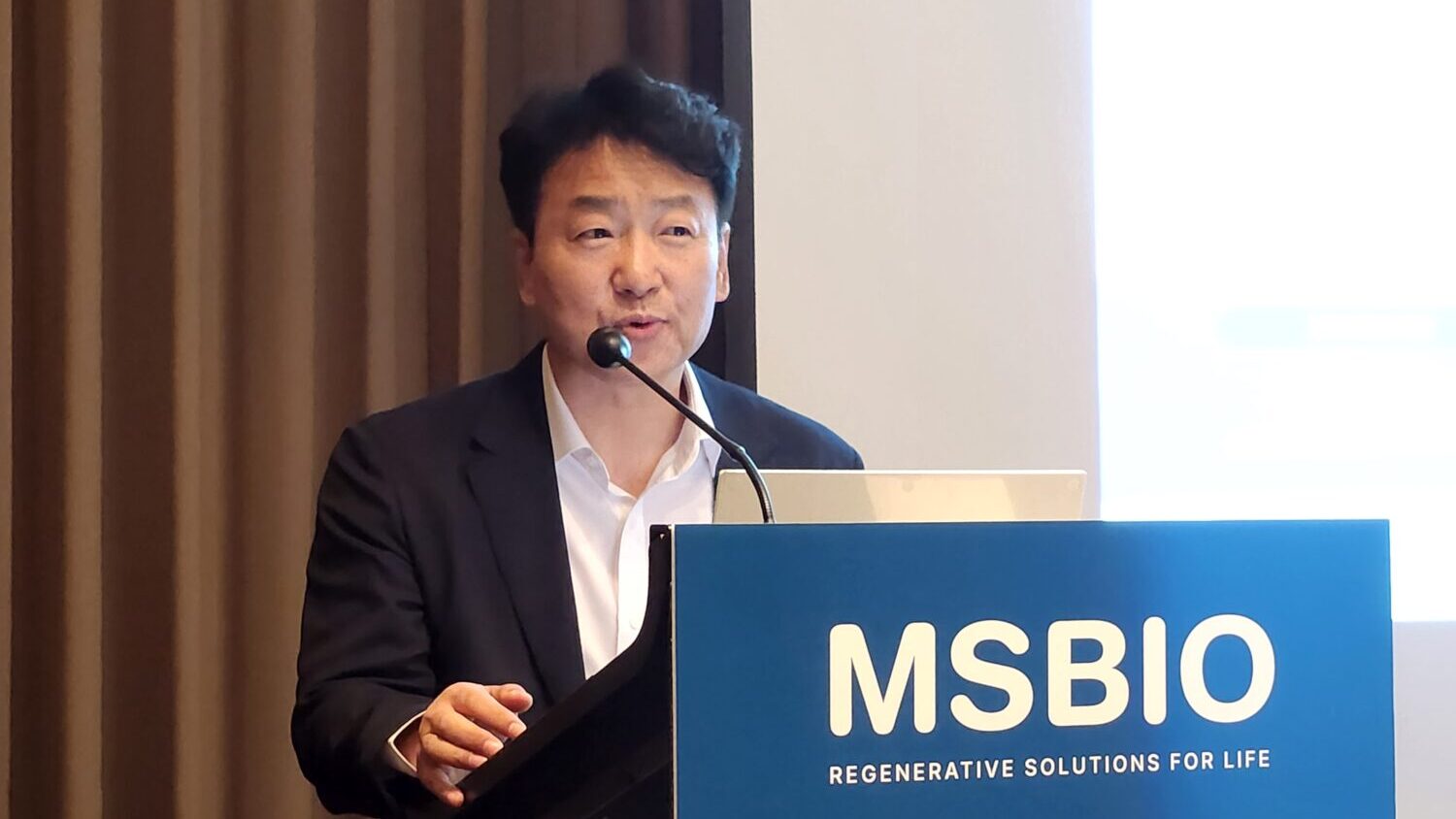
"We are not presenting future promises; we are already achieving strong profitability and rapid growth," said Kim Sung-po, CEO of MS Bio, during an investor briefing held at the Conrad Hotel in Yeouido, Seoul. "Through this IPO, we will aggressively invest in production infrastructure, next-generation product development, and global expansion to establish MS Bio as a global regenerative medicine leader."
Last year, MS Bio recorded 23.8 billion won in revenue and 8.6 billion won in operating profit, achieving a 36% operating margin. Driven by new product launches, the company targets 35.6 billion won in revenue and 12.6 billion won in operating profit this year, maintaining a long-term operating margin goal above 33%. Currently, revenue is anchored by human tissue grafts—such as acellular dermal matrix allografts for breast reconstruction—as well as medical collagen injectables and dental bone materials. Last year, human tissue products accounted for 54.2% of total revenue, while medical devices comprised 45.7%.
Sutureless Amniotic Lenses and Skin Boosters Drive Next-Gen Growth
MS Bio’s primary growth driver is its proprietary amniotic membrane lens (AM Lens). Unlike conventional amniotic products that require surgical suturing to cover corneal damage, MS Bio’s lens is placed over the affected area and secured with a standard contact lens. The sutureless procedure takes approximately one minute, eliminating the risk of surgical tissue damage.
While National Health Insurance coverage is currently restricted to severe conditions like corneal ulcers and perforations, MS Bio is actively working to establish a new non-reimbursed code by the first half of next year. Securing this code will allow the company to tap into the moderate-to-severe dry eye market, targeting an estimated 250,000 patients in South Korea who do not respond to existing therapies. Sales of the AM Lens are projected to grow from 900 million won this year to 3.5 billion won next year, eventually reaching 12.1 billion won by 2029.
Concurrently, MS Bio is expanding into aesthetics with its extracellular matrix (ECM) skin booster, "GCellre Rebornne," launched in March. Manufactured by MS Bio and distributed by GC Green Cross Wellbeing, the aesthetic line is expected to generate 4.2 billion won in revenue this year, with projections reaching 11.0 billion won in 2027 and 35.0 billion won by 2030.
Manufacturing Expansion and International Strategy
A substantial portion of the IPO proceeds will fund facility expansion in Ochang, North Chungcheong Province, where MS Bio has acquired a 2,000-pyeong site. The company plans to invest 19 billion won to construct a dedicated, automated medical device production facility. MS Bio will adopt a dual-track strategy, maintaining current production at its Seongnam site while scaling up new, high-volume products at the Ochang plant to optimize unit costs.
On the international front, MS Bio is pursuing strategic footholds in key overseas markets. In the United States, the company is evaluating the acquisition of a local tissue bank to secure raw materials and establish a regional production base. In Vietnam, MS Bio is planning local hospital partnerships to distribute its amniotic membrane lenses.
For its IPO, MS Bio is offering 4 million shares with an indicative price range of 6,800 to 7,800 won per share, raising an estimated 27.2 billion to 31.2 billion won. The company's expected market capitalization ranges between 189.5 billion and 217.4 billion won. Institutional demand forecasting concludes on the 2nd.