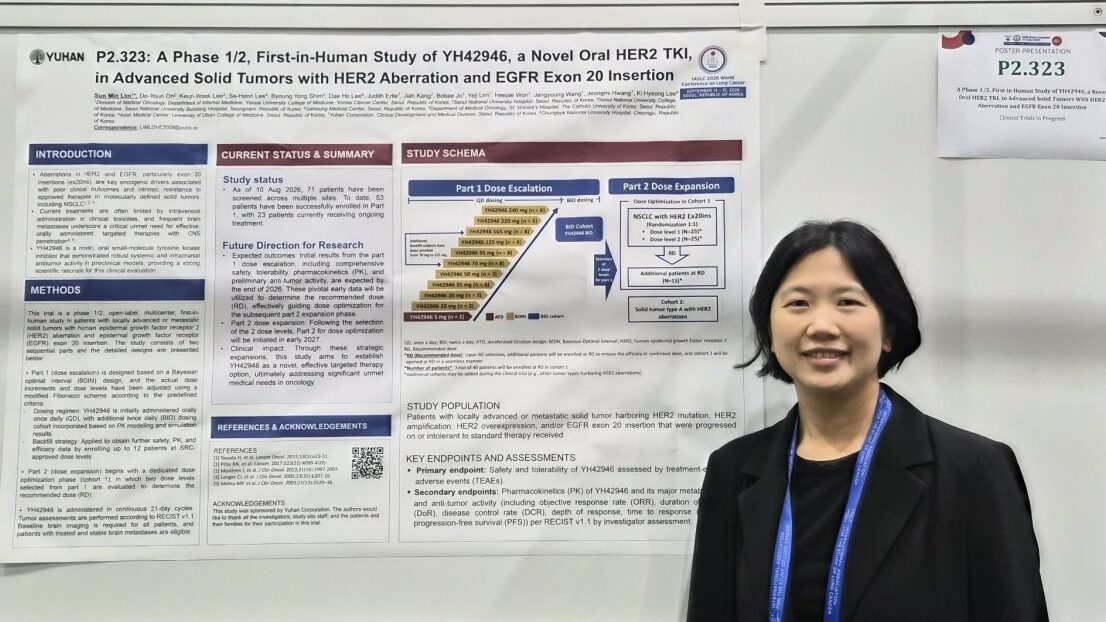
Yuhan Corporation has detailed the status and trial design of the ongoing Phase 1/2 clinical study for YH42946, an oral targeted anticancer candidate being developed for solid tumors with HER2 alterations and EGFR exon 20 insertion mutations. The company presented a poster on the study's progress and development timeline at the 2026 World Conference on Lung Cancer (WCLC), held at COEX in Seoul on the 14th.
YH42946 is an oral small-molecule tyrosine kinase inhibitor (TKI) that blocks signaling pathways driving tumor growth in cancer cells with HER2 or EGFR gene abnormalities. Yuhan acquired the candidate in 2023 through a technology transfer from South Korean biotech firm JINTS Bio, where it was originally developed under the code name JIN-A04.
Dose Escalation and Trial Strategy
The Phase 1/2 study is enrolling adult patients with locally advanced or metastatic solid tumors harboring HER2 mutations, amplification, or overexpression, as well as EGFR exon 20 insertion mutations.
The trial is currently in the dose-escalation phase, testing daily doses ranging from 5 mg up to 240 mg to assess safety, tolerability, pharmacokinetics, and preliminary antitumor activity. Based on pharmacokinetic analyses of drug concentrations, investigators expanded the trial to include a twice-daily dosing cohort alongside a backfill strategy at select dose levels to secure comprehensive data on safety and early efficacy.
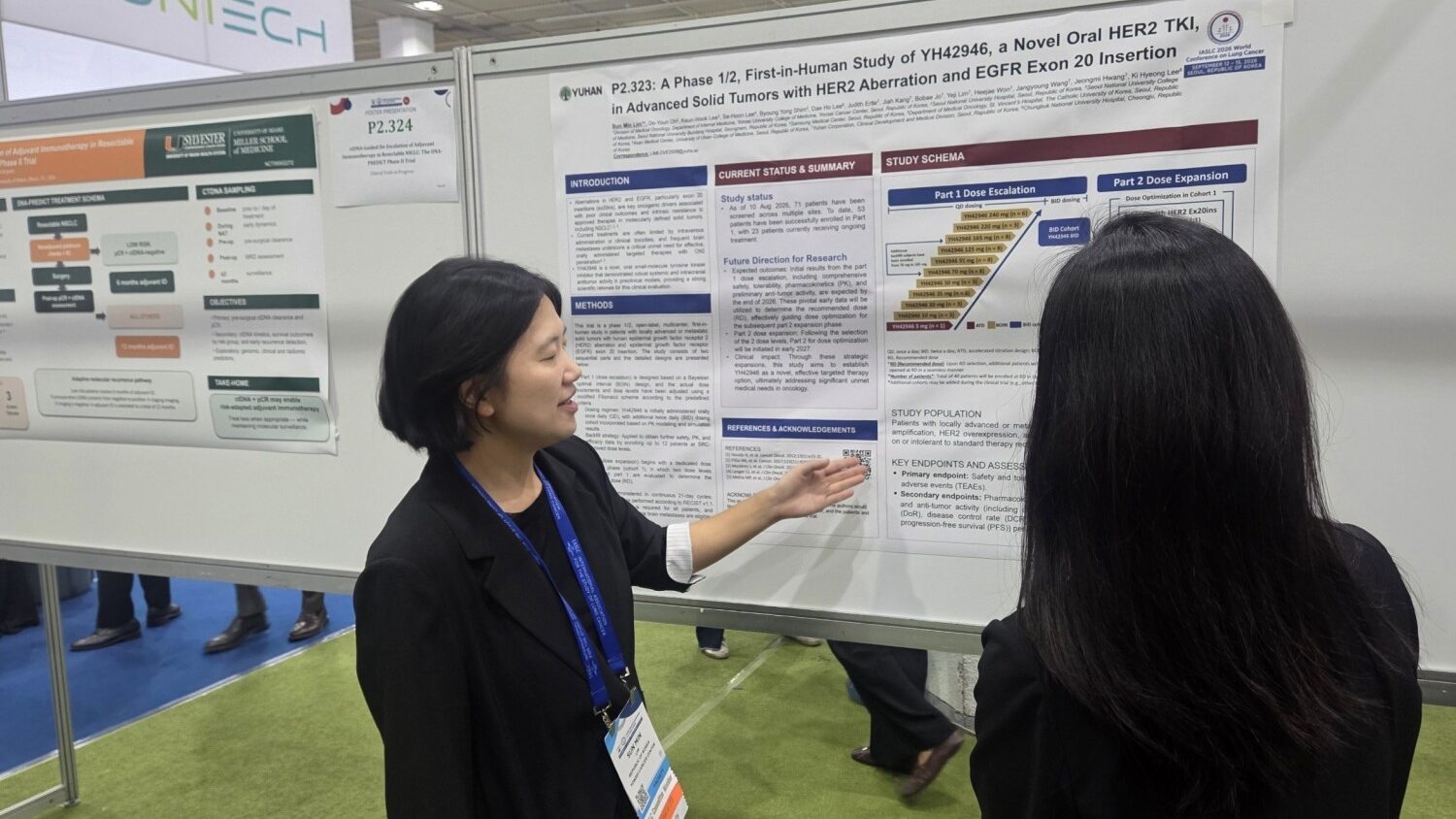
Preclinical CNS Activity and Selective Targeting
In preclinical non-small cell lung cancer (NSCLC) models featuring EGFR exon 20 insertions and HER2 alterations, YH42946 demonstrated significant tumor inhibition. Notably, in animal models with HER2-altered brain metastases, the candidate showed dose-dependent tumor regression, suggesting central nervous system (CNS) penetrance.
The nonclinical research, conducted jointly with a Yonsei University research team and published in npj Precision Oncology in July, demonstrated that YH42946 selectively targets cancer-associated HER2 alterations and EGFR exon 20 insertions while minimizing off-target toxicity on wild-type EGFR. Clinical trials will confirm whether these intracranial benefits translate to human patients.
Timeline for Expansion and Next-Phase Clinical Development
Primary endpoints for the study include safety and tolerability, alongside key efficacy indicators such as objective response rate (ORR), duration of response (DOR), and progression-free survival (PFS).
Yuhan plans to complete its analysis of the dose-escalation data by the end of this year. Based on safety, drug concentration, and preliminary response profiles, the company expects to select two candidate doses and initiate a 1-to-1 randomized dose-expansion trial in early 2027. This expansion phase will compare the two cohorts to establish the recommended dose for subsequent development before broadening clinical evaluation to other HER2-altered solid tumors.
“YH42946 holds strong potential as a convenient oral treatment option for solid tumor patients with HER2 alterations and EGFR exon 20 insertion mutations, with promising potential efficacy against brain metastases,” said Kim Yeol-hong, head of R&D at Yuhan. “Through this ongoing Phase 1/2 study, we will continue evaluating safety and efficacy to swiftly establish a recommended dose and advance follow-on development.”