
Epilepsy is traditionally treated as a condition defined primarily by seizures and the immediate need to control them. However, even when these seizures are successfully managed, researchers are discovering that other troubling signals continue to unfold inside the brain.
A groundbreaking study by Seoul National University Hospital has revealed that epilepsy patients exhibit significantly elevated signals of tau protein—a biomarker heavily associated with dementia—even when they have no diagnosis of cognitive decline and report perfectly intact memory.
The research team analyzed blood tests, electroencephalograms (EEGs), and other clinical data from 75 epilepsy patients with no history of dementia or subjective memory loss, comparing them against 47 healthy controls. The team was led by Professors Lee Sang-geon and Joo Geon of the Department of Neurology, and Professor Choi Hong-yoon of the Department of Nuclear Medicine, with Hong Sang-bin, a clinical instructor in the Department of Clinical Genomic Medicine, serving as the first author alongside Professor Shin Yong-won of the Department of Critical Care Medicine.
To map these protein changes, a subset of participants underwent positron emission tomography (PET) scans using flortaucipir, a radioactive tracer that binds specifically to tau protein to show its distribution and concentration across the brain.
Distinct Tau Accumulation in the Epilepsy Brain
Tau is a vital protein that normally acts like internal scaffolding to help brain cells maintain their shape. However, when excessive phosphate groups attach to tau abnormally—a process known as hyperphosphorylation—the proteins clump into twisted structures called neurofibrillary tangles. These tangles disrupt neuronal function and cause cellular damage, serving as a primary pathological hallmark of neurodegenerative conditions like Alzheimer’s disease. While recent animal models suggested that epilepsy might accelerate this protein buildup, it had not been firmly established whether tau signals rise in human epilepsy patients who are entirely free of dementia..
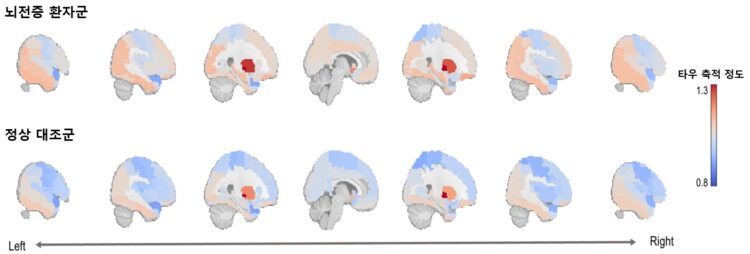
The PET scans revealed that the epilepsy group had distinctly higher tau signals across the cerebral cortex, the folded outer layer of the brain, compared to the healthy control group. Blood analyses mirrored these imaging results. When measuring plasma p-tau217 (phosphorylated tau 217), the proportion of patients exceeding the study's established threshold was just 5% in the control group, compared to a striking 24% in the epilepsy group.
Despite these elevated tau signals, the findings indicated that this phenomenon is not simply early-stage Alzheimer’s disease. Alzheimer’s is typically characterized by the concurrent buildup of amyloid protein alongside tau, but amyloid PET signals showed no significant difference between the two groups. Furthermore, the spatial distribution of the tau protein in the epilepsy patients differed from the typical patterns seen in Alzheimer’s cases.
While the researchers noted that these observations likely reflect a distinct pathological change unique to epilepsy, they emphasized that the study alone cannot entirely rule out underlying Alzheimer’s or conclusively prove that epilepsy directly causes tau to accumulate. The findings were published online in the international medical journal Brain.
Heavier Disease Burden Linked to Higher Tau and Systemic Aging
In deeper analyses, the research team identified a clear trend: tau signals were noticeably higher in patients tracking a heavier clinical disease burden, such as persistent EEG abnormalities or ongoing seizure activity.
Patients exhibiting "multifocal epileptiform discharges"—abnormal electrical spikes appearing independently across multiple brain regions—displayed the highest tau levels, a correlation that remained robust even after controlling for other variables. Elevated tau was also strongly tied to generalized EEG slowing and to cases where a patient's seizures persisted into adolescence. Additionally, among patients whose seizures originated in only one hemisphere, tau signals were consistently higher on that corresponding side of the brain. Notably, patients who developed epilepsy secondary to encephalitis showed the highest tau accumulation of all, leading the team to interpret inflammation as a potent driver of the protein's buildup.
Beyond localized brain chemistry, the study uncovered signs of accelerated systemic aging. By analyzing a vast array of blood proteins simultaneously and applying an algorithm called "OrganAge," the team calculated organ-specific biological ages independent of the patients' chronological ages. The results indicated accelerated biological aging across multiple vital organs, including the heart, muscles, pancreas, and the brain itself.
Crucially, the "brain age gap"—the discrepancy between estimated biological brain age and actual chronological age—was directly proportional to the strength of the tau signals. Patients with higher tau signals exhibited an increase in proteins related to mitochondria (the energy-producing centers of cells) and markers of oxidative stress, a state where reactive oxygen species attack and damage cells. Conversely, proteins associated with microglia, which clear cellular debris and regulate immune defenses in the brain, showed an inverse relationship with tau. This suggests that the rising tau signals in epilepsy patients occur alongside broader disruptions in energy metabolism, oxidative stress, and the brain's internal cleanup systems.

"It was striking that tau-related PET signals appeared far more clearly than expected in epilepsy patients who showed absolutely no dementia symptoms," said Professor Lee Sang-geon. "Moving forward, we need to closely investigate whether tau PET scans can be utilized as a clinical tool to assess future dementia risk and neurodegenerative progression in these patients."
Professor Joo Geon added, "This study holds great significance because we have confirmed, through direct imaging and blood analysis in real patients, that epilepsy is not just a simple seizure disorder. It is fundamentally linked to broader changes in brain proteins and even accelerated systemic aging."
The research team noted that while these results offer valuable clues for using tau PET or blood biomarkers to monitor brain health in epilepsy, it is still too early to implement these tests in routine clinical care. Similarly, anti-tau therapies currently in development for Alzheimer's disease represent an intriguing future research avenue for epilepsy but require extensive validation. The team emphasized that an epilepsy diagnosis does not mean a patient will inevitably develop Alzheimer’s disease. To map out the precise causal relationships, large-scale, long-term, multi-center follow-up studies are actively required to track whether these elevated tau signals ultimately translate to long-term cognitive decline.