Mr. A, a 50-year-old office worker from Busan, had lived with a stiff neck and tingling fingertips for years. Assuming it was a common "neck disc" (herniated disc), he relied on pain patches and occasional physical therapy. His life changed in an instant during a minor car accident. While others walked away with slight soreness, Mr. A collapsed on the spot, his limbs suddenly powerless. He was rushed to the hospital by ambulance, only to discover his condition wasn't a disc at all. It was Ossification of the Posterior Longitudinal Ligament (OPLL).

When Ligaments Turn into Bone
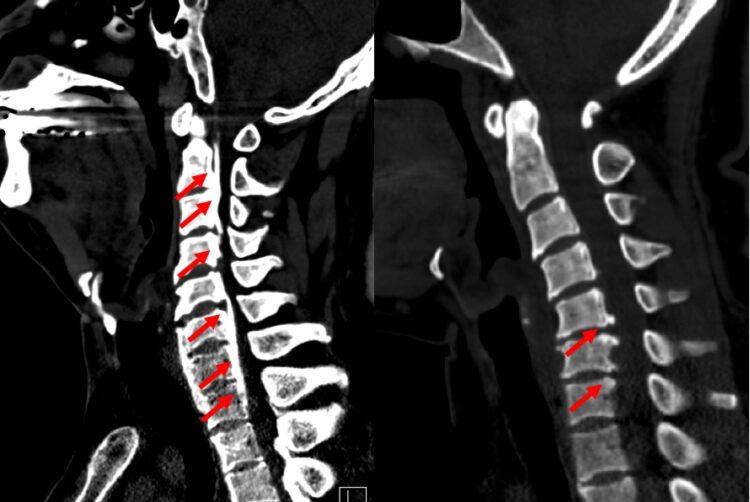
The spine is supported vertically by three major ligaments. The posterior longitudinal ligament runs inside the spinal canal, acting as a flexible shield for the spinal cord. However, in patients with OPLL, this flexible tissue undergoes a pathological change, calcifying into a hard, bone-like structure. As this "bone" thickens, it narrows the spinal canal and begins to choke the nerve bundle.
"This disease acts like a slow-motion chokehold on the nerves," explains Dr. Seok Sang-yoon, a specialist at the Bumin Hospital Spine Center. "While it may only cause minor tingling at first, a sudden external impact—like a minor car accident—can push the hardened ligament into the spinal cord, leading to an immediate emergency such as quadriplegia."
The "East Asian Disease": A Growing Prevalence
OPLL is significantly more common in East Asian populations, particularly in Korea and Japan. As society enters a "super-aged" phase, the diagnosis rate is soaring. Once thought to affect only 1–3% of Koreans, modern 3D CT diagnostics now show prevalence rates as high as 5.7%.
Men in their 50s and 60s are at the highest risk, with males being affected nearly twice as often as females. While the exact cause remains a mystery, researchers have linked OPLL to metabolic factors like diabetes and obesity. Genetics also play a major role; if a parent has the condition, there is a 25% chance their child will develop it. Experts warn that if you have a family history, you should not dismiss neck pain as a simple disc issue.

Recognizing the Warning Signs of Myelopathy
When OPLL progresses to "myelopathy"—significant spinal cord compression—the body sends distinct warning signals. Unlike a standard neck disc, which usually causes radiating pain in one arm, OPLL often affects fine motor skills and balance.
If you find it difficult to button a shirt, struggle to use chopsticks, or feel like you are staggering while walking, your spinal nerves may already be under severe pressure. Domestic research now identifies degenerative conditions like OPLL as a leading cause of non-traumatic spinal cord injury.
Treatment Criteria: Is Surgery Inevitable?
Finding "bone" where it shouldn't be doesn't always mean surgery is necessary. "Even if ossification is visible on a CT scan, we don't operate if the MRI shows the nerve canal is still wide enough and the patient has no neurological symptoms," says Dr. Seok. In mild cases, posture correction, medication, and regular observation every 6 to 12 months are sufficient.
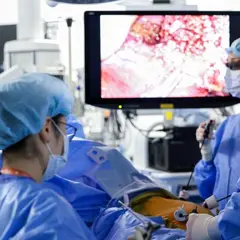
However, surgery becomes a necessity when "neurological deficits" appear. If motor skills decline or if there are issues with bowel or bladder control, physical therapy will no longer suffice. At this stage, the nerve passage must be surgically widened to prevent permanent paralysis. Options range from traditional front- or back-of-the-neck approaches to modern bi-directional spinal endoscopy (UBE).
Dr. Seok emphasized that patients with OPLL should strictly avoid habits like "cracking" the neck or receiving aggressive massages. In its hardened state, the ligament leaves the nerves vulnerable to fatal damage from even minor impacts.
Expert Profile: Dr. Seok Sang-yoon, A specialist at the Spine Center of Busan Bumin Hospital. Dr. Seok Sang-yoon joined the institution in March 2025 after serving as a clinical professor at Asan Medical Center in Seoul and an assistant professor at Eulji University Hospital in Daejeon. Specializing in spinal diseases from the cervical to the lumbar spine, he has been recognized with numerous accolades, including Best Paper awards from leading spine-related academic societies.

[Checklist] Could It Be OPLL? A 10-Second Self-Test
If you meet two or more of the following criteria, consult a specialist for a CT or MRI scan:
Fist Clenching Test: Clench and unclench your fists as fast as possible for 10 seconds. If you cannot exceed 20 repetitions, suspect nerve compression.
The Button Challenge: Do you struggle with fine motor tasks, such as buttoning a shirt or using chopsticks?
Straight Line Walk: Can you walk 10 steps in a straight line, touching heel-to-toe, without staggering?
Handwriting Changes: Has your handwriting become noticeably smaller, messier, or harder to control?
<Commonly Asked Questions>
How is OPLL different from a typical neck disc? A neck disc involves the soft "disc" protruding to press on nerves. In contrast, OPLL involves a ligament inside the spinal canal hardening into bone. This bone-like thickening compresses the entire spinal cord, often leading to more severe balance issues and "staggering" than a standard disc.
When are CT and MRI scans necessary for a diagnosis? A CT scan is the best tool for confirming the presence and shape of the "bone" (ossification). An MRI is then used to evaluate the "nerves," assessing the extent of spinal cord damage. Typically, doctors follow the order of confirming the ossification with a CT before assessing nerve impact with an MRI.
What neurological symptoms indicate that surgery is required? Surgery is considered a priority when fine motor skills decline (difficulty with chopsticks/buttons), balance is lost while walking, or when there is significant weakness in the limbs. The appearance of bowel or bladder control issues is a critical sign that immediate intervention is needed.
Why are neck massages or "cracking" habits so dangerous? In patients with OPLL, the spinal canal is already narrowed, leaving no extra room for the nerves. Sudden hyperextension or rotation—such as a sharp "crack" or a deep tissue massage—can cause the hardened ligament to strike the spinal cord, potentially causing instant paralysis.
How often should follow-up observations be conducted? For mild or asymptomatic cases, follow-ups are typically scheduled every 3 to 6 months at Bumin Hospital or a similar specialist center. If the condition remains stable, this may be extended to every 6 to 12 months. However, if tingling worsens or walking becomes difficult, an immediate re-evaluation is necessary.