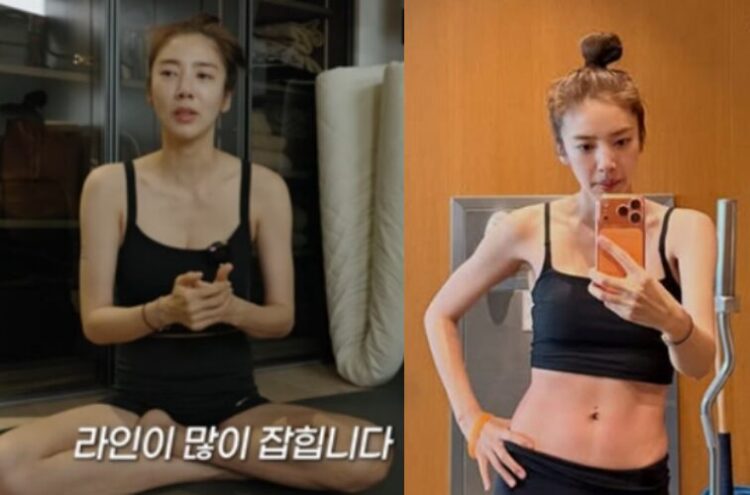
Singer and actress Son Dam-bi revealed her secret to getting abs after giving birth. She married Lee Kyu-hyuk, a former national speed skating representative, in 2022 and gave birth to a daughter last year.
Recently, Son Dam-bi posted a video titled ‘Son Dam-bi’s Crazy Health Management Method’ on her YouTube channel ‘Dam-bi Son’.
In the video, she opened up by saying, “These days, there are many comments asking, ‘Did you really get abs, unnie?’, ‘How do you manage after giving birth?’” Son Dam-bi made headlines by losing 17kg and confirming her weight at 47kg just three months after giving birth.
She continued, “Those who have experienced a cesarean section know that the process of recovering the rectus abdominis is not easy. It takes a long time and requires a lot of effort,” and added, “I don’t have perfect abs yet; the lines are just starting to show a little.”
She explained, “In cold weather, it’s more effective to sweat first with squash and then do ab exercises. I do squash on an empty stomach,” and said, “You need to combine cardio with ab exercises to see the lines. Women tend to lose elasticity in their belly fat after giving birth, and if left unattended, recovery becomes more difficult.”
Son Dam-bi also showcased her usual ab workout routine. After playing squash for 45 minutes without rest, she proceeded with sit-ups, crunches, and planks, recommending, “After doing three sets, it feels like my stomach is tearing, but without realizing it, the abs will start to take shape.”
Squash is Effective for Reducing Body Fat and Strengthening the Core
Among the exercises Son Dam-bi chose for her abs management, squash is an aerobic exercise where you hit a ball with a racket towards the wall and then receive the ball that bounces back. It requires agility and core strength, helping with body fat reduction and improving cardiovascular function.
However, in the early stages of starting exercise after giving birth, exercises like squash that involve sudden direction changes, increased abdominal pressure, and many jumping movements can put a strain on the abdominal incision and pelvic floor muscles. Therefore, it is safer to start at a lower intensity for 20-30 minutes rather than jumping straight into 45 minutes.
Classic Ab Exercises: Sit-ups, Crunches, and Planks
Next, the main ab exercises, sit-ups, crunches, and planks, are effective for restoring core stability and recovering abs. If it’s your first time doing ab exercises after giving birth, it’s best to start planks with your knees on the floor for a short time, and for crunches, rather than lifting your upper body completely, it’s better to curl just the rib cage slightly.
Additionally, helpful exercises include low-impact aerobic exercises like walking or stationary cycling, as well as ab exercises like hip bridges, bird dogs, and side planks. These movements strengthen the core without putting excessive pressure on the abdominal incision.
However, if your abdomen protrudes in a cone shape during exercise, or if you experience pain at the incision site, pelvic pressure, or a feeling of leaking urine, these are signs of overload, and you should immediately lower the intensity or stop.
Doing Cardio First and Then Ab Exercises is Good for Injury Prevention and Fat Burning
Meanwhile, as Son Dam-bi mentioned, doing cardio first and then ab exercises later is effective for enhancing workout results and preventing injuries.
As energy is consumed during cardio, blood sugar and glycogen are partially depleted, which can lead to better fat oxidation during subsequent ab exercises. Additionally, warming up through cardio raises body temperature, reducing the risk of injury.
If you had a cesarean section like Son Dam-bi, it is safe to start serious exercise at least six weeks later, after receiving confirmation from your obstetrician that your wound recovery and bleeding status are stable.
Exercises that directly exert force on the abdomen, such as sit-ups, crunches, and planks, are generally recommended to be done after eight weeks. At this time, it is advisable to check for any pain or pulling sensations and whether you can control your breathing while gradually increasing the intensity.