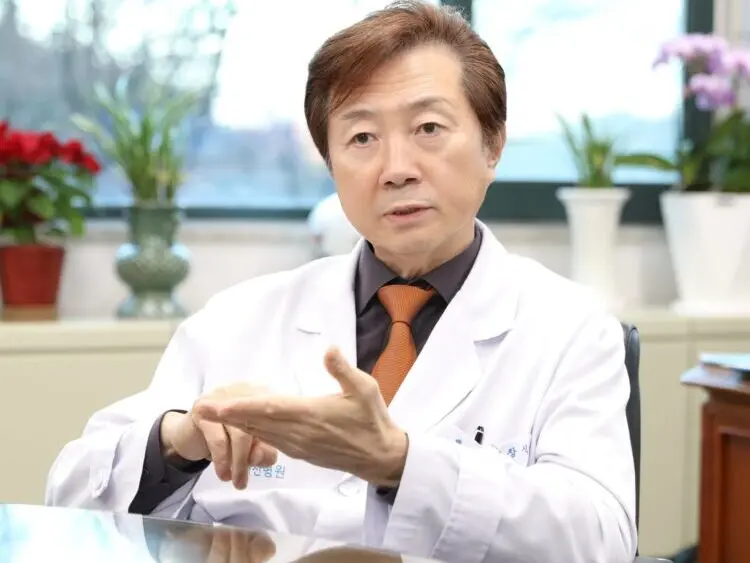
“The affection that Gangneung citizens—and residents across the Yeongdong region—have for Gangneung Asan Hospital is truly special. Amid the crisis in regional healthcare, we found a path to protect and further develop this precious hospital.”
In late 2021, the medical community was abuzz when a renowned physician—at the nation’s largest hospital, known as the top ‘knife’ in the colorectal field and drawing patients from all over the country—was suddenly appointed to lead a regional hospital. Some patients were stunned. Recently, news that he had secured a third consecutive term appeared “quietly” in the personnel notes sections of various newspapers. It was recognition of his success in stabilizing a hospital that had been wavering for four years and in presenting a survival model for regional hospitals.
Chang-sik Yoo, President of Gangneung Asan Hospital (64), is presenting a model for regional hospital survival by pushing through painful moments—such as having to close the cardiac emergency room just one year after taking office as doctors left one after another—and by weathering a crisis in which all residents in the so-called “IM-OS-Peds” (internal medicine, surgery, obstetrics & gynecology, pediatrics) left the hospital amid the physician-government conflict.
-It has already been four years since you came to Gangneung. At the peak of your career as a surgeon, you were assigned to a hospital where the director role was usually taken by retired physicians—must have been bewildering…
“In the fall of 2021, Seong-wook Park, President of Asan Medical Center, called me in and said, ‘Professor Yoo, you’ll need to go as the president of the Gangneung hospital—your patient care won’t be affected, right?’ I had once told my wife during a trip to Gangneung, ‘It would be nice to come to this hospital after retirement,’ but it was still a proposal that left me speechless. I asked President Park, ‘Couldn’t I go after I get the surgical system fully stabilized?’ and he replied, ‘Gangneung is more urgent.’ Since we had already built a system where seven junior and former trainee physicians performed surgeries, I concluded the hospital could manage without me. The issue was patients with Crohn’s disease, who often relapse—some held my hand and cried. Still, I trusted the medical center’s decision and packed my bags.”
-What was it like when you first arrived? The hospital looks beautiful, like a hotel in the forest…
“Gangneung Asan Hospital is a wonderful hospital, with inpatient wards featuring an ‘ocean view’ overlooking the East Sea and a ‘mountain view’ looking out toward Daegwallyeong. It has clean buildings and facilities, and state-of-the-art equipment. Above all, I quickly realized that local residents regard it almost as a sanctuary and place absolute trust in it.”
Gangneung Asan Hospital was established by the Asan Foundation, launched with private funds from the late Ju-young Chung, Honorary Chairman of the Hyundai Group. In line with the founder’s intent—“to help the most disadvantaged neighbors in our society”—the foundation provided medical volunteer services in remote farming and fishing communities, recognized the need for a general hospital, and opened this hospital following Seoul Asan Medical Center. Chairman Chung said, “Not for Hyundai Group’s business or my honor, but put the spirit of service first,” and he did not want the names Asan or Hyundai included. Just as Seoul Asan Medical Center’s first name was Seoul Central Hospital, this hospital’s first name was Gangneung Hospital.
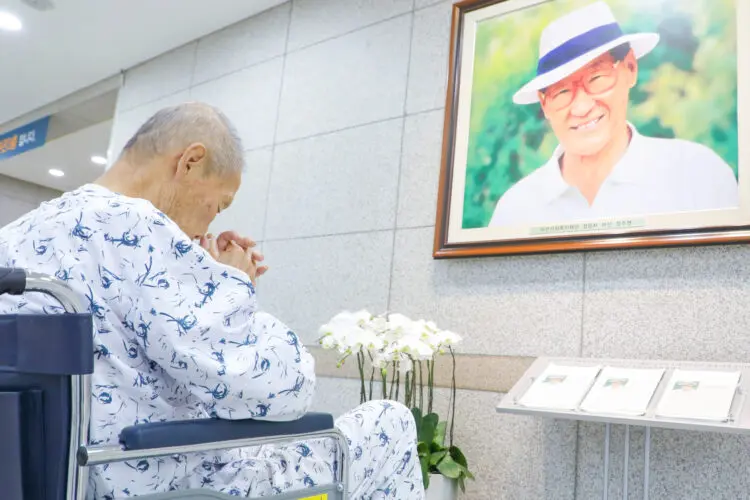
Chairman Chung was known for his deep love for his home province of Gangwon, to the extent that he took his pen name, Asan (峨山), from Asan-ri, Songjeon-myeon, Tongcheon-gun—his hometown beyond the armistice line—about an hour’s drive from the hospital. Residents here regard the hospital built by their “hometown hero” as their own, and some even pray in front of Chairman Chung’s portrait in the third-floor lobby.
-President Yoo is remembered as the person who built a multidisciplinary collaborative care system at the Seoul Asan Medical Center Cancer Center, and as the cancer hospital director who helped spread it across the medical community. You persuaded the Ministry of Health and Welfare to recognize reimbursement for multidisciplinary care, and… You could have brought those achievements to Gangneung Asan Hospital as well….
“When I first came, I wanted to make it a ‘hospital that performs surgery well,’ like Seoul Asan Medical Center. Before taking office, I expected internal limitations typical of a regional hospital, but most of that was unfounded. The staff’s capabilities were excellent, and a multidisciplinary collaborative care system was already functioning well. The hardware, including robotic surgery equipment, was also on par with many major university hospitals in Seoul. With shorter patient wait times, surgeries that require a one-month wait in Seoul could be done here in just a week.”
President Yoo said, “However, the problem was less with our hospital and more with South Korea’s healthcare system,” adding, “In the broader trend of regional hospitals collapsing, our task was to build a foundation for survival, and the immediate challenge was to keep specialists from leaving.”
“People in the Seoul metropolitan area may not feel it, but private university hospitals in the regions are on the verge of collapse. During COVID-19, young doctors were exhausted and began leaving, and the physician-government conflict poured fuel on the fire—metropolitan hospitals are now absorbing regional hospital faculty like vacuum cleaners.”
At Gangneung Asan Hospital, four of six cardiology fellows left one after another, leaving only two—an impossible situation for providing 24-hour care. In January 2023, one year into his term, President Yoo had no choice but to decide to close the cardiac emergency room on holidays and at night. The entire region was shaken, and complaints poured in. Trust in the hospital was at risk of collapsing.
President Yoo had to face reality with a clear head. Once he accepted that a sense of mission alone cannot hold a doctor whose heart has already left, an answer came into view. The challenge was execution. First, President Yoo sent an SOS to the City of Gangneung. He persuaded them that “using local welfare budgets for the hospital is the best welfare.”
The city wrestled with it, saying, “We want to help right away, but the legal basis for budget spending is weak.” As President Yoo consulted with the city, he also knocked on the door of the Gangwon Provincial Government. He requested a meeting with Jin-tae Kim, Governor of Gangwon, explained the urgent situation, and asked for provincial support. A task force (TF) was formed, led by the Vice Governor for Administration. Funding was arranged for specialist support payments, with the province covering 20% and the nine cities and counties that refer patients to Gangneung Asan Hospital jointly covering 80%. The hospital contacted cardiology specialists nationwide and filled positions one or two at a time, finally reopening the cardiac emergency room in November 2024. Gangwon media outlets reported the news with joy, as if it were their own achievement.
Gangneung Asan Hospital will also receive annual support of 800 million KRW from local governments for pediatrics, enabling it to operate a 24-hour pediatrics care system starting next year.
President Yoo said, “This kind of ‘proactive model for securing essential medical staff’ is something other cities and provinces are looking to emulate,” adding, “Securing public healthcare and essential care can be unlocked through budget investment that reflects local characteristics.”
Along with this, Gangneung Asan Hospital has focused on recruiting senior physicians. By emphasizing △Gangneung’s excellent living environment △respectful and satisfying working conditions △the hospital’s strong clinical environment, it recruited leading experts from Seoul Asan Medical Center, including Young-hwi Kim (Pediatrics) for pediatric cardiology, Jong-sung Kim (Neurology) as an authority in stroke, Seong-gu Lee (Gastroenterology) as a master of pancreaticobiliary ERCP (endoscopic retrograde cholangiopancreatography), Seong-woo Noh (Neurosurgery) as an authority in spine surgery, and Ki-soo Kim (Pediatrics) as an authority in neonatal care. It is also scouting other hospitals in Korea and overseas. In September 2022, it recruited Dr. Young-bin Choi, who had been working as a stroke subspecialist in the United States and Canada, to advance the stroke intensive care unit; last July, the hospital received a Grade 1 rating in the Health Insurance Review & Assessment Service’s stroke adequacy assessment.
“Right now, Gangneung Asan Hospital not only looks after the health of residents from Goseong County in Gangwon to Uljin County in North Gyeongsang, but some departments also see patients from the Seoul metropolitan area and from overseas. We run an annual deficit of 10 to 20 billion KRW, but I believe we play a role that cannot be converted into money. If the government or local governments simply fill the gaps in essential care for residents’ lives and health, we can maximize our strengths.”
Gangneung Asan Hospital will mark its 30th anniversary next year. It is reaching the stage Confucius described as “standing firmly without wavering”—the age of thirty. President Yoo is using 24 hours as if they were 25, aiming to ensure the hospital no longer wavers and to build cancer treatment competitiveness that surpasses major metropolitan hospitals. To this writer, it seemed entirely achievable on the foundation of cooperation between local government and the hospital.
I would like to share the voice of an acquaintance I met in Gangneung when I came to interview President Yoo. He spoke with confidence: “If the late Chairman Ju-young Chung could see from heaven, wouldn’t he be proud above all of Gangneung Asan Hospital, which is fighting so hard for the lives and health of people in his hometown?”