
Lung cancer is the second most commonly diagnosed cancer in South Korea and the leading cause of cancer mortality, making it one of the country's deadliest malignancies. According to 2024 cause-of-death statistics from the National Cancer Information Center, lung cancer claimed 19,401 lives, accounting for 21.8% of all cancer deaths.
Because early-stage lung cancer rarely presents obvious symptoms, many cases are diagnosed only after the disease has advanced. In recent years, however, improvements in early detection and personalized care have steadily raised survival rates. Treatment strategies have become increasingly tailored for non-small cell lung cancer (NSCLC)—which accounts for 80% to 85% of all lung cancer cases—guided by the specific genetic mutations of tumor cells. A prime example is targeted therapy directed at mutations in the epidermal growth factor receptor (EGFR) gene.
At the annual meeting of the World Conference on Lung Cancer (WCLC 2026), held in Seoul from September 12 to 15, researchers presented compelling new data on EGFR-mutated NSCLC. A key highlight was a long-term follow-up study demonstrating significant overall survival benefits for patients who received targeted adjuvant therapy following surgery.
Even in early-stage, operable NSCLC, identifying an EGFR mutation is a critical factor in determining post-surgical care. Removing all visible tumor tissue does not eliminate the risk of recurrence, making it essential to assess residual risk and determine whether additional treatment is needed.
How soon can lung cancer recur after surgery, what forms does recurrence take, and how can targeted therapy reduce this risk? Kormedi.com spoke with Professor Kim Se-hyun of the Division of Hematology-Oncology at Seoul National University Bundang Hospital to discuss post-surgical recurrence risks, EGFR-guided treatment options, and key considerations for patients.
Q. If a patient is diagnosed with lung cancer, up to what stage is surgery considered an option?
A. Lung cancer is broadly divided into non-small cell lung cancer (NSCLC) and small cell lung cancer (SCLC), based on how the cancer cells appear under a microscope. NSCLC accounts for approximately 80% to 85% of all lung cancer cases and includes subtypes such as adenocarcinoma and squamous cell carcinoma.
Staging is determined by evaluating tumor size, lymph node involvement, and whether the cancer has metastasized to distant organs. In general, surgery with curative intent is considered for stages 1 and 2, as well as select cases of stage 3A. In stage 3A, surgical feasibility depends on tumor location and the extent of spread to mediastinal lymph nodes in the central chest. In some instances, clinicians administer chemotherapy first to downstage the tumor before re-evaluating for surgery. Furthermore, because final staging is confirmed after pathologic examination of the resected tumor and lymph nodes, the pre-operative clinical stage estimated from imaging may differ from the post-operative pathological stage.
Q. What is an EGFR mutation, and why is genetic testing still necessary after lung cancer surgery?
A. EGFR is a receptor protein involved in cell growth and proliferation. When specific mutations occur in the EGFR gene, growth signals become hyperactivated, driving uncontrolled cancer cell growth. EGFR mutations represent one of the major genetic drivers in NSCLC and serve as a crucial biomarker for determining eligibility for targeted therapies.
EGFR mutations are particularly prevalent in Asian populations, including South Korea, and occur more frequently in non-smokers and women. In South Korea, they are especially common in lung adenocarcinoma, where approximately 40% of patients test positive for an EGFR mutation.
Historically, EGFR mutation testing was primarily performed to select drugs for advanced or metastatic lung cancer. However, as targeted therapies have proven effective in the post-operative adjuvant setting, genetic testing has become essential for shaping treatment strategies even in early-stage disease.
Q. Can cancer still return after complete surgical removal?
A. In surgical oncology, "complete resection" means that all macroscopically detectable tumor tissue has been removed. It does not guarantee that every microscopic cancer cell has been eradicated. Micrometastases that are undetectable on routine imaging can remain in the body and gradually grow over time, leading to disease recurrence.
Because recurrence can occur even in early-stage, resected lung cancer, long-term post-operative management is essential. Treatment for early-stage lung cancer should not be viewed as ending in the operating room, but rather as a broader continuum of care focused on managing residual recurrence risk.
Q. When is the risk of post-surgical recurrence highest, and how does it manifest?
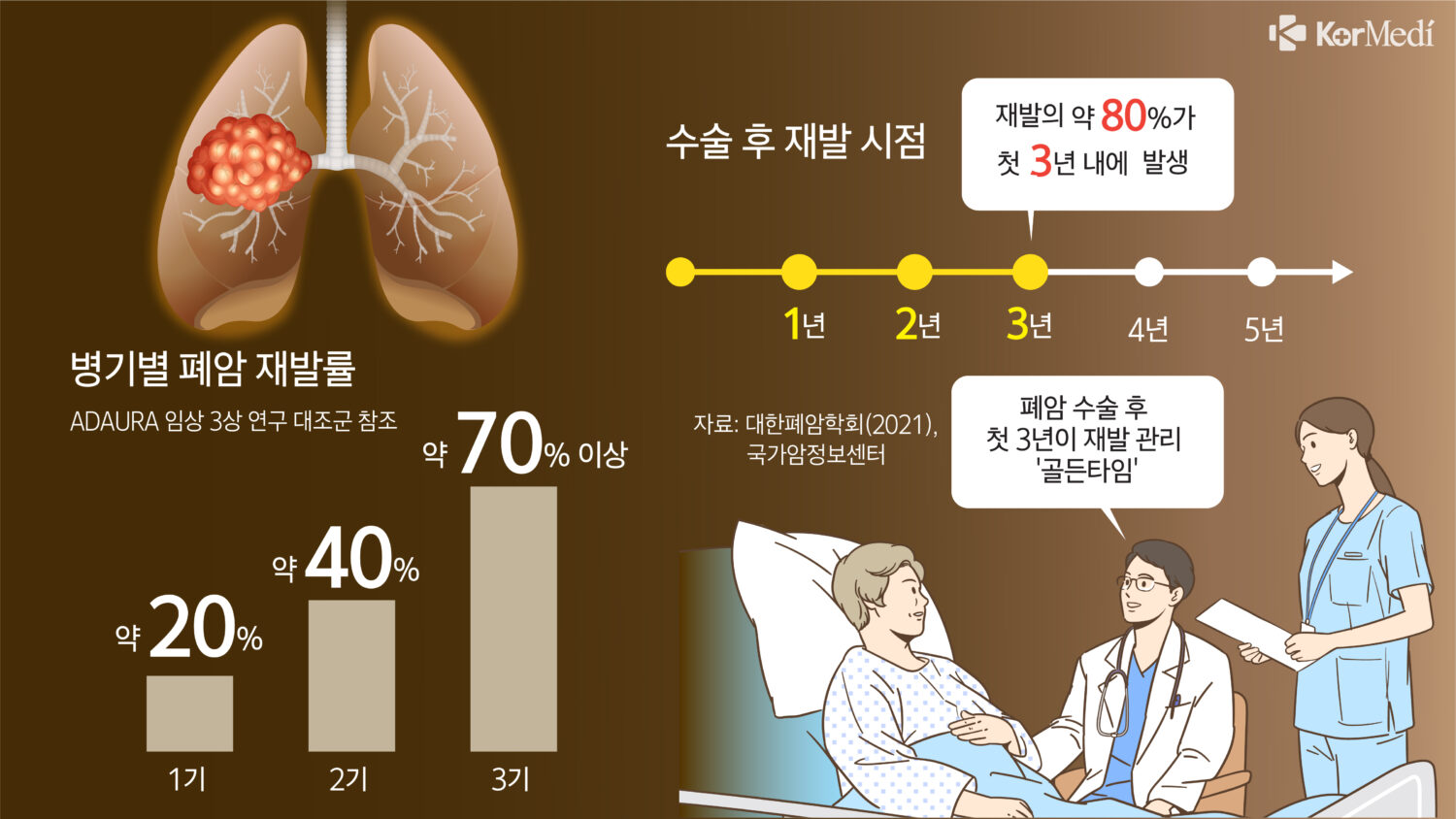
A. Recurrence is heavily concentrated within the first three years following surgery, making diligent monitoring during this window particularly critical. Recurrence can manifest locally in the operated lung or regional lymph nodes, or as distant metastases in organs such as the bones, liver, and brain. Patients with EGFR-mutated NSCLC require close surveillance for central nervous system (CNS) metastases, including brain lesions, necessitating tailored follow-up imaging based on their clinical profile.
Q. If an EGFR mutation is identified, what post-surgical treatment options are available?
A. Clinicians evaluate tumor stage, recurrence risk, and overall health to determine whether adjuvant therapy is warranted. For patients with EGFR-mutated NSCLC, adjuvant targeted therapy can suppress remaining microscopic cancer cells and significantly lower recurrence risk. A standard-of-care option is osimertinib (Tagrisso), administered as adjuvant therapy following complete tumor resection.
According to the global Phase 3 ADAURA trial involving patients with completely resected stage 1B to 3A EGFR-mutated NSCLC, adjuvant osimertinib reduced the risk of recurrence or death by 77% in stage 2 to 3A patients compared to placebo. Across the overall study population (stages 1B to 3A), the risk reduction was 73%, while the risk of CNS recurrence or death dropped by 76% in stage 2 to 3A patients.
Long-term follow-up data presented at WCLC 2026 further confirmed these survival benefits. An eight-year overall survival (OS) analysis demonstrated an eight-year OS rate of 74% in the osimertinib group versus 58% in the placebo group for stage 2 to 3A patients, representing a 47% reduction in the risk of death. Because osimertinib is taken for up to three years, these results are especially clinically meaningful, demonstrating sustained survival advantages long after treatment completion.
Q. How does post-surgical adjuvant therapy differ from treatment administered after recurrence occurs?
A. The primary objective of post-surgical adjuvant therapy is to eradicate remaining microscopic disease and prevent cancer from returning after visible tumors are removed. Conversely, treatment after recurrence aims to control disease progression and manage symptoms once cancer has already reappeared.
If EGFR-mutated NSCLC recurs in distant organs like the brain, bones, or liver, metastatic symptoms can severely impair daily functioning and quality of life. While targeted therapy remains an option after recurrence based on mutation profile and prior treatments, administering adjuvant therapy proactively after surgery offers an opportunity to prevent recurrence altogether.

Professor Kim emphasized that patients should have thorough discussions with their medical team regarding expected treatment benefits, potential side effects, treatment duration, and practical considerations.
In South Korea, because osimertinib is taken long-term and post-operative adjuvant use is not currently covered by national health insurance, financial burden remains a significant consideration for patients.
"Living without disease recurrence carries profound value beyond clinical metrics—it means returning to work and family while maintaining daily life," noted Professor Kim. "Because each patient's recurrence risk, baseline health, and financial situation differ, individuals should carefully weigh both the benefits and burdens of treatment in close consultation with their care team to choose the path that best fits their lives."