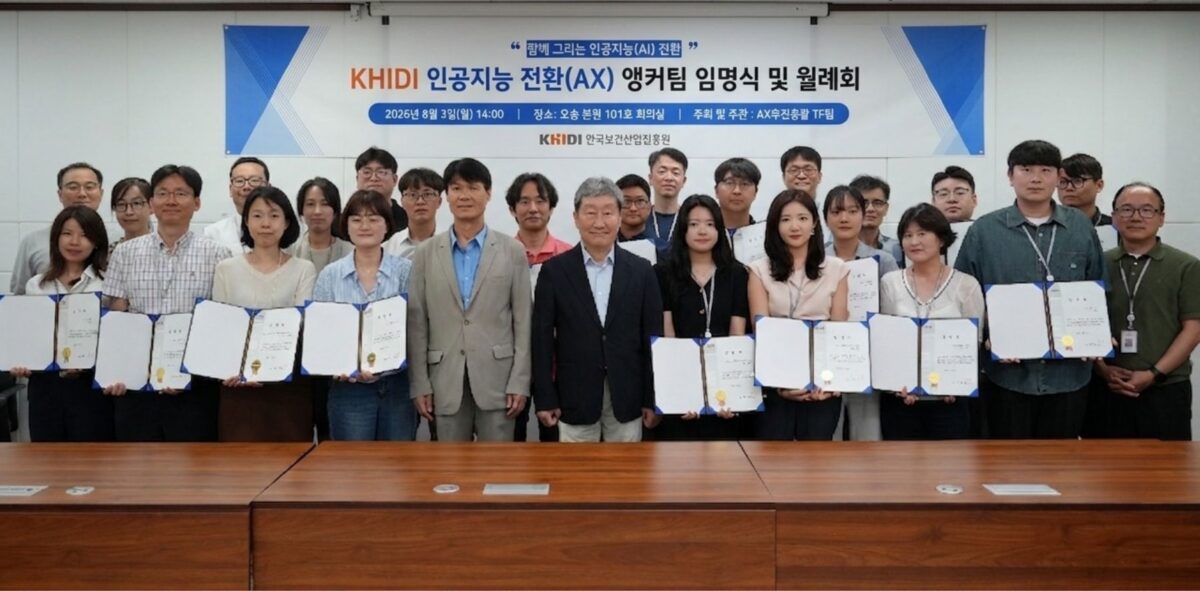
Staff supporting biohealth research and development (R&D) spend substantial time navigating and analyzing massive volumes of technical documentation while managing national projects. To streamline these operational demands, the Korea Health Industry Development Institute (KHIDI) is expanding generative artificial intelligence across its entire operational framework and support services for researchers and biotech enterprises.
KHIDI announced on Wednesday that it has established an AX Promotion General Task Force Team alongside division-level working groups to execute an agency-wide AI transformation (AX). Rather than simply adopting standalone AI tools, AX aims to fundamentally redesign internal workflows and service delivery models around AI-driven processes. Operating under the Ministry of Health and Welfare, KHIDI oversees national R&D programs across pharmaceuticals, medical devices, cosmetics, and healthcare services, guiding enterprises from early-stage research to commercialization and global market expansion.
Expanding BION GPT Across Agency Operations
The current initiative builds on BION GPT, a generative AI platform launched in 2024 specifically designed for biohealth R&D administration. BION GPT assists staff with R&D project management, literature searches, and data analysis, significantly reducing the administrative burden of gathering and organizing complex information.
To scale these operational gains across the entire organization, KHIDI launched its central AX Task Force on June 8. Each division now operates an "anchor team," forming a 27-member working-level network tasked with identifying departmental automation needs, designing tailored AI initiatives, and implementing them into daily operations. By empowering staff directly involved in routine workflows, KHIDI aims to target repetitive administrative tasks and material reviews effectively.
Concurrently, KHIDI is upgrading the platform's core capabilities. On July 8, the institute issued a 100 million won tender for the "HTDream Artificial Intelligence (BION GPT) Service Advancement Project." Now in its second phase, the project focuses on enhancing the platform's functional scope and accuracy.
Prioritizing Security, Ethics, and Performance Metrics
The initiative aligns with broader public-sector modernization efforts, following the Ministry of the Interior and Safety’s release of its Public-Sector AI Adoption and Utilization Guide on June 10, which outlines a five-stage framework from planning to operational deployment.
Because biohealth R&D management routinely involves unpublished research findings, proprietary corporate data, and personal health information, strict data governance is critical. KHIDI is conducting comprehensive employee training on AI ethics, cybersecurity, and personal information protection, alongside practical workshops on generative AI utilization. Progress is reviewed monthly in meetings chaired by the planning director to gather frontline feedback.
To measure real-world impact, KHIDI plans to evaluate concrete performance metrics, including project processing speeds, platform adoption rates, response accuracy, and user satisfaction among researchers and participating companies.
"As a core national institution dedicated to fostering the biohealth industry, an AI transformation across our work systems and customer-facing services is directly linked to our future competitiveness," said Jung Young-hoon, planning director at KHIDI. "By establishing a systematic blueprint and mobilizing organization-wide capabilities, we will lead the AI transformation of the K-biohealth sector."