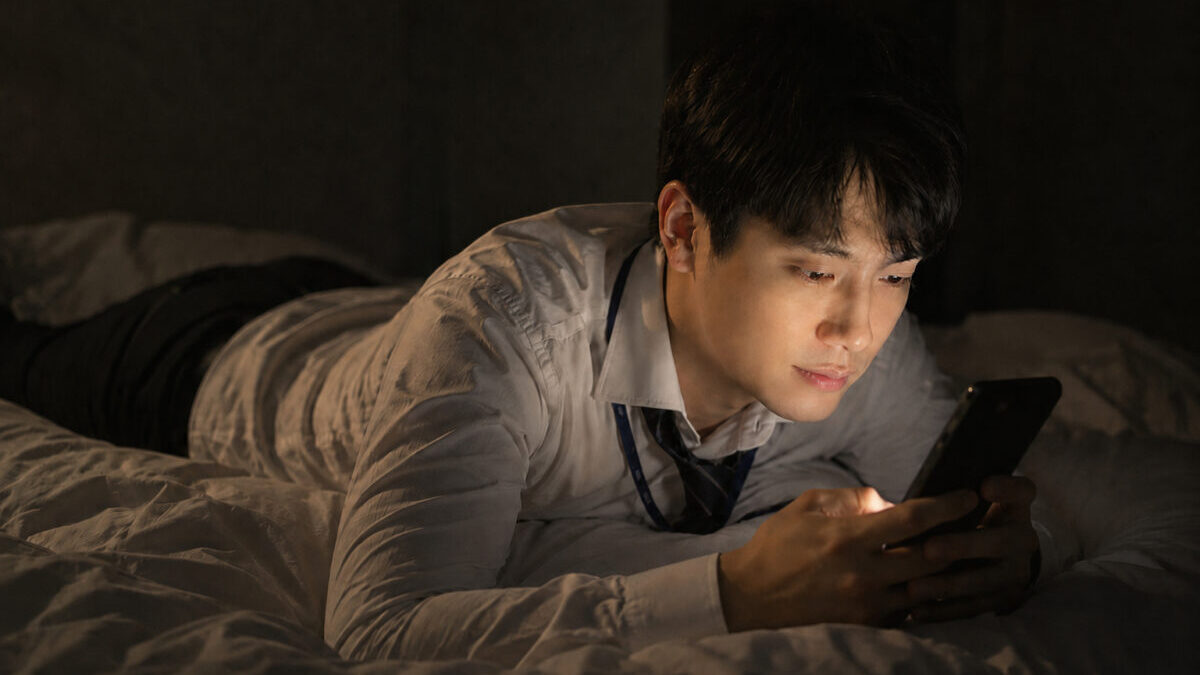
Many people scroll on their smartphones face down in the dark before falling asleep. However, if this habit triggers severe eye pain, vision blur, or nausea, it should not be dismissed as simple eyestrain or indigestion. These symptoms may signal acute angle-closure glaucoma, a condition in which the eye's fluid-drainage pathway suddenly closes, causing intraocular pressure (IOP) to spike rapidly.
Jung Jong-jin, a glaucoma specialist at the Glaucoma Center at Kim's Eye Hospital, warned on the 21st that staring at a smartphone for long periods in the dark or lying face down can elevate IOP. Individuals with inherently narrow drainage pathways inside the eye must be particularly vigilant against acute angle-closure attacks.
How Smartphone Use Impacts Eye Pressure
A clear fluid called aqueous humor constantly circulates inside the eye to maintain its shape before draining out through a dedicated pathway. Eye pressure is determined by the balance between the production and drainage of this fluid.
This drainage route, known as the anterior chamber angle, is located where the iris meets the cornea. When this pathway narrows or closes—a state known as angle closure—aqueous humor cannot escape. The resulting surge in IOP can cause irreversible damage to the optic nerve, which transmits visual information to the brain.
Using a smartphone does not automatically cause glaucoma in everyone. However, studies show that looking at a near screen for extended periods, particularly in dim lighting and with the head tilted downward, can temporarily elevate IOP.
In a 2018 study published in PLOS ONE, researchers at Seoul National University Hospital evaluated 39 healthy adults under age 40 who read and typed on smartphones in both bright and low-light environments. In low light, average IOP rose from 13.9 mmHg before phone use to 17.3 mmHg after 15 minutes. Eye pressure returned to baseline within 15 minutes after stopping, with greater head tilt correlating with larger pressure increases.
An overseas study published in the Journal of Glaucoma in 2024 observed similar findings among 60 healthy adults and 22 open-angle glaucoma patients whose pressure was medically controlled. After reading for 30 minutes, participants experienced higher IOP increases when using a smartphone compared to reading printed paper. However, pressure levels normalized within 20 minutes of stopping.
While these findings do not prove that smartphones directly cause permanent glaucoma, they confirm that specific postures and lighting environments can cause transient spikes in eye pressure.
Darkness and Posture: Blocking the Drainage Pathway
In the dark, the pupil dilates to allow more light into the eye. While harmless for most, pupil dilation in an eye with a narrow anterior chamber angle can push surrounding iris tissue into the drainage pathway, blocking fluid outflow and triggering a rapid IOP spike.
Lying face down further compounds this risk. In another Seoul National University Hospital study, researchers placed 24 patients (37 eyes) with intermittent angle closure face down in a dark room. IOP increased by at least 8 mmHg in 28 of the tested eyes, with thicker lenses correlating to higher pressure spikes. Researchers noted this was a 45-minute diagnostic provocation test in pre-disposed patients rather than a measure of everyday smartphone risk, but it underscores the physical mechanism at play.
Because a narrow anterior chamber angle cannot be detected in a mirror, an ophthalmic exam is required to evaluate internal eye structures. Farsighted individuals, those with a family history of angle-closure glaucoma, and older adults—whose lenses naturally thicken with age—face a higher baseline risk.
To mitigate risk during smartphone use, maintain ambient lighting rather than keeping the room pitch-black. Sit upright rather than lying face down, avoid holding the screen too close to the face, and take regular breaks to focus on distant objects.
Recognizing Warning Signs and Emergency Protocol
Acute angle-closure glaucoma develops rapidly. Symptoms include severe eye pain, localized redness, hazy vision, and rainbow-colored halos around lights. As IOP surges, patients often experience severe headaches, nausea, and vomiting, leading many to misdiagnose the condition as a migraine or stomach ailment.
Because acute angle-closure glaucoma is a medical emergency that can lead to permanent vision loss if untreated, immediate intervention is essential. Anyone experiencing sudden eye pain and redness accompanied by blurred vision and nausea should seek emergency ophthalmic care immediately.
"Screen time duration is important, but the environment and posture in which you use your devices matter just as much," Jung emphasized. "Avoid using smartphones for extended periods in the dark or while lying face down, and consult an eye specialist without delay if you experience eye pain or vision changes."