
"Doctor, please take this."
"What is it?"
"I bought you a probiotic drink so you’ll stay healthy."
"Probiotics…?"
At some point, sweetened probiotic drinks transformed into mainstream health icons. Yet yogurt—produced by fermenting milk—originates from a food not inherently designed for human digestion, serving primarily as complete nutrition for calves. Does industrial fermentation truly turn dairy into a cure-all health food?
Lactic Acid Bacteria vs. Probiotics: Understanding the Distinction
A common point of confusion is whether "lactic acid bacteria" and "probiotics" are identical.
The term "probiotics" combines pro ("for") and bio ("life"), referring broadly to live microorganisms that confer health benefits upon the host—effectively, the "beneficial bacteria" residing in the gut. A primary subset of these beneficial microbes is lactic acid bacteria, which produce lactic acid during metabolism. However, because beneficial bacterial strains exist that do not produce lactic acid, "beneficial bacteria" remains a broader category [1].
The World Health Organization (WHO) defines probiotics strictly as "live microorganisms which when administered in adequate amounts confer a health benefit on the host." Consequently, dead, heat-treated, or inactivated bacteria do not qualify as probiotics.
Driven by modern stress and Westernized diets, public concern over gut health has skyrocketed. With media campaigns relentlessly promoting the narrative that probiotics equal instant gut wellness, probiotics have captured third place in total health functional food sales in South Korea while ranking first in frequency of consumer purchases [2, 3].

Yet the clinical reality is often overshadowed by commercial exaggeration. Proponent supplement marketers frequently suggest that instead of altering one's diet to cultivate a healthy microbiome, individuals can simply swallow a few pills. But science tells a more complex story about our internal ecosystem.
Forty Trillion Microorganisms: Why Diversity Protects the Gut
Popular wisdom often cites 100 trillion microorganisms inhabiting the human intestines, but contemporary research places the figure closer to 40 trillion—rivaling a complex tropical rainforest. Because the human body consists of roughly 30 trillion cells, microbial inhabitants actually outnumber our own cells [4].
In any natural ecosystem, biodiversity is vital because every organism plays a distinct, interdependent role. The gut microbiome is a symbiotic community comprising bacteria, archaea, fungi, viruses, and yeast, with bacteria overwhelmingly dominant at approximately 99%.
Estimates indicate that between 500 and 1,000 bacterial species reside within the human digestive tract, weighing a combined 0.5 to 1.0 kilogram, with a concentration of 50 billion to 100 billion bacteria per gram [5, 6, 7].
Gut bacteria are broadly divided into three functional groups:
Beneficial bacteria (probiotics): Synthesize protective compounds and support metabolic health.
Harmful bacteria: Produce toxins and drive inflammatory disease.
Neutral bacteria: Normally function like beneficial microbes, but shift into pathogenic behavior when the gut environment deteriorates—such as when beneficial populations decline.
Lactic acid bacteria—including genera such as Lactobacillus and Bifidobacterium—ferment dietary fiber to generate lactic acid. This mild acidity lowers the intestinal pH, effectively suppressing opportunistic pathogens like E. coli, Listeria, and Salmonella, which thrive in neutral environments but struggle in acidic conditions [8, 9, 10].
The Hidden Gifts of Beneficial Microbes: Vitamins and Short-Chain Fatty Acids
Beyond producing lactic acid, resident microbes synthesize essential micronutrients, most notably B-complex vitamins and short-chain fatty acids (SCFAs).
Beneficial bacteria manufacture B vitamins vital for cellular energy metabolism—including B1, B2, B3, B5, B6, B7, B9, and B12—alongside vitamin K2. While vitamin K1 governs blood clotting, vitamin K2 directs calcium deposition toward bones while preventing arterial calcification, thereby supporting cardiovascular health [11]. Although humans cannot synthesize most vitamins independently, gut microbes can supply up to 30 percent of the recommended daily intake [12].
Even more remarkably, bacteria ferment dietary fiber—a substance indigestible by human enzymes—into short-chain fatty acids such as acetate, propionate, and butyrate [13].
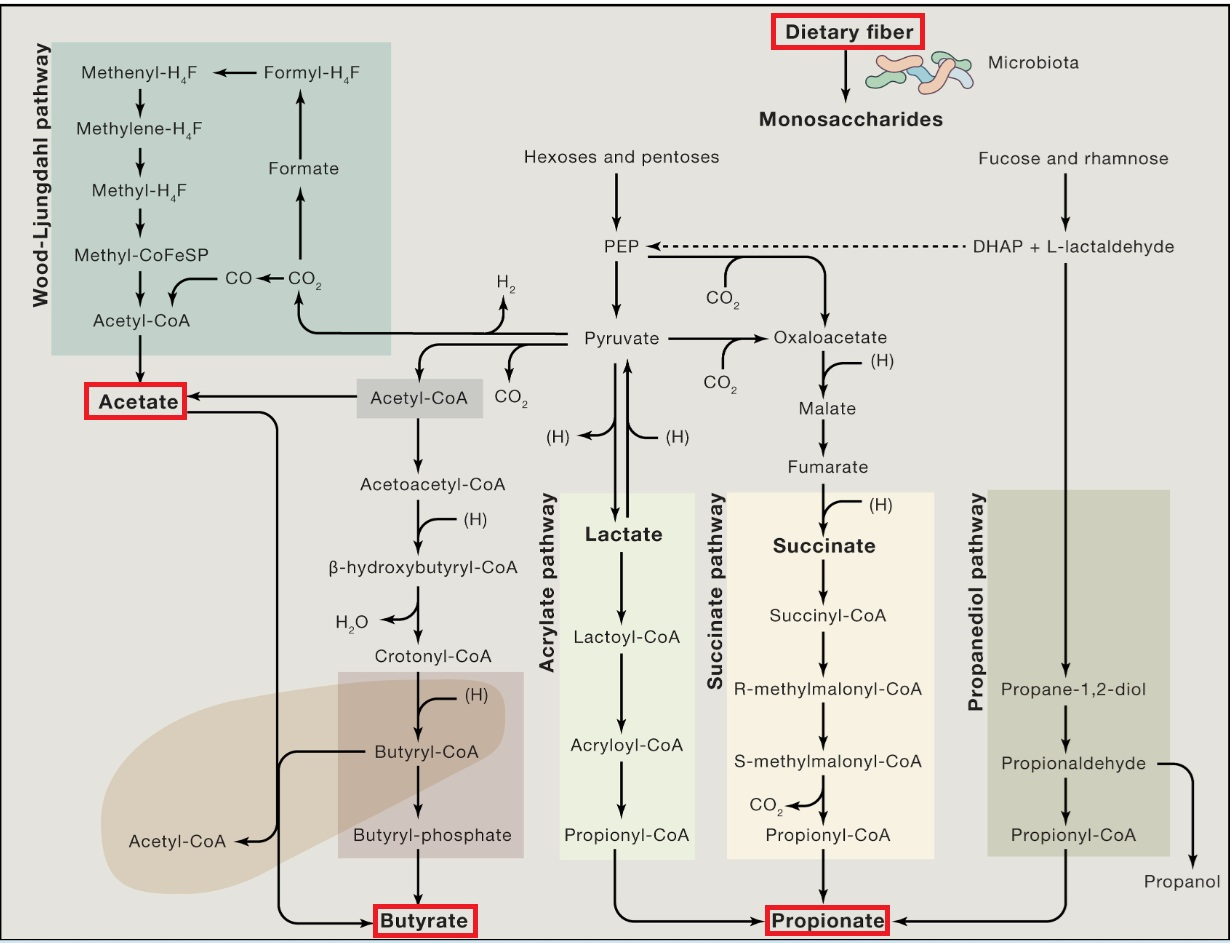
These organic acids maintain a healthy, mildly acidic gut environment that discourages harmful microbes while encouraging beneficial proliferation. Among them, butyrate acts as the primary energy source for colonic epithelial cells, reinforcing the intestinal mucosal barrier and suppressing systemic inflammation [14].
Kevin Whelan, a professor of nutrition at King’s College London, highlights clinical research demonstrating that individuals with high dietary fiber intake exhibit greater longevity alongside significantly reduced risks of cardiovascular disease, cancer, and diabetes [15].
Moving Beyond the Protein Craze: The True Fuel for Gut Bacteria
While the food market was dominated for years by a high-protein craze centered on muscle growth and weight loss, consumer focus is shifting toward dietary fiber [16]. Abundant in plant-based foods such as fruits, vegetables, whole grains, and legumes—and entirely absent from animal products—fiber represents the true foundation of sustainable gut health.
Song Moo-ho, MD, orthopedic surgery and lifestyle medicine specialist

References
1. Health Kyunghyang https://www.k-health.com/news/articleView.html?idxno=40180#
2. Electronic Times https://www.etnews.com/20240904000150
3. ZDNET Korea https://zdnet.co.kr/view/?no=20241122154150
4. R Sender, S Fuchs, R Milo. Revised Estimates for the Number of Human and Bacteria Cells in the Body. PLoS Biol 2016;14(8):e1002533.
5. JA Gilbert, MJ Blaser, JG Caporaso, et al. Current understanding of the human microbiome. Nature Med 2018;24(4):392-400.
6. Wikipedia https://en.wikipedia.org/wiki/Gut_microbiota
7. J Walter, R Ley. The human gut microbiome: ecology and recent evolutionary changes. Annual review of microbiology 2011;65(1);411-429.
8. EJE Brownlie, D Chaharlangi, EO Wong, et al. Acids produced by lactobacilli inhibit the growth of commensal Lachnospiraceae and S24-7 bacteria. Gut Microbes 2022;14(1):2046452.
9. Z Gao, EBM Daliri, JUN Wang, et al. Inhibitory effect of lactic acid bacteria on foodborne pathogens: a review. Journal of food protection 2019;82(3):441-453.
10. UB Saha, SD Saroj. Lactic acid bacteria: prominent player in the fight against human pathogens. Expert review of anti-infective therapy 2022;20(11):1435-1453.
11. JG LeBlanc, C Milani, GS De Giori, et al. Bacteria as vitamin suppliers to their host: a gut microbiota perspective. Current opinion in biotechnology 2013;24(2):160-168.
12. A Brauer-Nikonow, M Zimmermann. How the gut microbiota helps keep us vitaminized. Cell Host & Microbe 2022;30(8):1063-1066.
13. A Koh, F De Vadder, P Kovatcheva-Datchary, F Bäckhed. From dietary fiber to host physiology: short-chain fatty acids as key bacterial metabolites. Cell 2016;165(6):1332-1345.
14. C Martin-Gallausiaux, L Marinelli, HM Blottière, et al. SCFA: mechanisms and functional importance in the gut. Proc Nutr Soc 2021;80(1):37-49.
15. A Reynolds, J Mann, J Cummings, et al. Carbohydrate quality and human health: a series of systematic reviews and meta-analyses. The Lancet 2019;393:434-445.
16. Dong-A Ilbo https://www.donga.com/news/It/article/all/20260220/133390654/2