
Earth formed approximately 4.6 billion years ago, but it was not until about 60 million years ago that early primates—highly intelligent ancestral mammals characterized by relatively large brains—appeared in Africa. As the Miocene epoch dawned, a geological period spanning from 23 million to 6 million years ago, these primates began migrating from Africa into Europe and Asia [1].
About 6 million years ago, two distinct lineages diverged from these ancestral apes. One branch developed bipedalism—the ability to walk upright on two legs—and evolved into early human ancestors, while the other lineage eventually split into modern chimpanzees and bonobos [2].
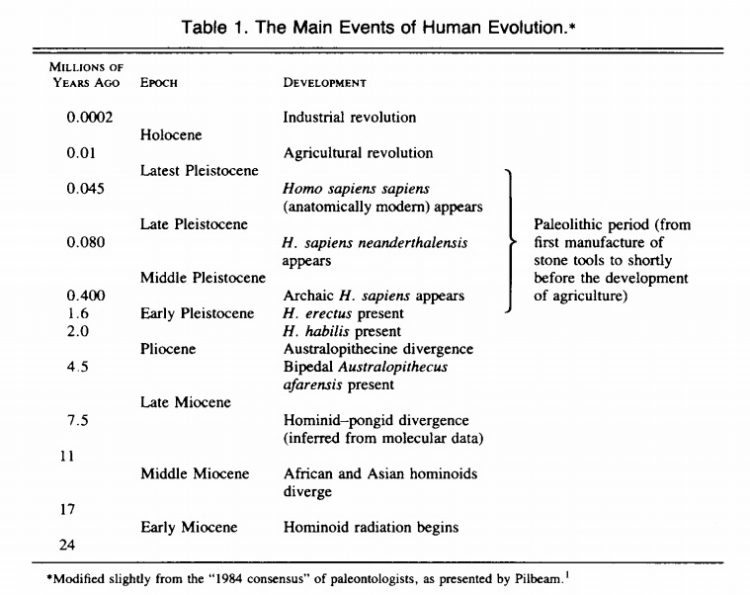
The hominin Australopithecus, widely considered an early human ancestor, emerged roughly 4 million years ago. The genus Homo, closer in meaning to "human," appeared around 2 million years ago with the arrival of Homo habilis and Homo erectus. More anatomically modern humans, Homo sapiens, appeared approximately 200,000 years ago, followed by Homo sapiens sapiens about 40,000 years ago, who closely resemble humans today [3].
Dietary Adaptation and the Impact of the Ice Age
To understand what our ancestors ate to survive, we must look to the Paleolithic era, a period starting about 2 million years ago when early humans lived as hunter-gatherers and utilized primitive stone tools. This contrasts with the Neolithic era, the agricultural age that began roughly 10,000 years ago as the last Ice Age waned, global temperatures rose, and humans began cultivating grains and establishing permanent settlements [4].
Throughout the Paleolithic era, human survival hinged entirely on environmental adaptation. Because humans are remarkably adaptable, they managed to inhabit ecosystems ranging from tropical rainforests to arid deserts and frigid polar regions.
Food sources varied widely by geography, season, and technological capability. However, human anatomy remains inherently better suited to gathering and digesting plant matter than to hunting and consuming raw meat. Consequently, the baseline diet of early humans was overwhelmingly plant-based, consisting of tropical fruits, root vegetables, wild greens, and nuts [5, 6].
This baseline was fundamentally disrupted by the Ice Age. Beginning roughly 3 million years ago, Earth experienced prolonged periods of glacial expansion punctuated by warmer interglacial intervals, cycling every 40,000 to 100,000 years. The human genus emerged and evolved during this volatile climate era, enduring the last major glacial period before flourishing in the current interglacial epoch [7, 8].
Anthropologists estimate that Homo habilis, living between 2.3 million and 1.4 million years ago, relied primarily on plants during ordinary times. However, during severe glacial stretches when vegetation became scarce, survival forced them to act as scavengers. Much like modern hyenas, they likely consumed the marrow and leftover carcasses abandoned by apex carnivores [9], as early human anatomy lacked the natural weaponry to hunt large game bare-handed. When plant foods were entirely unavailable, they also used stones to catch small animals or fish.
Fire, Hunting, and the Three Shifts in Human Nutrition
True, full-scale hunting emerged with Homo erectus, who lived from 1.9 million to 300,000 years ago and utilized sophisticated stone hand-axes to secure animal protein [10]. As glacial cold persisted, meat consumption accelerated. Homo erectus also mastered the control of fire, using it for warmth and protection against predators. Crucially, fire allowed humans to cook meat that was otherwise tough or dangerous to eat raw. This birth of culinary practice significantly boosted the human intake of animal fat and protein [11, 12].
Dietary composition fluctuated wildly with the climate. During intense glacial periods, hunted meat became a survival necessity, while warmer interglacial periods saw a return to plant-forward gathering. In hyper-arid regions like the savannah, where forests gave way to grasslands and grazing herds multiplied, meat sometimes comprised 50% to 60% of the total human diet. Yet, whenever conditions allowed for settled agricultural life to begin, plant-based foods quickly reclaimed up to 90% of total dietary intake [13].
Looking back, the human diet has undergone three monumental shifts. The first occurred roughly 3 million years ago with the onset of the Ice Age, forcing forest-dwelling, fruit-eating hominins to adopt a hunter-gatherer lifestyle rich in animal fats and proteins. The second shift arrived 10,000 years ago with Neolithic agriculture; as the ice retreated, grain cultivation surged, returning the human diet to a carbohydrate-rich, plant-dominant model [14].
The third and most radical shift followed the Industrial Revolution in the late 18th century. Breakthroughs in agriculture, grain refining, and food preservation exponentially increased the consumption of processed carbohydrates like refined sugar and flour. Simultaneously, modernized animal husbandry made fatty meats from grain-fed livestock cheap and widely available. This created a nutritional landscape entirely foreign to human evolutionary history [15].
While extreme climate shifts forced our ancestors to adapt to meat consumption for sheer survival, evolutionary biology indicates that humans are fundamentally rooted in a plant-based heritage.
Song Moo-ho, MD, is an orthopedic surgery and lifestyle medicine specialist.

References
1. P Andrews, J Kelley. Middle Miocene Dispersals of Apes. Folia Primatologica 2007;78(5-6):328-343.
2. Wikipedia https://ko.wikipedia.org/wiki/%EC%A7%80%EA%B5%AC%EC%9D%98_%EC%97%AD%EC%82%AC
3. SB Eaton, M Konner. Paleolithic nutrition: a consideration of its nature and current implications. N Engl J Med 1985;312:283-289.
4. Korea Institute for Advanced Study, Origins of Agriculture, Horizon https://horizon.kias.re.kr/6770/
5. RF Kay. Diets of early Miocene African hominoids, Nature 1977;268:628-630.
6. SJC Gaulin, M Konner. On the natural diet of primates, including humans. In: Wurtman RJ, Wurtman JJ, editors. Nutrition and the Brain. New York: Raven Press 1977;1-86.
7. Dong-A Ilbo https://www.donga.com/news/Opinion/article/all/20181103/92709752/1
8. Wikipedia https://ko.wikipedia.org/wiki/%EB%B9%99%ED%95%98%EA%B8%B0
9. P Shipman. Early hominid lifestyle: hunting and gathering or foraging and scavenging? Oxford BAR 1983:31-49.
10. K Milton. Primate diets and gut morphology: Implications for hominid evolution. In: Harris M, Ross EB, eds. Food and evolution: towards a theory of human food habits. Philadelphia: Temple University Press 1987:93-115.
11. Hankyoreh https://www.hani.co.kr/arti/international/international_general/526629.html
12. Wikipedia https://ko.wikipedia.org/wiki/%EC%B4%88%EA%B8%B0_%EC%9D%B8%EB%A5%98%EC%9D%98_%EB%B6%88%EC%9D%98_%EC%9D%B4%EC%9A%A9
13. RS MacNeish. A summary of the subsistence. In: Byers DS, ed. The prehistory of the Tehuacan Valley. Vol. 1. Austin, Tex.: University of Texas Press 1967:290-309.
14. K Ye, Z Gu. Recent advances in understanding the role of nutrition in human genome evolution. Advances in Nutrition 2011;2(6):486-496.
15. KW Alt, A Al-Ahmad, JP Woelber. Nutrition and Health in Human Evolution-Past to Present. Nutrients 2022;14(17):3594.