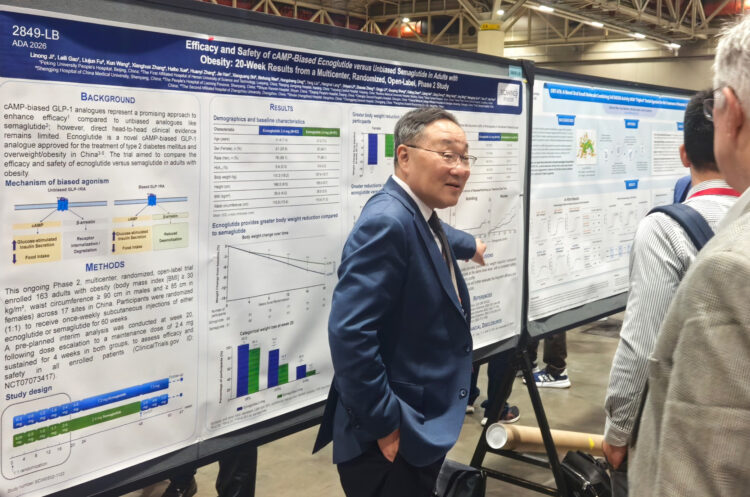
HK inno.N announced on June 9 that its obesity drug candidate, ecnoglutide, demonstrated superior weight-loss efficacy compared to semaglutide—the active ingredient in Wegovy—in a head-to-head Phase 2 clinical trial. The findings were presented by HK inno.N’s China-based partner, Sciwind Biosciences, as a late-breaking abstract at the 2026 American Diabetes Association (ADA) Scientific Sessions held in New Orleans, Louisiana, from June 5 to 8.
Ecnoglutide is the world’s first cyclic adenosine monophosphate (cAMP)-biased glucagon-like peptide-1 (GLP-1) receptor agonist. While it belongs to the same popular GLP-1 class as Wegovy, Ozempic, and Saxenda, ecnoglutide is uniquely engineered to enhance selectivity for the cAMP signaling pathway while minimizing receptor internalization. HK inno.N licensed the drug in 2024 and is currently conducting Phase 3 clinical trials in South Korea for both chronic weight management and type 2 diabetes.
The multicenter, randomized study directly evaluated ecnoglutide against semaglutide across 17 research centers in China, enrolling 163 adults with obesity. Participants were randomized in a 1:1 ratio to receive once-weekly subcutaneous injections of either ecnoglutide or semaglutide at an identical maintenance dose of 2.4 mg.
By week 20, the ecnoglutide group achieved a 35% greater mean percentage reduction in body weight compared to the semaglutide group. Specifically, the mean weight loss was 12.8% for patients treated with ecnoglutide versus 9.5% for those on semaglutide. Furthermore, the proportion of patients who lost at least 10% of their body weight was nearly double in the ecnoglutide arm, reaching 74% compared to 40% in the semaglutide group.
Anthropometric measurements also favored the novel candidate. After 20 weeks of treatment, the average reduction in waist circumference was 10.5 cm in the ecnoglutide group compared to 8.7 cm in the semaglutide group, representing a 20% greater decrease. Additional body measurements, including arm and neck circumferences, also showed more pronounced improvements with ecnoglutide.
In addition to its robust efficacy, ecnoglutide demonstrated better gastrointestinal tolerability than standard semaglutide treatment. According to HK inno.N, this improved safety profile stems from ecnoglutide's structural design, which maximizes cAMP signaling selectivity to simultaneously optimize weight-loss efficacy and patient compliance.
"These results provide a compelling clinical example of the superiority that biased GLP-1 agonists can offer over existing standard therapies," said the study’s principal investigator, Professor Linong Ji of Peking University People’s Hospital.
Kwak Dal-won, CEO of HK inno.N, emphasized the drug’s potential, stating, "This presentation once again confirms the clinical promise of ecnoglutide. We are committed to doing our utmost to advance its domestic development and deliver an innovative, highly effective treatment option for patients in South Korea."
HK inno.N originally secured the exclusive rights for the domestic development and commercialization of ecnoglutide through a licensing and partnership agreement signed in 2024 with Sciwind Biosciences, a Chinese clinical-stage biopharmaceutical company specializing in GLP-1 peptide therapeutics.