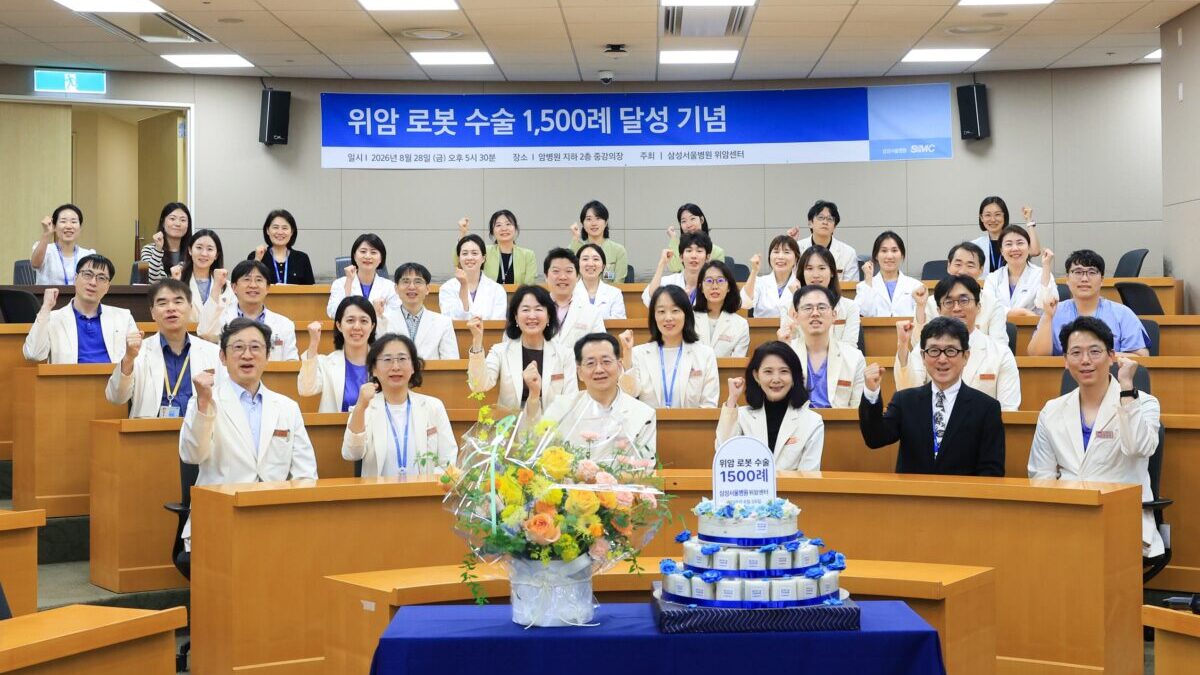
Samsung Medical Center has performed more than 1,500 robot-assisted stomach cancer surgeries, reaching the milestone 16 years after introducing the procedure in 2010. Last year, robotic procedures accounted for more than 20% of all stomach cancer operations at the hospital.
According to data released Sept. 2 by Samsung Medical Center, surgeons performed 1,174 stomach cancer operations in 2025. Of those, 256 were robot-assisted surgeries, representing 22% of the total volume. The hospital has steadily expanded minimally invasive options—including both laparoscopic and robotic approaches—to reduce patient pain, blood loss, and scarring.
South Korea's First Dedicated Gastrointestinal da Vinci 5 System
To support expanding surgical demand, Samsung Medical Center recently deployed the da Vinci 5, an advanced surgical robot manufactured by Intuitive, specifically for gastrointestinal procedures. Samsung Medical Center is currently the only hospital in South Korea to designate a da Vinci 5 system exclusively for gastrointestinal surgery.
The da Vinci 5 received approval from the U.S. Food and Drug Administration (FDA) in March 2024 and launched in South Korea in October of the same year. Built upon the da Vinci Xi architecture, the fifth-generation system features more than 150 component upgrades alongside enhanced imaging and control capabilities. Notably, it incorporates "Force Feedback" technology, allowing surgeons to tactilely sense the force exerted when instruments manipulate body tissue.
Weighing Precision Against Operating Time and Cost
While robotic equipment offers high precision, medical guidelines note that robotic procedures are not automatically superior to standard laparoscopic surgery for every patient.
The 2024 Korean Gastric Cancer Treatment Guidelines, published jointly by the Korean Gastric Cancer Association and related academic bodies, issue a "conditional recommendation" for robotic gastrectomy. The guidelines state that while robotic surgery may lower certain postoperative complication rates, patients must weigh those benefits against longer operative times and higher medical costs.
Clinical research highlights these trade-offs. A 2025 meta-analysis combining four randomized clinical trials involving 919 stomach cancer patients found that robotic surgery took an average of 16.95 minutes longer than laparoscopic surgery. While robotic procedures yielded fewer overall complications and shorter hospital stays, researchers observed no statistically significant differences in severe complications, anastomotic leakage, reoperation rates, or intraoperative blood loss.
A separate 2025 study analyzing six randomized clinical trials involving 1,055 patients similarly observed a trend toward longer operative times for robotic procedures, though the difference was not statistically significant across all cohorts.
"By introducing dedicated robotic systems, we anticipate further refinements in surgical techniques that preserve both treatment efficacy and patient quality of life," said Lee Jun-ho, head of gastrointestinal surgery at Samsung Medical Center. "We remain focused on developing procedures that deliver optimal clinical outcomes."
Clinical Outcomes and Survival Metrics
Samsung Medical Center reported an overall five-year relative survival rate of 89.5% for its stomach cancer patients, with a 90-day postoperative mortality rate of 0.42%. By comparison, South Korea's national average five-year relative survival rate for stomach cancer stands at 78.6%, while the average 90-day postoperative mortality rate across domestic tertiary general hospitals is 0.98%.
Hospital officials noted that while these metrics reflect high clinical standards, direct comparisons between institutions require context, as patient age, cancer staging, comorbidities, and surgical candidacy vary by facility.
"Reaching 1,500 robotic stomach cancer surgeries underscores our global clinical competitiveness," said Lee Ji-yeon, director of the Stomach Cancer Center at Samsung Medical Center. "We will continue to advance stomach cancer care through precise diagnosis and tailored treatment strategies."