Korean researchers have uncovered a biological mechanism that could significantly improve the efficacy of treatments for chronic myeloid leukemia (CML). The discovery may pave the way for new therapeutic strategies that address the limitations of current targeted therapies, such as tyrosine kinase inhibitors (TKIs), which can fail or lead to drug resistance in some patients.
A research team led by Kim Dongwook at the Hematologic Malignancies Center of Uijeongbu Eulji Medical Center announced on the 23rd that they have clarified a unique cellular response during therapy. In a collaborative study with teams led by Kim Hongtae at UNIST and Lim Junghoon at KAIST, the researchers demonstrated for the first time that targeted cancer therapy causes ribosomes—the protein-producing structures inside cells—to collide. These collisions activate the ZAK protein, which then induces leukemia cells to die.
The ZAK protein plays a vital role in regulating signals related to cancer and stress responses. Once activated by ribosome collisions, the protein stimulates the p38 signaling pathway, a cellular stress response that triggers apoptosis (programmed cell death) in leukemia cells.
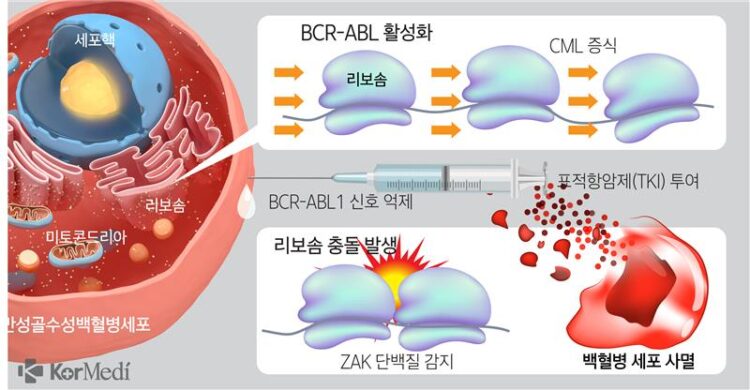
Currently, CML treatment centers on TKIs that suppress BCR::ABL1, the gene responsible for the disease. While effective, these drugs can result in reduced response rates or the development of resistance in certain patient populations.
According to the research team, the ZAK protein typically promotes the proliferation of leukemia cells. However, during targeted therapy, its function reverses, driving the cells toward death. The team explained that ZAK acts as a molecular sensor that detects the therapeutic environment and pivots the cellular response accordingly. The study further revealed that in cells lacking the ZAK protein, the efficacy of targeted drugs was significantly reduced—a finding consistent in both laboratory models and patient-derived cells.
The research was published in the latest online issue of Leukemia, a prominent international academic journal in the field of hematology.
“The level of ZAK protein expression is closely associated with the progression stage of chronic myeloid leukemia, meaning it could serve as a vital indicator for predicting disease behavior or monitoring treatment response,” said Professor Kim Dongwook. “In the future, we expect to design personalized treatment strategies for patients based on their specific ZAK protein levels and sensitivity to ribosome collisions.”