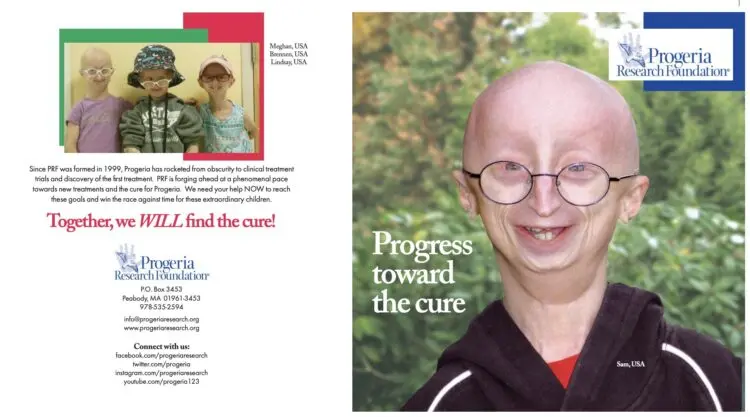
"Not long ago, we published this translation in memory of the progeria patient who sadly left us and became a 'star in the sky.'
The medical staff at Inha University Hospital shared these sentiments on the 9th while distributing the Korean version of the 'Progeria Handbook' to the world through the Progeria Research Foundation's website.
The revised Korean translation of the 'Progeria Handbook' is the result of a talent donation by the medical staff of the Rare Disease Management Project Team and the Biomedical Research Institute at Inha University Hospital. This work goes beyond a simple translation of the existing handbook containing internationally accepted clinical guidelines; it also includes tests and support that can be conducted for domestic progeria patients, as well as medical advice, making it a 'Korean Practical Guideline.'
Progeria, an extremely rare disease with fewer than 10 patients in the country
Progeria is a disease that causes the body to age rapidly, occurring in approximately 1 in 20 million people. It is also the disease that the character 'Areum,' played by Kang Dong-won and Song Hye-kyo in the movie 'My Life's a Mess' (2014), experienced.
It is known that there are fewer than 10 patients aged 5 to 20 in the country. The medical staff at Inha University Hospital had to say goodbye to another progeria patient during the clinical trial process last year, just before the revision of the 'Progeria Handbook.'

Progeria patients appear healthy at birth, but rapid aging symptoms appear within the first 1 to 2 years of life. They do not grow in height, their eyes bulge, and aging progresses rapidly with skin aging and hair loss, leading to an average death age of 14.5 years.
Rare and incurable genetic disease of unknown cause, with early heart disease as the main cause of death
The cause of the disease is a randomly occurring mutated gene in the body. This mutation produces an abnormal protein called progerin, which causes the body's tissue cells to age rapidly. Progeria patients die from diseases such as arteriosclerosis, myocardial infarction, and stroke, which are typically experienced by the elderly, at a young age. According to the World Health Organization (WHO), heart disease is the leading cause of death among progeria patients worldwide.
There is currently no cure for progeria. Although there is one treatment approved by the U.S. Food and Drug Administration (FDA), it costs about 1.4 billion won per dose and is known to only extend life by about 2.5 years. Currently, some domestic and international researchers are continuing to conduct gene research and stem cell therapy for the treatment of progeria.
Professor Lee Ji-eun from the Department of Pediatrics at Inha University Hospital, who participated in the translation of the 'Progeria Handbook,' stated, "I hope the Korean version of the handbook will be of practical help to progeria patients and medical staff," and added, "As one of the medical staff researching and treating progeria, I will continue to provide warm support so that patients can dream of a better tomorrow."
The full text of the revised Korean version of the 'Progeria Handbook' can be found on the Progeria Research Foundation's website (www.progeriaresearch.org).