Office workers struggle every day at lunchtime. It may seem trivial, but the choice of lunch greatly affects vascular health. Many office workers in our country relieve work stress with spicy, salty, and greasy foods. It is a kind of lunch culture. If this habit accumulates, it becomes a 'vascular time bomb' that leads to high blood pressure and hyperlipidemia.
In particular, the proportion of soup dishes in Korean dining out menus is high. As a result, sodium intake exceeds twice the recommended amount by the World Health Organization (WHO). This is something office workers should pay special attention to as the new year begins.
Based on the nutritional data from the Ministry of Food and Drug Safety and recent research published in international journals, we selected and analyzed five lunch menus that promote vascular health and five that harm it. Foods harmful to vascular health include jjamppong, budae jjigae, kalguksu, jajangmyeon, and je-yuk deopbap, while foods good for vascular health include grilled fish set meal, bibimbap, hoe-deopbap, ssambap set, and sundubu jjigae. The selection criteria for good vascular health menus are not based on 'taste'. The focus is on low sodium and saturated fat content, and high dietary fiber, unsaturated fatty acids, and plant-based protein content.
“Restaurant owners can help office workers’ health”… Just make the broth less salty or add more vegetables
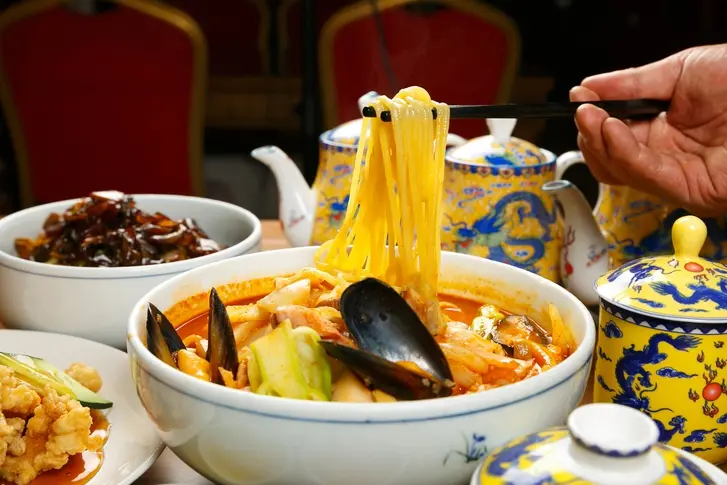
The number one bad lunch menu for vascular health is analyzed to be jjamppong. According to a survey by the Ministry of Food and Drug Safety, one bowl of jjamppong (based on 1000g) contains 4000mg of sodium. If you drink all the broth, you are consuming double the WHO's daily recommended intake (2000mg). Due to the spicy broth flavor, you may not feel the saltiness, but excessive sodium pulls water into the blood vessels, causing a rapid increase in blood pressure.
The second worst lunch menu is budae jjigae. Processed meats like ham and sausage contain sodium nitrite and saturated fats that can cause cancer. A study published by the University of Hong Kong in the international journal 《European Heart Journal》 (July 2023) also showed that as processed meat intake increases, the risk of cardiovascular disease and mortality significantly rises.
The third is kalguksu. Kalguksu has high salt content in the broth itself, but the refined wheat noodles cause a 'blood sugar spike'. The fourth is jajangmyeon, and the fifth is je-yuk deopbap. Jajangmyeon contains a lot of sugar and oil during the cooking process, and its high carbohydrate content increases triglycerides. Je-yuk deopbap, with its sweet and salty seasoning and greasy cooking method, can increase insulin resistance, raising the risk of diabetes.
Good lunch menus for protecting blood vessels… Grilled fish set meal, bibimbap, hoe-deopbap, ssambap, sundubu jjigae, etc.
On the other hand, the best lunch menu for protecting blood vessels is the grilled fish set meal. Omega-3 fatty acids abundant in mackerel and Spanish mackerel are excellent at lowering blood triglycerides and suppressing blood clot formation. The American Heart Association (AHA) strongly recommends consuming fish at least twice a week.
The second best lunch menu is bibimbap. It allows for the intake of various vegetables at once, and the dietary fiber in the vegetables helps suppress blood sugar spikes and aids in cholesterol excretion. However, it is best to use as little gochujang as possible. Those who mix it can control the amount, so it is not a big problem. The third is hoe-deopbap. It is an excellent menu that allows for the consumption of fresh raw fish and vegetables. Reducing the amount of rice by half and increasing vegetable intake will enhance the effect.
The fourth is ssambap set. Even if you eat meat, adding plenty of wrapping vegetables can reduce the absorption of saturated fats and increase satiety, preventing overeating. Finally, the fifth is sundubu jjigae (clear broth) or tofu dishes. According to research published by the National Cancer Institute (NCI) in the international journal 《JAMA Internal Medicine》 (July 2020), a higher intake of plant-based protein is associated with a lower risk of premature death. However, it is better to choose clear soups or tofu stir-fries rather than spicy sundubu.
“Focus on solid ingredients for the broth, eat only half a bowl of rice, and add as many vegetables as possible”
Experts advise that by simply following three principles when choosing lunch menus: ▶ focus on solid ingredients for the broth ▶ eat only half a bowl of rice ▶ add as many vegetables as possible, you can reduce fatigue during afternoon work hours and protect vascular health. Additionally, restaurant owners can also participate in protecting office workers' vascular health by willingly accepting customers' requests to make it less salty or by adding more vegetables instead of serving less broth.
[Frequently Asked Questions]
Q1. Is it really okay to leave the broth of soup dishes like jjamppong and just eat the solid ingredients?
A1. Yes, it is the most realistic alternative to protect vascular health. According to a survey by the Ministry of Food and Drug Safety, about 60-70% of the sodium in soup dishes like jjamppong or kalguksu is dissolved in the broth. If you focus on the noodles and solid ingredients and leave the broth, you can reduce sodium intake to less than half. Additionally, developing the habit of eating rice separately without mixing it in the broth can greatly help prevent a rapid rise in blood sugar after meals.
Q2. If I drink a lot of water after eating spicy and salty food, will sodium be expelled immediately?
A2. Drinking water helps, but it is not a fundamental solution. Water dilutes the sodium concentration in the blood, but it does not effectively 'push' sodium out of the body. To expel sodium, foods rich in potassium are needed. If you eat salty food for lunch, it is much more effective to eat bananas or tomatoes for dessert or to include green vegetables like broccoli or spinach in your dinner than just drinking water.
Q3. The grilled fish, which is the 'best' lunch menu, is delicious with crispy skin; can I eat it all?
A3. It is best to remove the burnt parts as much as possible. Fish skin is rich in omega-3 fatty acids, but if the skin turns black during direct grilling, carcinogenic substances like benzo[a]pyrene may be produced. Especially, fish skin that is fried until crispy can increase the levels of advanced glycation end products (AGEs), which can cause inflammation, so it is most beneficial for blood vessels to focus on the flesh or choose steaming methods.