Today’s topic is the long-running, fiercely contested debate over umami. Using gyokuro tea as our material, I will reflect from the perspective of the philosophy of science, focusing solely on the vocabulary word “umami.”
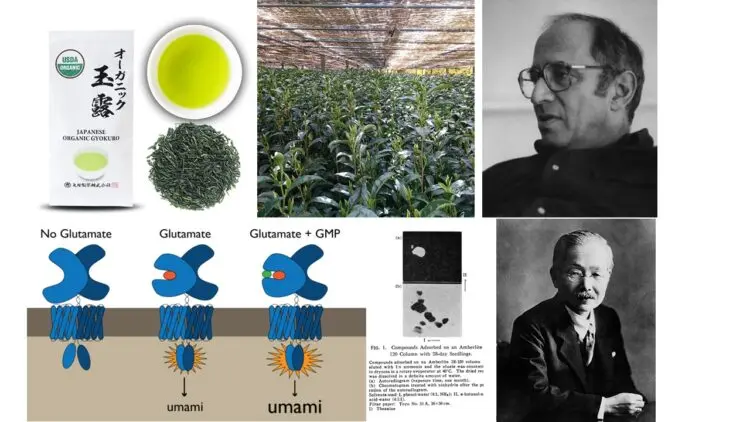
Gyokuro tea (Jade Dew Tea) is a green tea with a strong umami taste. It is produced in Uji, Japan. For centuries, it has been made from leaves grown under shade by blocking sunlight before plucking.
The reason its umami is so strong is that the tea leaves contain a high level of the amino acid “theanine.” Theanine helps enhance the umami of tea leaves. In ordinary tea leaves, when exposed to sunlight, theanine is converted into the polyphenol compound “catechin”; blocking sunlight prevents theanine from being converted into catechin.
However, umami was recognized as a basic taste by the global scientific community only in the 21st century. Theanine and catechin are also substances that became known only with modern chemistry. These facts are the starting point for reflecting on the umami debate.
Until the 20th century, was there no concept of umami as a 5th taste?
From the 16th century, in Japan, experience accumulated that shading tea leaves from sunlight made the taste smoother and sweeter. This became practical knowledge, and tea growers blocked sunlight to increase umami.
Shade cultivation began even before there was a word for “theanine.” It was later discovered that shade cultivation increases the content of the amino acid theanine and strengthens umami. More importantly, until 1908, the very concept of “umami” as a taste was not included in the vocabulary of science.
The umami debate vividly demonstrates one of the key points Thomas Kuhn made in 『The Structure of Scientific Revolutions』: the proposition that “science operates on top of a linguistically articulated world.” A “linguistically articulated world” means that every observation, experiment, and conclusion handled by science already takes place within concepts and categories that a society and community have agreed upon through language. A phenomenon without a name is, scientifically speaking, as good as nonexistent.
Through shade cultivation, tea people knew the changes in tea with their tongues and bodies. When light is blocked, bitterness decreases and a gentle “depth” emerges. But in the tea people’s language at the time, there was no scientific term “umami”; instead, there were only everyday expressions such as “smooth,” “mild,” and “nutty.”
From Kuhn’s perspective, the umami of this period was an “unarticulated reality.” The sensation clearly existed, but because it had not been incorporated into a public linguistic system through which science could describe and exchange it, it could not be recognized as an academic or institutional reality. In other words, the tea people’s experience unfolded outside science’s language game.
In 1908, Ikeda Kikunae isolated glutamic acid from kelp broth and named that taste “umami.” He commercialized it in the form of the seasoning “Ajinomoto” and released it to the global market.
Only then did “umami” become a public term and get thrown into the center of controversy. In Kuhn’s analysis, this act of naming is not merely assigning a label. It was “an act of creating a new world.” The name “umami” fixed and presented the category of taste it referred to, and demanded a new system of taste classification.
At the time, the Western-centered scientific community still stood on the four basic tastes: sweet, salty, sour, and bitter. The emergence of “umami” meant that a taste previously explained only as something like “a mixture of salty and sweet” became a provisional candidate for an “independent fifth taste.”
However, through long-standing psychophysics experiments, textbooks, and education, taste had been fixed as four “basic tastes.” Accepting a new taste category was not a simple addition; it was an extremely complex task that required rewriting the entire structure of experimental design and theory.
Japan’s “umami” vs. the West’s “savory”
Here Kuhn’s proposition works sharply. The way scientists see the world is shaped by the conceptual language they use. For Western scientists, “umami” was a foreign term that did not translate into laboratory language.
Although the word “umami” appeared, it was connected only to Japanese culinary culture, and Western experimental traditions were not prepared to construct it as an independent sensory category. In Japan, umami was a taste with substance; in the West, it was still merely a blended flavor in which saltiness and sweetness were mixed.
Another of Kuhn’s insights is that language drives the development of scientific tools. In an era without the concept of “umami,” there was no reason to develop tools to measure or experiment on it. After the concept of “umami” emerged, Japan rapidly advanced experimental designs, sensory evaluation techniques, and chemical analyses to support it.
Unlike Japan, where the emergence of language created direction for observation, analysis, and measurement, Western laboratories had no designs to isolate the perceptual characteristics of glutamic acid as an independent taste. Phenomena such as synergy (glutamic acid + nucleotides) were treated as “mixture effects.” From this point, the West and Japan came into strong conflict over whether umami was real.
The umami clash was not simply a “difference in data interpretation.” At the time, translation of umami between the two language systems was impossible. Kuhn says that if scientists belong to different paradigms, they may even use the same word yet refer to different things.
In the umami debate, the Japanese word “umami” was a clear, independent category that Japanese people had experienced through culinary practice. But the Western word “savory” was merely a loose category referring to an overall flavor in which aroma, saltiness, and richness were mixed. The West’s “savory” could not accurately translate Japan’s “umami,” and this mismatch directly affected experimental design and data interpretation.
Thomas Kuhn, “Science operates on top of a linguistically articulated world”
Let’s return to gyokuro tea. The umami that tea people experienced while drinking gyokuro tea entered the newly emerged taste category called “umami” only in 1908. Until then, the tea people’s experiential knowledge could not be translated into the language of science.
The fact that shade cultivation increases theanine content and, as a result, raises umami was demonstrated more than 60 years later through pioneering research by Kito and others in 1966.
However, until the end of the 20th century, umami was treated as virtually nonexistent in arenas of international academic exchange. This directly shows what Kuhn called the “dependence of observational language on theoretical language.” For observation to be established, a language to contain that observation is necessary. In Western societies that lacked the language of umami, this taste was not recognized either.
Scientific language is not a neutral medium that records facts; it reflects institutional and cultural power. The “four tastes” paradigm was firmly entrenched within the West’s long-standing structures of education, publishing, and peer review. Introducing a new concept term would require a reorganization of authority and institutions. It was impossible for Western taste science of the time to recognize “umami” by referencing Japanese culinary culture.
Still, the end approached. In the early 21st century, umami receptor proteins were identified. Psychophysics experiments also showed that umami is not a mixed taste but an independent one. At last, umami was recognized as a basic taste in the international scientific community. Umami was incorporated into the conceptual systems of industry and academia.
And Japan’s traditional food culture “washoku,” based on umami, was inscribed in 2013 as a UNESCO Intangible Cultural Heritage of Humanity. Now no one doubts that “umami exists.”
If the language of umami had not existed, a substantial portion of the experimental data, industrial technology, and culinary knowledge we have today might never have emerged at all. Language does not merely describe reality; it creates reality, sets the direction of inquiry, and makes certain things exist. The umami debate confirms the proposition that “scientific facts exist only within the vessel called ‘language.’”
At the same time, it also suggests that practical knowledge that has not been put into language must wait an unnecessarily long time to be scientifically recognized. Even methods already validated in life, like shade cultivation, can be accepted late by the establishment because of language barriers.
In retrospect, the umami debate is a case in which experiential knowledge preceded scientific knowledge. Tea people drank, enjoyed, and passed on a taste that, to science, “did not yet exist.” They described it as subtle and simply smooth, but they were pioneers who opened the door of perception early.
Language followed later. This taste acquired the name “umami” in 1908, and it took a century after that for a conceptual system capable of translating umami to be established.
Only now has umami become a taste that is real to people around the world. Tea people who already knew umami before it was recognized by the scientific community and the world were fortunate beneficiaries who enjoyed an extra bonus that others did not know about early on.
The history of the umami debate teaches that tastes, sensations, and phenomena that are still outside our vocabulary even now may still be waiting to be put into language.
Yoo Young-hyun, Tea Clinic Director (Audio column 1+1 Story https://www.youtube.com/@yhyoo0906)