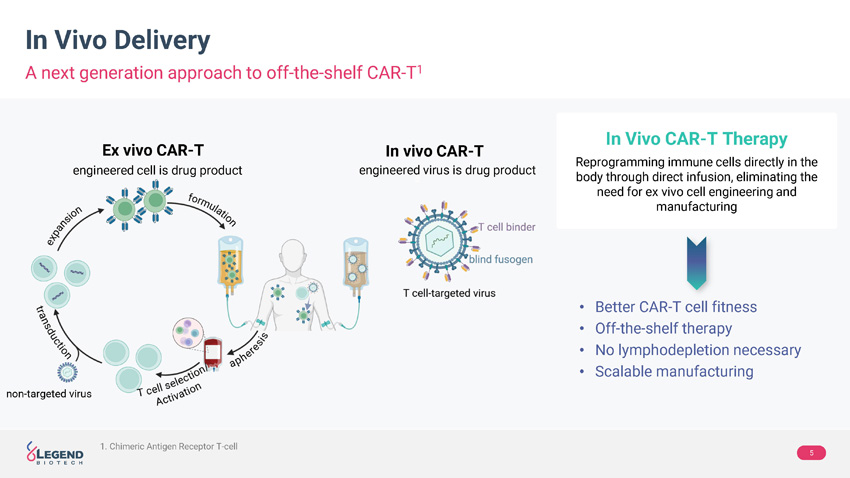
CAR-T therapy for blood cancers conventionally involves removing a patient’s immune cells, modifying them in a laboratory to attack cancer cells, and reinfusing them into the body. Now, a next-generation treatment designed to eliminate this complex manufacturing process by creating cancer-fighting immune cells directly inside the patient is set to enter clinical trials in the United States.
U.S.-based Legend Biotech announced on the 15th (local time) that the Food and Drug Administration (FDA) has cleared its investigational new drug (IND) application for LB2501, allowing a Phase 1/2 clinical trial to move forward in the U.S. The trial will enroll patients with relapsed or refractory blood cancers, including B-cell non-Hodgkin lymphoma.
CAR-T is a cancer immunotherapy that equips a patient’s T cells to recognize and destroy cancer cells. While conventional approaches require extracting T cells for off-site genetic modification, LB2501 uses a single infusion of a gene-delivering lentiviral vector to transform T cells into CAR-T cells directly within the body. The vector acts as a specialized carrier engineered to harness a virus’s gene-delivery mechanism without being able to replicate.
LB2501 simultaneously targets two surface proteins on cancer cells: CD19 and CD20. This dual-targeting approach ensures that if a cancer cell loses one target, the therapy can still strike via the other. According to Legend Biotech, this marks the first time the FDA has cleared a clinical trial for an in vivo CAR-T therapy targeting both proteins.
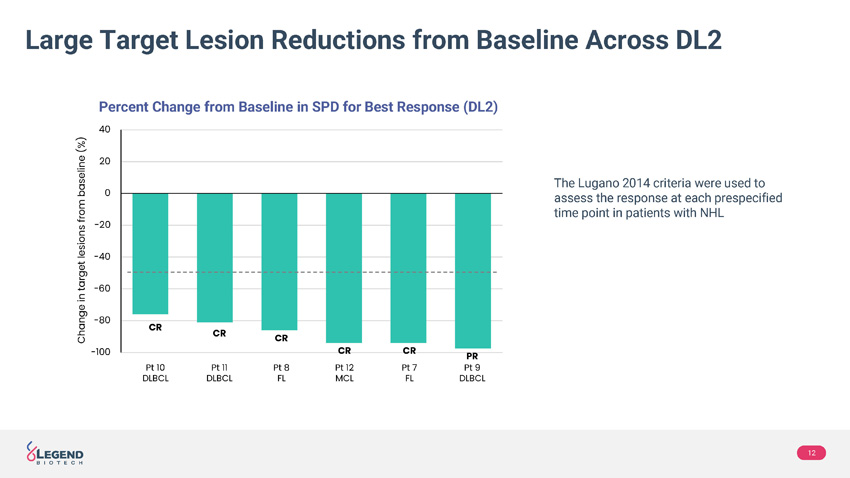
In an earlier-stage trial conducted in China, the treatment demonstrated tumor reduction and clearance. According to Phase 1 data presented at the European Hematology Association (EHA) congress in June, six of 12 patients (50%) with relapsed or refractory B-cell non-Hodgkin lymphoma achieved an objective response, with five (41.7%) reaching complete remission.
All six patients in the higher-dose cohort responded to the treatment, and five achieved complete remission. In contrast, none of the six patients in the lower-dose cohort showed an objective response.
Conventional CAR-T treatments typically require patients to undergo lymphodepleting chemotherapy prior to infusion to clear space for the new cells to multiply. In the LB2501 trial, patients received the therapy without lymphodepletion pretreatment, yet CAR-T cell expansion was still observed in all six patients in the high-dose group.
In safety assessments, 11 of 12 patients (91.7%) experienced grade 3 or higher adverse events, primarily driven by decreased blood cell counts. This total includes all treatment-emergent adverse events regardless of drug causality.
Cytokine release syndrome (CRS)—a systemic inflammatory reaction triggered when immune cells become activated—occurred in eight patients (66.7%). All cases were mild to moderate (grade 1 or 2), with no severe cases of grade 3 or higher reported.
However, the researchers noted key limitations, including the small sample size of 12 patients and a short median follow-up of 2.3 months in the high-dose group. Further studies will be needed to evaluate the durability of complete remissions and determine whether the approach offers superior safety and efficacy compared to traditional CAR-T therapies.