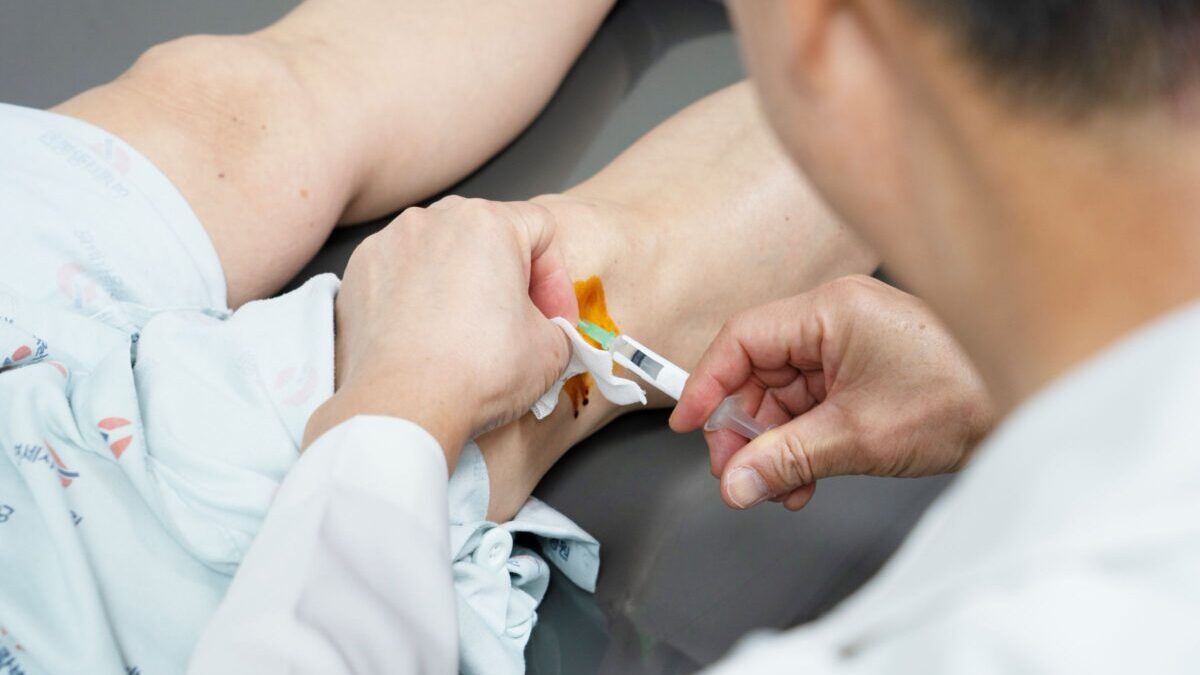
Patients with moderate knee osteoarthritis who received injections of stromal vascular fraction (SVF) isolated from their own adipose tissue experienced lower disease progression over one year compared to those who underwent arthroscopic treatment, according to a recent study.
The SVF injection group also reported lower pain levels at 6 and 12 months post-treatment.
However, because the analysis evaluated retrospective outcomes from previously treated patients, the findings alone do not definitively prove that SVF injections halt osteoarthritis progression.
Yonsei Sarang Hospital, a joint-specialty hospital designated by the Ministry of Health and Welfare, announced on the 10th that it compared 12-month clinical outcomes between moderate knee osteoarthritis patients treated with autologous fat-derived SVF injections and those who underwent arthroscopic surgery.
Comparing Matched Patient Cohorts
The research team initially identified 441 patients who met the study criteria between April 2022 and June 2025—217 in the arthroscopy cohort and 224 in the SVF injection cohort. All participants were classified as Stage 2 or 3 on the Kellgren-Lawrence (K-L) grading scale, an X-ray classification system ranging from Stage 0 to Stage 4 based on joint-space narrowing and bony changes.
To minimize baseline variables such as age, body mass index (BMI), sex, and initial pain severity that could skew post-treatment results, researchers applied propensity score matching (PSM). The statistical process created a balanced comparison group of 108 patients: 54 in the arthroscopy group and 54 in the SVF group.
Pain Relief Diverges After Six Months
Pain levels were evaluated using the Visual Analog Scale (VAS), where higher scores indicate greater pain. Through the first three months following treatment, both groups showed comparable pain reduction with no significant difference.
A clear gap emerged at six months. The average VAS pain score was 2.8 in the arthroscopy group compared to 2.5 in the SVF group. At 12 months, scores were 3.5 in the arthroscopy group and 2.9 in the SVF group. The research team noted that the SVF group's pain scores were statistically significantly lower at both the 6- and 12-month evaluations.
Lower Progression Rates at One Year
The most pronounced difference occurred in the rate of radiographic disease progression, defined as an increase of at least one K-L grade over the 12-month period.
In the arthroscopy group, disease progression occurred in 31.5% of patients (17 out of 54), compared to 3.7% (2 out of 54) in the SVF group. Additionally, four patients in the arthroscopy group eventually underwent total knee arthroplasty, whereas none in the SVF group required joint replacement.
However, researchers cautioned that because the total number of joint replacement conversions was small, the data alone cannot conclusively prove that SVF therapy reduces the long-term risk of total knee surgery.
Understanding SVF and Study Scope
SVF utilizes a combination of cellular components harvested from a patient's own fat tissue. While often categorized alongside stem cell therapy, SVF does not isolate a single adipose-derived stem cell type. Instead, it consists of a cellular mixture that includes connective tissue cells and vascular-related cells. These cells are thought to modulate inflammation and improve the tissue environment within damaged joints.
Arthroscopic treatment, by contrast, involves inserting a small endoscope into the knee joint to inspect and repair structural causes of pain, such as torn menisci or damaged cartilage.
The study authors emphasized that the findings should not be interpreted as definitive proof of one treatment's superiority over the other. Because the study retrospectively analyzed historical patient records rather than randomly assigning participants in a prospective clinical trial, unmeasured confounding factors could still influence the results despite propensity score matching.
Ko Yong-gon, director of Yonsei Sarang Hospital, said, “While both treatments provided early pain relief, the SVF group maintained lower pain scores at 6 and 12 months, and exhibited a substantially lower rate of radiographic disease progression over the one-year period.”
Ko added, “Because this is a retrospective observational study, unmeasured potential factors cannot be completely ruled out even after propensity score matching. Rather than drawing overly definitive conclusions based solely on these observational data, there is a clear need to rigorously verify long-term efficacy through future large-scale prospective randomized controlled trials.”