
While the heart pumps blood throughout the body, the cardiac muscle itself relies on a continuous supply delivered not only by large coronary arteries on its surface but also through a vast network of tiny microscopic vessels. When these microvessels fail to function properly, the health consequences can be severe.
A multicenter study in South Korea has found that patients with impaired function in these microvessels face nearly twice the risk of death, myocardial infarction, and other major cardiovascular events compared to those with healthy microvascular function.
Samsung Medical Center announced on Sept. 7 that measuring "microvascular resistance reserve" (MRR) can help identify long-term risk in patients with suspected coronary microvascular dysfunction. The joint study—led by Prof. Lee Ju-myeong of Samsung Medical Center alongside Prof. Lee Seung-heon, Prof. Ahn Jun-ho, and Prof. Hong Young-joon of Chonnam National University Hospital—analyzed 1,003 patients across seven South Korean medical institutions. The findings were published online Aug. 28 in the European Heart Journal.
Uncovering Hidden Ischemia Beyond Large Arteries
Coronary microvascular dysfunction (CMD) is a condition in which the small blood vessels supplying the heart muscle cannot dilate adequately during increased physical demand. Even without obvious blockages in the major coronary arteries, an insufficient microvascular response leaves the heart muscle short of oxygen—a state known as myocardial ischemia. This can cause persistent chest pain, yet standard coronary angiography often fails to identify the underlying cause.
Clinicians have traditionally evaluated microvascular function using metrics such as coronary flow reserve (CFR) and the index of microvascular resistance (IMR). In recent years, microvascular resistance reserve (MRR) has gained traction as a streamlined metric. MRR reflects how effectively microvessels lower vascular resistance when the heart requires extra blood flow; a lower value indicates a reduced capacity to increase blood delivery. Previous research established an MRR threshold of 2.5 or lower to identify abnormal function.

Elevated Risk Confirmed Across 1,000 Patients
To determine whether MRR corresponds to real-world outcomes, researchers tracked 1,003 patients who underwent coronary angiography and physiological testing for suspected ischemic heart disease between April 2022 and November 2024.
Patients were categorized into the microvascular dysfunction group if their MRR was 2.5 or lower in at least one tested coronary artery. This placed 334 patients (33.3%) in the dysfunction group, while the remaining 669 patients were classified as having preserved function.
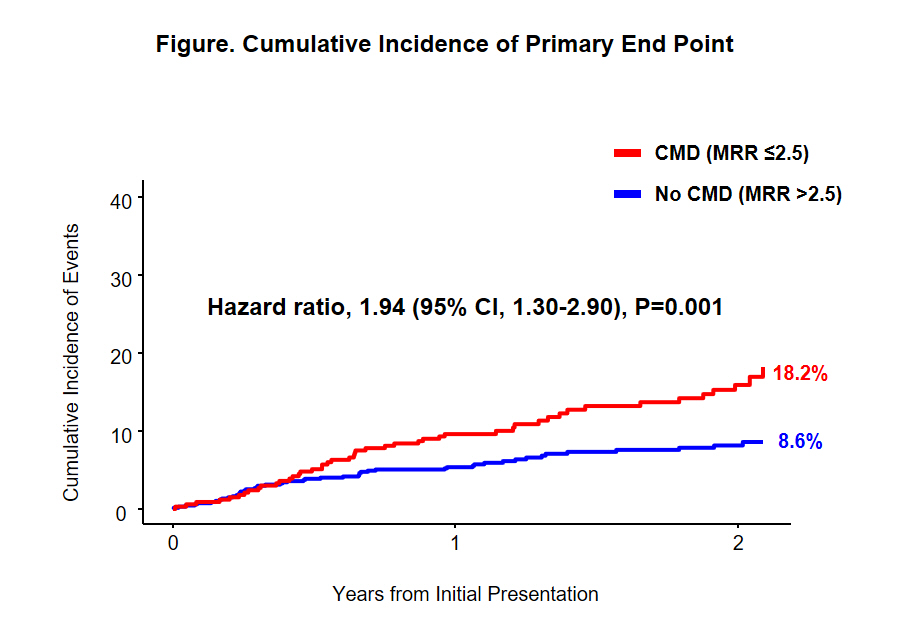
Over a median follow-up of 1.9 years, researchers tracked a composite endpoint comprising all-cause death, myocardial infarction, repeat revascularization, and hospitalization for heart failure. Overall, 47 patients in the dysfunction group and 49 in the preserved-function group experienced such events. Adjusting for varying follow-up periods, the estimated two-year event rate was 18.2% in the microvascular dysfunction group compared to 8.6% in the preserved group.
Unadjusted analysis showed a 1.94-fold higher event risk for patients with impaired microvascular function. After adjusting for multiple clinical variables, including age, the risk remained 1.78 times higher.
The researchers noted that because this was an observational study demonstrating association rather than direct causation, further research is required to confirm whether altering treatment strategies based on MRR values directly reduces mortality or heart attacks.
Diagnostic Implications and Comparative Insights
The clinical takeaway is clear: the absence of severe narrowing in large coronary arteries does not guarantee that heart vessel function is entirely normal. Patients experiencing recurrent chest pain or shortness of breath during exercise despite normal angiography results may be suffering from impaired microvascular function. MRR is not intended for routine health checkups, but rather for symptomatic patients undergoing angiography and physiologic testing.
The cohort in this study represents the same 1,003 patients from the "FLOW-CMD" registry, published by the research team in The Lancet in May. In that earlier study, microvascular dysfunction was defined using combined CFR (below 2.0) and IMR (25 or higher) thresholds, identifying 163 patients (16.3%). Reanalyzing the same group using the MRR threshold of 2.5 or lower identified 334 patients (33.3%), demonstrating how single-metric evaluation expands clinical capture based on differing physiological parameters.
"We demonstrated the feasibility of evaluating microvascular dysfunction—traditionally assessed using multiple combined indicators—more simply through a single metric, MRR," said Prof. Lee Seung-heon. "Confirming that this metric correlates directly with actual patient outcomes is a meaningful advancement."
Lead investigator Prof. Lee Ju-myeong added, "Because coronary microvascular dysfunction cannot be detected by standard angiography alone, diagnosing the root cause of chest pain has long been challenging. We hope these findings will help establish a clearer standard for precise diagnosis and risk assessment."
The findings were also presented during the "Latest Clinical Research on Managing Coronary Microvascular Disease" session at the European Society of Cardiology annual meeting (ESC Congress 2026) in Munich, Germany, on Aug. 28.