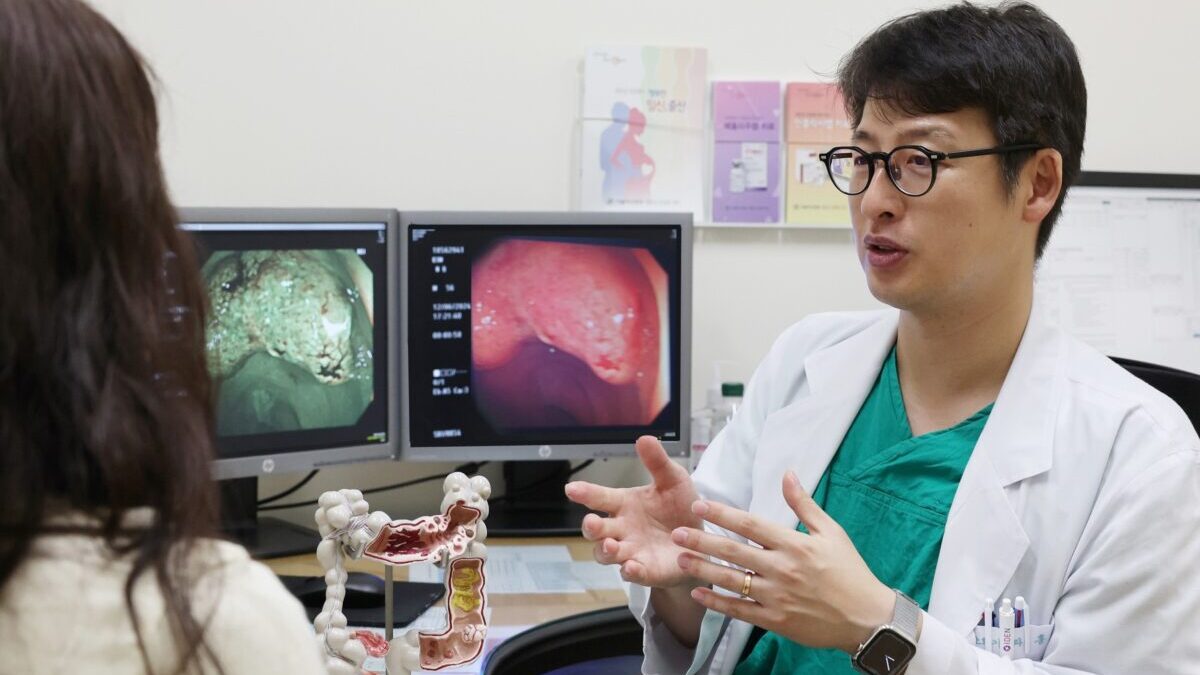
For many people, colorectal cancer screening feels daunting from the start. South Korea’s national cancer screening program relies on the fecal occult blood test, which requires collecting a stool sample at home. If the result is abnormal, patients must undergo a colonoscopy—a procedure requiring dietary restrictions and bowel preparation the day before.
A joint study by South Korean researchers offers a promising, less invasive alternative: detecting colorectal cancer through a simple blood draw. Using an artificial intelligence (AI) system that analyzes DNA fragments circulating in the bloodstream, researchers identified about nine out of ten colorectal cancer patients, including 84.2% of early-stage cases. However, researchers cautioned that the approach is not yet ready to replace established national screening programs or colonoscopies.
Asan Medical Center announced on Aug. 27 that a research team led by Professors Byun Jung-sik and Hong Seung-wook of its Division of Gastroenterology, in collaboration with GC Genome, published the findings in The American Journal of Gastroenterology.
AI Decodes DNA Traces Left by Cancer Cells
When cells die, fragments of their genetic material—known as cell-free DNA (cfDNA)—enter the bloodstream. DNA fragments released by cancer cells differ from normal cell-free DNA in length, genomic breakpoint patterns, and end-sequence characteristics.
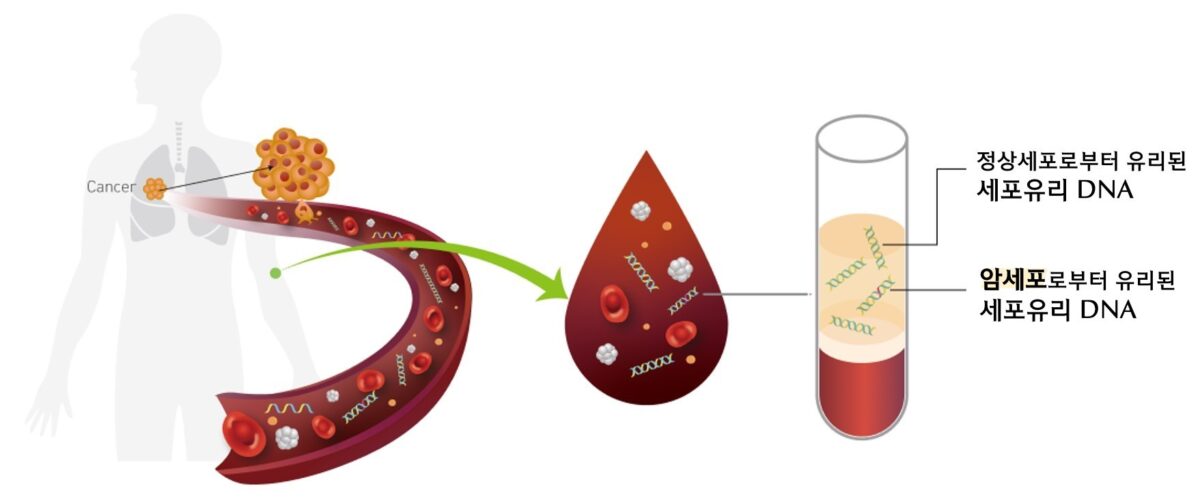
Building on these genomic differences, the research team developed an AI model that evaluates multiple fragment features simultaneously to detect subtle patterns indicative of cancer.
The study analyzed 1,677 participants: 302 colorectal cancer patients, 108 patients with high-risk precancerous polyps (advanced colorectal adenomas), and 1,267 individuals confirmed healthy via colonoscopy. Data from 1,250 participants was used to train the AI model, while a separate validation cohort of 427 individuals was tested to evaluate its diagnostic accuracy.
The blood test demonstrated a diagnostic sensitivity of 90.4% for colorectal cancer, correctly identifying roughly nine out of ten patients. Its specificity reached 94.7%, accurately classifying nearly 95 out of 100 healthy individuals.
Early-Stage Detection and High-Risk Polyps
The test maintained high sensitivity across disease stages: 84.2% for Stage 1, 85.0% for Stage 2, 94.4% for Stage 3, and 100% for Stage 4. For early-stage colorectal cancers that can be removed endoscopically, sensitivity reached 90.0%.
The study also assessed the test's ability to identify advanced colorectal adenomas—precancerous polyps that carry a high likelihood of malignant transformation. The blood test detected 58.3% of these high-risk lesions, compared to typical detection rates of 25% to 40% for traditional fecal occult blood tests.
While the blood test showed higher overall sensitivity for cancer (90.4%) than historical benchmarks for stool tests (70% to 80%), researchers emphasized that the study was not a direct head-to-head comparison on the same patient cohort.
Early detection remains crucial for survival. According to the Korea Central Cancer Registry, 32,610 new colorectal cancer cases were diagnosed in South Korea in 2023, making it the third most common cancer. The five-year relative survival rate stands at 94.9% when the disease is localized, but plummets to 20.4% once it metastasizes to distant organs.

Addressing Low Screening Participation
The primary advantage of blood-based testing lies in patient convenience. Eliminating stool collection and bowel preparation could significantly lower barriers to screening. National Health Insurance Service data cited by Asan Medical Center shows that the participation rate for South Korea's national colorectal cancer screening program was 44.4% in 2025—the lowest among major national cancer screening programs.
“This study demonstrates the potential to reduce the burden patients experience with existing screening methods by enabling convenient colorectal cancer screening through a single blood draw,” said Byun Jung-sik, director of the Gastrointestinal Endoscopy Center at Asan Medical Center. “Combining the convenience of liquid biopsy with AI technology could make colorectal cancer screening far more accessible.”
Despite these promising results, hurdles remain before clinical adoption in routine health checkups. Large-scale prospective trials are needed to validate the test's efficacy in the general asymptomatic population, where cancer prevalence is low. Furthermore, a positive blood test result would not serve as a final diagnosis, but rather as a trigger for follow-up colonoscopy to confirm cancer or remove precancerous polyps.