Major institutional asset managers are steadily increasing their equity stakes in South Korean pharmaceutical and biotechnology companies, drawn by proprietary platform technologies, robust drug candidate pipelines, and expanding international market footprints.
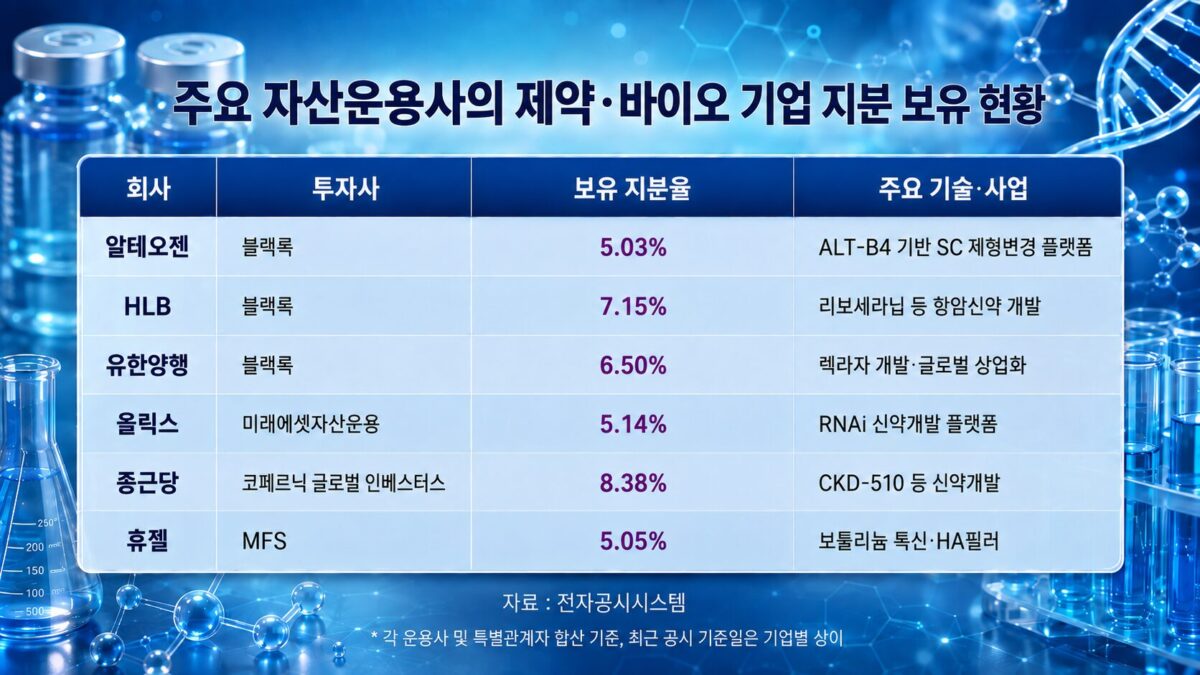
According to regulatory filings, BlackRock Fund Advisors, an affiliate of the world’s largest asset manager, disclosed that it held 2,694,448 shares in Alteogen. After raising its stake from 4.98% (2,670,175 shares) to over 5%, BlackRock triggered mandatory public disclosure requirements. The stated purpose of the holding is passive investment.
Alteogen’s core value lies in its proprietary Hybrozyme platform, which uses the recombinant human hyaluronidase enzyme ALT-B4 to convert intravenous (IV) biologics into subcutaneous (SC) formulations. To date, Alteogen has executed nine licensing agreements for ALT-B4, with cumulative maximum potential deal values—including terminated contracts—reaching $8.829 billion (approximately 12.48 trillion won).
BlackRock’s capital deployment extends well beyond Alteogen. The firm held a 7.15% stake in HLB (9,525,885 shares), up 1.10 percentage points from 6.05%. It also increased its stake in Yuhan Corporation to 6.50% (4,785,125 shares), up 1.43 percentage points over the same period. Yuhan has successfully commercialized its non-small cell lung cancer treatment, Lekraza, as a global therapeutic, while HLB is advancing international development of its targeted cancer drug, rivoceranib.
Expansion Spans RNAi, Traditional Pharma, and Medical Aesthetics
Domestic and foreign institutional investors are also taking substantial positions in specialized biotech and traditional drugmakers. Mirae Asset Global Investments recently reported raising its stake in Olix Pharmaceuticals from 4.85% to 5.14%. Of the additional 62,102 shares acquired, 61,906 were purchased directly on the open market rather than through mechanical ETF creation or redemption. Olix specializes in RNA interference (RNAi) therapeutics designed to silence disease-causing genes.
Among traditional pharmaceutical firms, Chong Kun Dang has seen sustained interest from U.S.-based Copernic Global Investors. After first crossing the 5% ownership threshold late last year, Copernic continued buying shares to boost its stake to 8.38%. Chong Kun Dang possesses strong internal R&D capabilities, highlighted by the 2023 out-licensing of its proprietary HDAC6 inhibitor, CKD-510, to Novartis.
Meanwhile, U.S. asset manager Massachusetts Financial Services Company (MFS) raised its stake in Hugel to 5.05%. Hugel has built competitive manufacturing and quality standards in medical aesthetics, particularly with its botulinum toxin and hyaluronic acid (HA) fillers, which have entered major markets including the United States, China, and Europe.
Passive Investment with Long-Term Structural Significance
These investments highlight a broad strategy targeting platform biotech developers, traditional drugmakers, medical aesthetic leaders, and oncology innovators. The common thread among these Korean companies is their ownership of proprietary platform technologies, successful international out-licensing deals, and active commercialization efforts in global markets.
Because most filings classify these holdings as passive investments, the share purchases do not automatically reflect explicit endorsements of technical capabilities, as portfolio adjustments can also stem from index rebalancing or fund inflows. Nevertheless, the expanding presence of Korean biopharma inside major global portfolios demonstrates that as technology exports and international regulatory approvals accumulate, the sector is increasingly cementing its position as a core asset class for institutional capital.