Medical AI tools designed to assess cardiovascular risk from retinal images and analyze brain scans for stroke severity are set to undergo multi-center clinical validation across South Korean hospitals. The Ministry of Health and Welfare and the Korea Health Industry Development Institute (KHIDI) held a launch ceremony for the "AI Applied Products Rapid Commercialization Support Program (AX-Sprint)" in the digital medical device sector, selecting six operating consortia to receive government backing.
Bridging the Gap Between Approval and Hospital Adoption
Even after receiving regulatory approval from the Ministry of Food and Drug Safety, medical AI tools often face significant hurdles entering clinical practice. Developers must generate real-world evidence demonstrating safety, clinical effectiveness, and cost-efficiency to convince healthcare providers and qualify for National Health Insurance reimbursement. Without insurance coverage, hospitals and patients must pay out-of-pocket, severely limiting clinical adoption.
The AX-Sprint initiative targets this post-approval bottleneck. Running from 2026 to 2027, the program provides up to approximately 1.9 billion won per consortium to support multi-center clinical studies, compile real-world data, and prepare applications for new medical technology assessments and National Health Insurance listing. Each lead company has partnered with at least two medical institutions to build clinical evidence.
Advancing Stroke, Parkinson's, and Cancer Diagnostics
In the brain disease category, consortia led by JLK and Heuron were selected. JLK will deploy its stroke-analysis AI across 22 medical institutions, including Hallym University Sacred Heart Hospital and Seoul National University Bundang Hospital. The software analyzes CT and MR scans—including diffusion-weighted imaging (DWI)—to calculate cerebral blood flow, quantify acute cerebral infarction volume, and identify potential stroke etiologies to guide rapid treatment decisions.
Heuron will validate its Parkinson's diagnostic support tool, "Heuron IPD," across three institutions, including Sinchon Severance Hospital. By analyzing brain MR images to detect the degeneration of nigrosomes—structures within the midbrain substantia nigra involved in motor control—the consortium aims to enhance diagnostic accuracy and reduce unnecessary positron emission tomography (PET) scans.
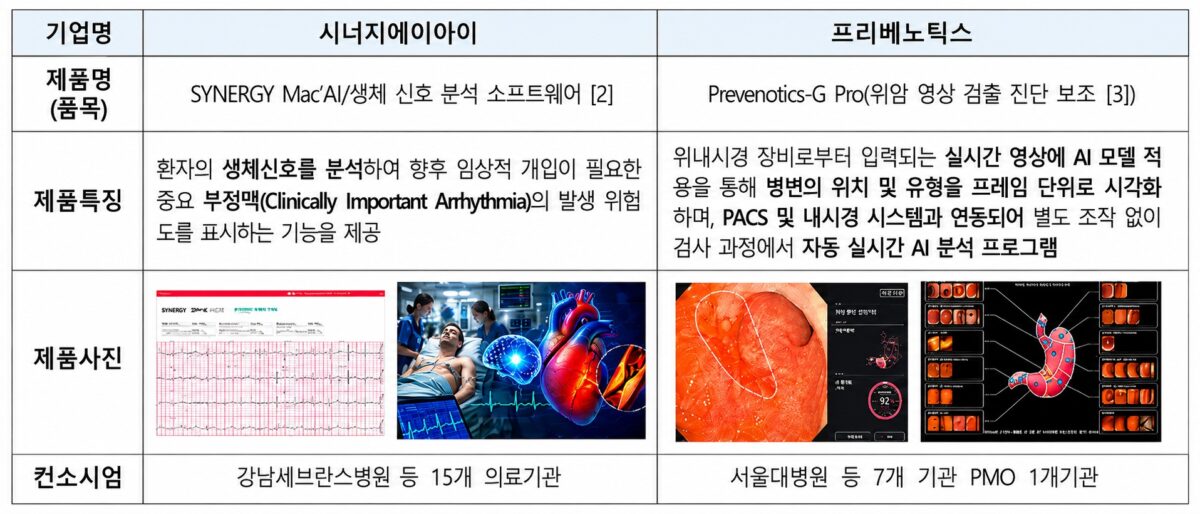
In oncology, Lunit and Prevenotics were chosen to expand cancer screening tools. Lunit will deploy its chest X-ray tool ("Lunit INSIGHT CXR") and mammography software ("Lunit INSIGHT MMG") across 10 medical centers, including Seoul National University Hospital, gathering approximately 250,000 real-world cases to support insurance reimbursement. Meanwhile, Prevenotics will integrate its gastroscopy AI, "Prevenotics-G Pro," into gastroenterology units at seven hospitals. The tool analyzes endoscopy video feeds in real time to highlight precancerous gastric lesions and streamline picture archiving and communication system (PACS) workflows.

Predicting Cardiovascular and Cardiac Risks
In the cardiovascular field, Synergy AI and Mediwhale secured support. Synergy AI’s "SYNERGY Mac’AI" will be tested across 15 university hospitals, including Seoul St. Mary’s Hospital and Korea University Guro Hospital. The system analyzes patient biosignals to predict high-risk arrhythmias, enabling clinicians to prioritize critical cases.
Mediwhale will validate "DrNoon for CVD" across four medical centers, including Sinchon Severance Hospital and Hanyang University Guri Hospital. The AI evaluates cardiovascular disease risk by examining microvascular health in non-invasive retinal fundus photographs, offering a novel screening tool for chronic disease management and pre-operative risk assessment.
The Ministry of Health and Welfare emphasized that these AI applications are designed to assist clinicians in decision-making rather than make autonomous medical diagnoses. By covering clinical validation costs, the government aims to establish a repeatable market-entry pathway and share accumulated data across South Korea's emerging medical AI sector.