

Eating a lot of meat, by itself, does not sharply raise cancer risk. What matters more than the “amount” is the “type.”
A study found that the risk of dying from cancer can vary depending on which kinds of meat people eat most.
Do cancer death rates differ by the type of meat you prefer?
A joint research team from Seoul National University Hospital and Ewha Womans University Seoul Hospital analyzed the relationship between meat-eating habits and cancer-type-specific mortality among about 147,500 Koreans ages 40 and older.
The researchers grouped meat into red meat, chicken, organ meats and processed meats.
Red meat refers to beef and pork. Organ meats are meats made from internal organs such as beef small intestine, beef large intestine, beef abomasum, liver and heart. Processed meats refer to meats that undergo additional processing to improve shelf life, such as sausage, ham, bacon and jerky.
The analysis found that total meat intake — in other words, how much meat people ate — had little association with cancer mortality for both men and women. But when the team broke the results down by meat type, the patterns differed by sex.
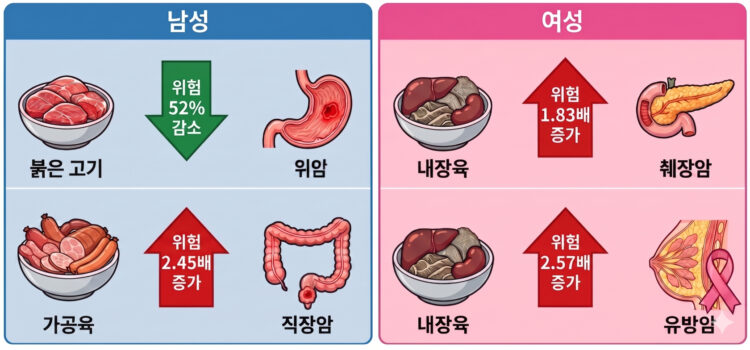
Among men, the top 25% group that consumed the most red meat had nearly half the risk of dying from stomach cancer compared with the bottom 25% group. This trend was particularly pronounced among relatively lean men. Men who ate processed meat had a 2.45 times higher risk of dying from rectal cancer than non-consumers.
Among women, organ-meat intake was linked to mortality. The group that consumed relatively more organ meats (top 50%) had a 2.57 times higher risk of dying from breast cancer and a 1.83 times higher risk of dying from pancreatic cancer than the bottom 25%. This association appeared more clearly among older adults ages 60 and above.
Why these results?
The findings run counter to expectations, given that the global food industry has long circulated statistics suggesting red-meat consumption raises cancer risk.
The research team cited several possible reasons Korean men’s red-meat consumption may have been associated with a lower risk of dying from stomach cancer. Koreans mainly eat red meat grilled. Compared with Westerners, who tend to prefer salted or smoked preparations, Koreans consume less salt and fat.
The team also said the socioeconomic context should be considered. Groups that consume more meat tend to have relatively higher economic status, which may mean they participated more actively in stomach-cancer screening.
For women, the team said organ-meat consumption may be tied to its composition. Organ meats such as liver and beef small intestine contain more heavy metals than ordinary lean meat. Heavy metals typically accumulate in fatty tissue, but if heavy metals leach into the bloodstream during the aging process, they can raise cancer mortality.
Park Min-sun, a professor of family medicine at Seoul National University Hospital, said, “We confirmed that what kind of meat people eat, more than how much they eat, can be related to cancer health,” and added, “A sex-specific approach that takes dietary habits and living environments into account is needed.”
Still, the research team said the findings came from an observational study, making it difficult to draw firm conclusions about a direct causal relationship between meat consumption and cancer mortality. The team said additional research is needed that reflects cooking methods and changes in dietary habits.