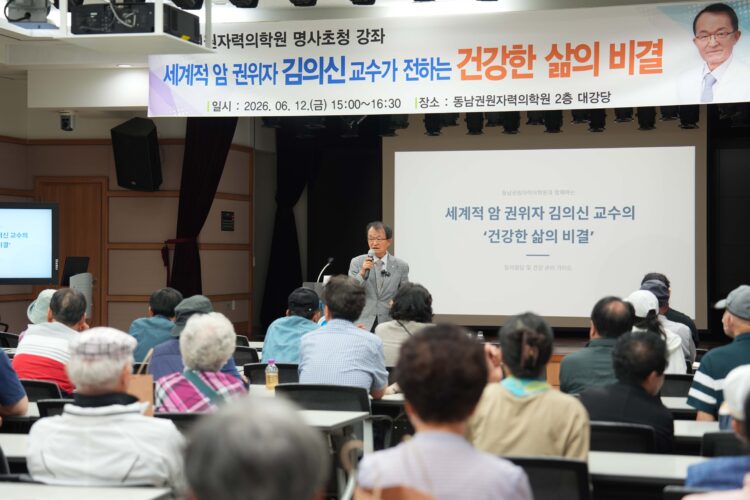
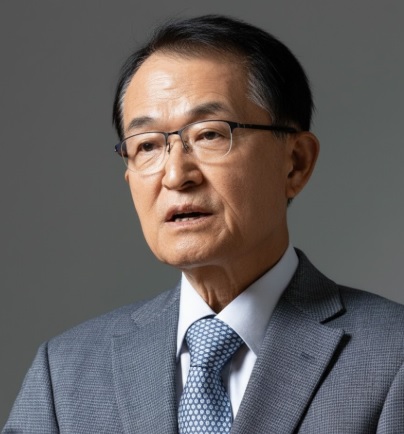
Kim Eui-shin, a world-renowned cancer expert and lifetime professor at the MD Anderson Cancer Center, delivered a public health lecture for patients and their families on the afternoon of June 12 at the main auditorium of the Dongnam Institute of Radiological & Medical Sciences (DIRAMS) in Gijang County, Busan. The institute is headed by President Jeong Seung-pil. Instead of focusing narrowly on rigid cancer therapies or complex medical facts, Kim spoke at length about the foundational principles of healthy living, touching on life and death, health and illness, mindset, relationships, diet, and exercise.
"Death is a natural process… Start by thinking about how you want to live"
Kim opened the lecture by addressing the concept of mortality. “Death isn’t something extraordinary—it’s a natural process that every human being goes through,” he said, adding that there is “no need to be overly sorrowful or feel wronged.” He pointed specifically to the biological reality that around the age of 40, our bodies begin to lose more cells than they newly create, noting that aging and chronic disease are simply a natural part of life.
He stressed that because life is inherently short for everyone, what truly matters beyond mere longevity is thinking deeply about why you live and how you choose to spend your time. He also noted that it is no coincidence that individuals who remain mentally active—such as philosophers, deep thinkers, and musicians—often enjoy longer lives.
Kim shared that throughout his career, he has frequently observed that people who live with an eye toward helping others and contributing to society tend to live longer and stay healthier. “In quite a few cases, the more wealth or status someone has, the more their sense of grievance and attachment grows, which can actually complicate cancer treatment,” he said, adding that the ultimate goal should be living a good life rather than simply living as long as possible.
Body and mind are one… A positive, proactive life builds health
Emphasizing the critical importance of mental health, Kim explained that every organ in the human body is directly connected to the brain. “Your thoughts, emotions, and overall state of mind exert a major impact on physical health,” he said. “People who live positively and proactively, regularly meet with friends, and maintain active social relationships naturally cultivate better health.”
He noted that this mindset plays an especially crucial role for cancer patients undergoing treatment. Citing clinical cases involving American patients, Kim said he has consistently seen that patients who experience less worry, anxiety, and treatment-related stress also tend to suffer from fewer side effects during chemotherapy.
“Doctors can assist with treatments, but actual recovery is an achievement the body accomplishes on its own,” he said, stressing that true health is possible only when the body and soul exist in perfect harmony. He added that there is still a great deal about the human capacity to heal that modern science cannot fully explain.
Cancer is different for everyone… Early detection and mindset matter
Kim also addressed why cancer can be so notoriously difficult to treat. “Everyone’s chromosomes and genetic sequences are entirely unique, and the nature of cancer differs accordingly,” he said. “Consequently, a single treatment regimen will not produce the identical effect for everyone.”
He added that cancer is a highly complex disease whose characteristics can shift day by day, causing responses to vary wildly from person to person. However, noting that early-stage cancers generally boast excellent treatment outcomes, he credited South Korea’s exceptionally high cancer survival rate to both advanced medical technology and the widespread practice of early detection through regular health screenings.
In the field of oncology, Kim explained that the concept of "remission" matters far more than an absolute notion of a complete cure. Rather than becoming dangerously fixated on the idea that every single cancer cell must be aggressively eliminated, he suggested that living the remainder of your life joyfully and meaningfully is often much better for your overall health.
Clinically, remission refers to a stable state in which a disease’s symptoms or signs lessen or entirely disappear. However, it differs fundamentally from a full cure or complete recovery because doctors cannot conclusively declare that the disease is entirely gone. Kim noted that many patients in South Korea suffer from insomnia simply because they are plagued by the knowledge that cancer is inside their bodies, warning that such excessive anxiety does not aid health.
The secret to health is balance… Eat well, sleep well, and move well
According to Kim, individuals who successfully overcome cancer typically share one key trait: a commitment to a balanced life. “Even things that are inherently good for the body become a problem if taken to excess, and even bad habits turn into illness if they go too far,” he said, emphasizing that maintaining equilibrium between what helps and what harms is vital.
When audience members pressed him with questions regarding the specific lifestyle and dietary habits cancer patients should adopt or avoid, Kim offered a direct response: “The best healing method is to eat wholesome food in appropriate amounts, get sufficient sleep, think positive thoughts, and rest well.”
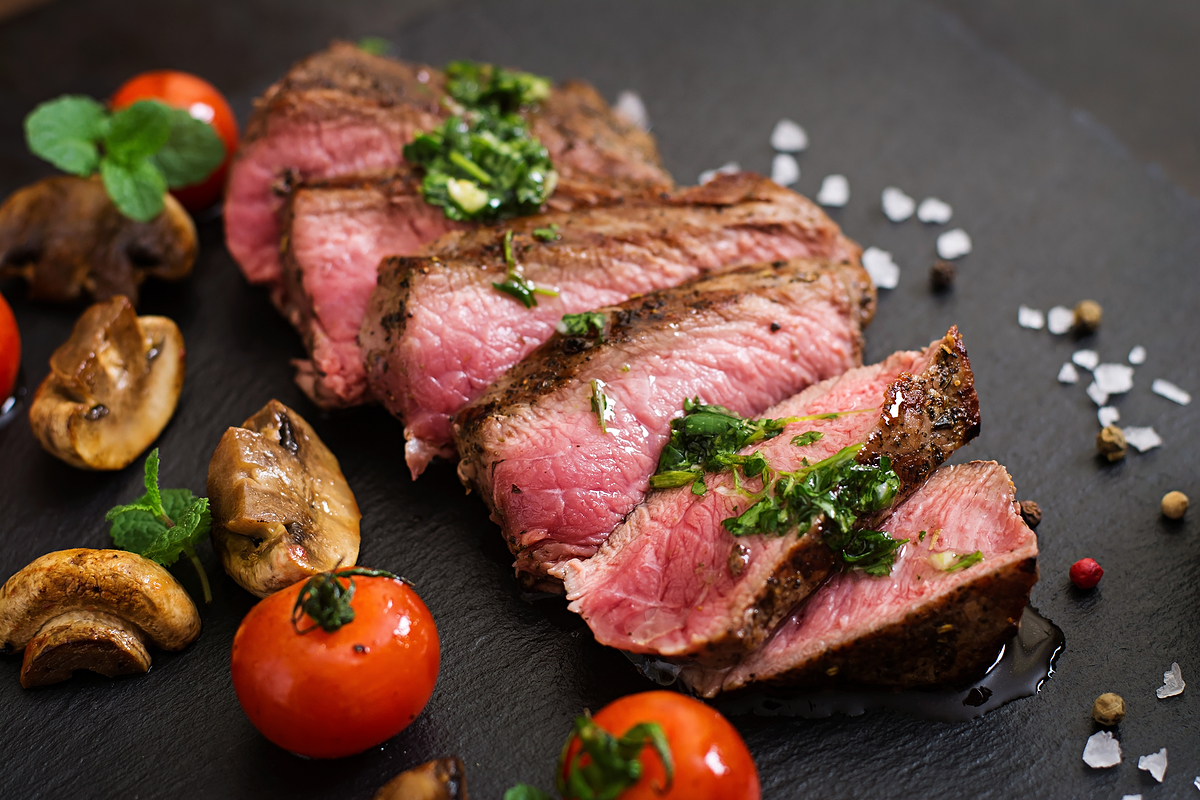
He firmly stressed that smoking, drinking, and a high-fat, meat-centered diet severely damage health. Instead, he recommended a diet that incorporates clean, high-quality proteins such as duck, tofu, and eggs, consumed in moderate amounts alongside vegetables and nutrient-dense seaweeds like gim (laver) and gamtae (sea trumpet). Kim explicitly warned that the nicotine found in cigarettes is a primary driver of genetic alterations and vascular diseases.
Pointing to what he described as excessive stress and worry in South Korea, he also discussed the profound connection between gut health and mental well-being. “In the United States, immune-compromised cancer patients are especially eager to leave the clinical environment out of concern over hospital-acquired pathogens,” he observed. “Rather than remaining hospitalized for too long, it is important to return to daily life within what's possible.” He cautioned against the prevailing approach in South Korea that relies almost exclusively on institutional hospital treatment.
Kim repeatedly championed the vital role of physical activity. “Maintaining physical stamina and adequate muscle strength provides a massive advantage during cancer treatment,” he said. “Warming the body through exercise and physical activity and making yourself appropriately tired promotes sound sleep and accelerates recovery.” He cited appropriateness and moderation as the core twin principles of a healthy life.
"Don’t fight cancer — live healthfully with it"
Closing out his lecture, Kim delivered a profound message of hope to the patients in attendance. “Cancer is not a disease a doctor can cure alone,” he concluded. “Eating well, spending your days happily, living with true peace of mind, exercising, reflecting, and finding meaningful ways to help society—that is the most important path to living healthfully alongside cancer.”
The lecture completely filled the 200-seat auditorium, drawing not only currently admitted inpatients but also individuals who had regularly followed Kim’s lectures online and traveled long distances to attend in person. Patients and their families remarked that the session allowed them to re-evaluate not just the latest medical breakthroughs, but the deeper meaning of happiness beyond a diagnosis and the true value of a healthy old age. Many deeply agreed that it was a meaningful lecture that made them realize their overall attitude toward life and cancer is far more important than the fear of the disease itself.