

As discussed in last week’s column(*), the structure of the human mouth—including the jaw joint and teeth—more closely resembles that of herbivores than that of carnivores or omnivores. So what does the rest of the digestive system tell us?
(*) Reference: “What do our mouth, jaw and teeth tell us to eat today?” (Kormedi.com, June 4, 2026) https://kormedi.com/2821745/
1. Saliva
Herbivores have much larger, more developed salivary glands than carnivores. That is because they eat plants, which require prolonged chewing, and they can swallow only after food has been thoroughly mixed with saliva and softened. Consequently, herbivores produce large amounts of thin, watery (serous) saliva. Carnivores, by contrast, produce relatively smaller amounts of thick, sticky (mucous) saliva, which helps lubricate and move food down the throat quickly even when they swallow large chunks with minimal chewing. Human salivary glands are also large, like those of herbivores, and human saliva is thin and fluid.
Furthermore, herbivore saliva—and human saliva—contains amylase, a carbohydrate-digesting enzyme. This enzyme begins breaking down the complex carbohydrates found in many plants as food is chewed and mixed in the mouth. Because the natural diets of carnivores and omnivores contain very little carbohydrate, their saliva completely lacks amylase. They also have no physiological need to mix food with saliva, so they chew cursorily and swallow their meals whole.
2. Stomach, small intestine
Because carnivores and omnivores swallow their prey in massive chunks, their stomachs are remarkably large, accounting for 60% to 70% of the total capacity of their digestive tract. When they capture an animal, their bodies are built to consume as much meat as possible quickly in a single sitting, and then digest it slowly while resting afterward. For example, wild lions typically catch food once every three to four days and eat until they are completely full.
Herbivores and humans, however, can safely swallow only food that has been well-chewed and softened, so the stomach is much smaller—occupying about 30% of the total capacity of the digestive tract. The human esophagus is narrow and suited only to moving small amounts of food downward. Eating too quickly, attempting to swallow large volumes, or swallowing poorly chewed food (with dense meat being the most common cause) can easily lead to physical choking.
The chemical environment of the stomach also exhibits a profound divergence. A carnivore's gastric juice is intensely acidic, maintaining a steady pH of 1 to 2 even after a meal. This concentrated acidity is strong enough to dissolve the bones or tough muscle tissue of prey, aiding meat digestion while effectively neutralizing dangerous, food-borne bacteria that thrive in spoiling meat.
Herbivores, by contrast, have a much milder stomach acidity around pH 4 to 5, meaning they cannot break down meat efficiently. In particular, human stomach acidity sits around pH 1.5 to 3.5 when fasting, but following a meal it dilutes to around pH 4 to 5. This makes meat highly difficult to break down easily, and even when it does digest, the process takes a long time. (For reference, because the pH scale is logarithmic, the difference in acidity between each level is tenfold rather than twofold; pH 1 is ten times more acidic than pH 2.)
Because meat is relatively easy for true carnivores to break down chemically, their small intestines are short—spanning only about three to six times their body length. If meat remains in the intestinal tract for an extended period, it generates a substantial volume of metabolic toxins and putrefactive substances, meaning carnivores must excrete it quickly after eating.
Herbivores absorb nutrients from a wide variety of plants, but because processing indigestible fiber takes a significant amount of time, their small intestines are much longer and more intricate than those of carnivores—measuring roughly 10 to 12 times their body length. Following this pattern, the human small intestine is exceptionally long, closely matching the proportions seen in great apes that consume herbivorous diets (humans measure 7.5 to 9 meters, while apes measure 6 to 9 meters). The anatomical structure of the human small intestine has far more in common with herbivores than with carnivores.
3. Large intestine
The large intestine absorbs water from the digested remnants passing from the small intestine, forming solid stool for eventual excretion. Carnivores possess a simple, short, and cylindrical large intestine that functions primarily to absorb water and salt rapidly.
In contrast, the human large intestine displays a wide, elongated, and distinctly sacculated structure characteristic of herbivores. It is a highly specialized organ engineered to slow transit time, absorb water and electrolytes, synthesize essential vitamins, and host a complex microbiome that ferments dietary fiber to generate a substantial amount of cellular energy in the form of short-chain fatty acids.
4. Other points
The physical appendages of these groups tell a similar story. Carnivores and omnivores possess long, curved, sharp, and powerful claws perfectly adapted for hunting and tearing other animals. Herbivores and humans, however, possess flat, blunt nails shaped instead for gathering, peeling, and handling fruits and vegetables.
Body cooling functions differently as well. Carnivores and omnivores completely lack sweat glands in their skin; instead, they lower their body temperature by sticking out their tongues and panting with shallow, rapid breaths to evaporate moisture. A dog running around on a hot day and cooling off with its tongue hanging out is a familiar example.
Herbivores, by contrast, regulate their body temperature by sweating from eccrine glands distributed across the skin of their entire body. Simply observing a person resting in sweat-soaked clothes after an intense workout makes it easy to recognize that human thermoregulation aligns closely with herbivores.
Look to our closest living relatives in the animal kingdom, and the biological pattern becomes even clearer. Chimpanzees are genetically the closest living animals to humans, with DNA profiles that match ours by approximately 98%. While chimpanzees are technically classified as omnivores, they derive the vast majority of their daily calories from fruits, leaves, blossoms, and wild berries. While they occasionally consume insects and small game, meat accounts for a mere 2% of their total dietary proportion.
In conclusion, the overall structure of the human oral cavity and gastrointestinal tract closely mirrors that of herbivores. It completely lacks the balanced, transitional physical traits found in true mammalian omnivores like bears or canines. Therefore, one can clearly conclude that the human body was anatomically designed to consume plant-based foods rather than animal tissue.
Because the human digestive system is uniquely optimized for a plant-based diet, many of the chronic metabolic and digestive diseases that arise from heavy meat consumption occur simply because eating meat does not align with the baseline structure of the human body.
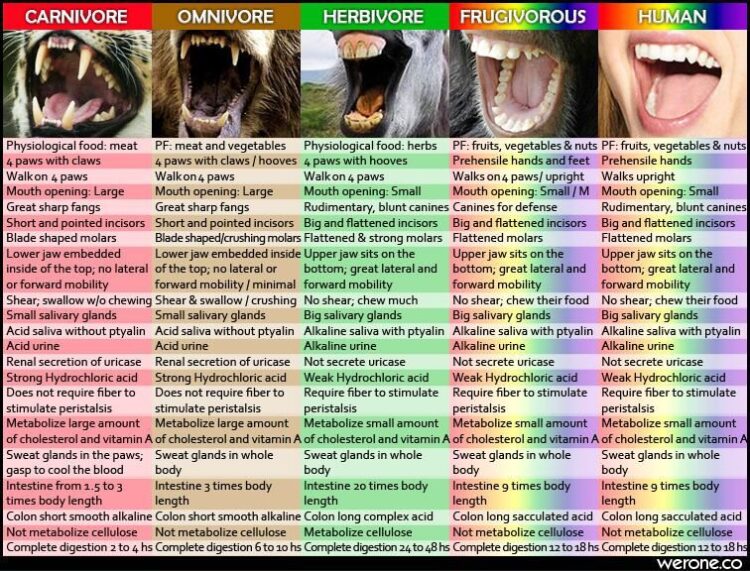
For readers who wish to review these anatomical proportions in greater detail, please refer to the comparison chart below.
In the next column, I will explain why humans—despite possessing an anatomy optimized for plant consumption—initially began eating meat, and the systemic health consequences that resulted. Humans were not omnivores to begin with.
Song Mu-ho, MD Specialist in Orthopedics and Lifestyle Medicine

References
1. A Tucker, I Miletich. Salivary glands: development, adaptations and disease. Vol. 14. Karger Medical and Scientific Publishers, 2010.
2. C Boehlke, O Zierau, C Hannig. Salivary amylase – The enzyme of unspecialized euryphagous animals. Archives of Oral Biology 2015;8(60):1162-1176.
3. Wikipedia https://ko.wikipedia.org/wiki/Lion
4. Dr. Bill's Pet Nutrition https://drbillspetnutrition.com/carnivores-omnivores-herbivores/?srsltid=AfmBOorMPzrEzXyaJFB_CNg1G57xwauvdt42RZ5cwPgBA2z5n4BUDmTk
5. Wikipedia. https://en.wikipedia.org/wiki/Gastric_acid
6. HP Simonian, L Vo, S Doma, et al. Regional postprandial differences in pH within the stomach and gastroesophageal junction. Digestive diseases and sciences 2005;50:2276-2285.
7. A Hila, H Bouali, S Xue, et al. Postprandial Stomach Contents Have Multiple Acid Layers. Journal of Clinical Gastroenterology 2006;40(7):612-617.
8. T. Colin Campbell Center for Nutrition Studies https://nutritionstudies.org/are-humans-herbivores-or-omnivores/
9. Liv hospital https://int.livhospital.com/how-long-are-human-intestines-surprising-facts/
10. DJ Chivers, CM Hladik. Morphology of the gastrointestinal tract in primates: comparisons with other mammals in relation to diet. Journal of Morphology 1980;166(3):337–386.
11. TT Kararli. Comparison of the gastrointestinal anatomy, physiology, and biochemistry of humans and commonly used laboratory animals. Biopharmaceutics & drug disposition 1995;16(5):351–380.
12. Viva https://viva.org.uk/health/physiology-vegan/
13. H Kaessmann, S Paabo. The genetical history of humans and the great apes. J intern Med 2002;251:1-18.
14. K Wong. The 1 percent difference. Genome comparisons reveal the DNA that distinguishes Homo sapiens from its kin. Sci Am 2014;311(3):100.)
15. All about wildlife http://www.allaboutwildlife.com/what-do-chimps-eat
16. Vancouver Sun https://vancouversun.com/opinion/opinion-humans-are-designed-to-eat-plants