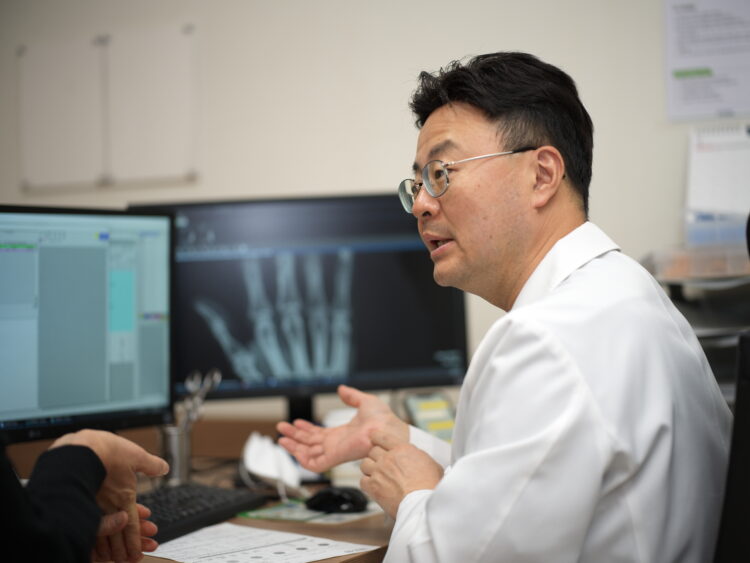
“After the right-thumb replantation surgery, I’ll treat the patient using this specific method.” – Doctor A
“Is that treatment really necessary? In my experience, it wasn’t effective.” – Doctor B
“Actually, my patients recovered faster when we omitted that treatment.” – Doctor C
“Even if it does have some effect, the financial burden on the patient is significant.” – Doctor D
“Then, let’s skip that treatment and monitor the course.” – Doctor E
“Ah, you’re right. I almost ended up… just trusting what was written in the textbook.” – Doctor A
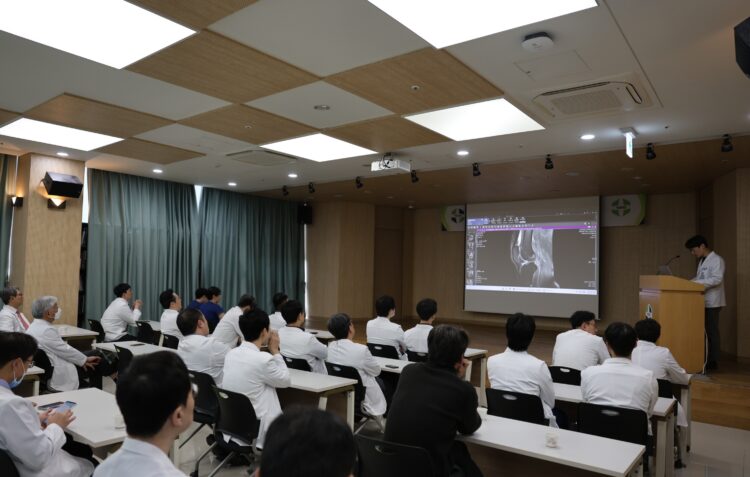
This is the scene at Yeson Hall, the auditorium on the 9th floor of Bucheon Yeson Hospital in Gyeonggi Province. Every morning at 7:50 a.m., about 30 physicians at this hospital gather and debate like this to find the best possible treatment for their patients. All doctors take turns presenting and discussing the progress, prognosis, and other details of about 20 surgical patients from the previous day. Sometimes, heated debates even lead to ideas for research papers. Anyone can freely share an opinion, and anyone can challenge anyone else. Except for weekends and public holidays, they do not take a single day off from this ritual.
A "Five-No" Hospital Where Specialized Knowledge Trumps Hierarchy
Yeson Hospital, whose name means “pretty hands,” has no untouchable sacred ground. Kim Hee-joong, Honorary Director—known as a “master of hip-joint treatment,” who has served as President and Chair of the Korean Orthopaedic Association and as Deputy Director of Seoul National University Hospital—willingly follows these “open rules.” So does Baek Gu-hyeon, Honorary Director—known as a “world-renowned authority on treating congenital thumb deformities,” who has served as Chair of the Korean Society for Surgery of the Hand and the Korean Society for Microsurgery, and as Secretary-General of the International Federation of Societies for Surgery of the Hand. Kim Jin-ho, the Chief Director who founded the hospital, also follows the outcomes of discussion rather than sticking to the treatment methods he is personally used to.
At Yeson Hospital, not only is there no “sacred ground,” there are also no private offices for professor-level specialists. They work in an open space like a general office and immediately ask the specialist in front of or next to them about anything they are curious about. It is also a rare hospital in that it does not have physicians with “multiple specialties (double majors),” a practice common in private clinics to increase revenue.
It seems the “Pretty Hands Hospital” is a “three-no (三無) hospital”: no sacred ground, no private offices, and no double majors. And judging by how Director Kim Jin-ho initially declined the interview and only agreed with difficulty, it’s also a “four-no hospital,” adding "no aggressive marketing" to the list.
“At our hospital, there are so many outstanding surgeons that I’d rank about fifth in the surgical pecking order,” Director Kim explains. “However, when a doctor gets packaged as a famous ‘star’ for a particular treatment, that influence can make it easy to perform treatments that aren’t necessary or to stop looking for other ways to treat. Because every person’s body and circumstances are different, treatment approaches often need to differ as well. That’s why sharing doctors’ real-world experiences is important. In university hospitals, it’s hard to go against your mentor, but we don’t treat even a mentor’s opinion as the correct answer. Consulting each other about what the best treatment is—that is our culture. There are many times when the attending physician changes the initial surgical plan after hearing another doctor’s opinion, and I’m no different.”
In this sense—because there is no absolute formula for treatment and no coercion to “do only this”—Yeson Hospital could also be called a “five-no hospital.” More appropriate treatment for patients has led to excellent outcomes, and the hospital has become known as a “hospital with high patient satisfaction.” It became the only hospital to receive the Ministry of Health and Welfare’s specialty-hospital certification in two areas: finger replantation surgery and joint treatment. It is also a hospital where orthopaedic specialists are on standby until 10 p.m., 365 days a year, to treat emergency patients late at night.
Evidence-Based Medicine and the Rejection of Overtreatment
When asked how it is possible to maintain such a rigorous schedule in a climate where orthopaedic specialists are incredibly difficult to recruit, Director Kim is candid.
“When we recruit specialists, if we say they must attend the ‘7:50 Conference’ and take night duty until 10 p.m. about once a week, some doctors hesitate. Even if they come from a university hospital as a specialist, they need to learn for 3 to 6 months while seeing patients and assisting in surgery. However, if you attend the 7:50 Conference for just one or two years, you can become a more specialized doctor than anyone else in this field. Also, our doctors can practice and do research to their heart’s content, guided by their conscience. Our hospital also sends physicians for training at a level comparable to university-hospital professors.”
Regarding the controversies over overtreatment due to incentive systems in neurosurgery and orthopaedics, Director Kim remains firm.
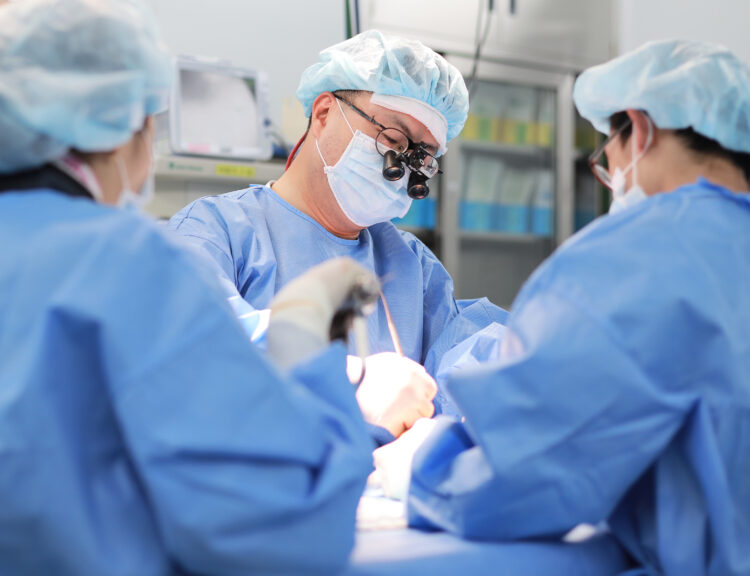
“Of course we have an incentive system. However, no matter how much money we could make, we do not recommend unnecessary treatments or treatments that could harm the patient. Through our system, we review treatment methods and prevent care that does not help the patient. We have even dismissed doctors who refused to comply.”
He further notes, “As for stem cell therapy, we still do not allow it because we cannot verify its effectiveness. We have permitted autologous platelet-rich plasma (PRP) injection therapy on a pilot basis with limited indications, and we plan to decide what to do depending on the results.”
A Foundation Built on Clinical Guilt and Patient-First Philosophy
This kind of evidence-based care came from putting patients first. The reason Director Kim Jin-ho decided to build the hospital was also because of his experiences with patients.
As an intern, Director Kim wanted to go into thoracic surgery and spent two months practically living in the intensive care unit, but he wavered when a senior thoracic-surgery resident asked, “Do you want to live like me?” He changed direction after a senior in obstetrics and gynecology said, “Orthopaedics is awesome!” He volunteered for the orthopaedics department at Boramae Hospital and worked for two months so intensely he lost track of day and night. However, amid uncertainty, he became a casualty of residency quota adjustments and did not make it into the Seoul National University Hospital residency program. While trying to regroup, he went to his hometown of Daegu and received an SOS from a senior who was working at Hyundai Hospital. That senior was handling the constant influx of patients alone and had a stellar reputation in hand replantation surgery.
At that time, Director Kim Jin-ho decided that “hand surgery” would be his lifelong subspecialty. After completing his residency at Seoul National University Hospital, he served as an assistant professor at Sanggye Paik Hospital. In May 2002, after seeing patients until Friday night, he went out for plans on Saturday when he received a call from a resident: “A woman in her 50s has arrived with a fractured upper arm bone and a severed thumb.” In the moment he hesitated about whether to go back to the hospital, he was told that plastic surgery would handle the case. Surgery on the arm bone should have come first, but the plastic surgeon performed only the thumb replantation. By the time Kim learned this, it was too late. Tormented by the guilt of thinking, “Even though it was the weekend, I should have gone in…,” he lay awake at night and resolved to build a hospital that would properly treat hands.
Growth Through Hardship and Systematization
Director Kim persuaded a senior who was working at a university hospital in Incheon, and in January 2005 he opened Yeson Orthopaedics. However, on the first day, there were only 15 patients. In June, patient volume suddenly surged. The mystery was soon solved: professors at nearby university hospitals were traveling to Europe for a conference and had told others, “If an emergency patient comes in, you can send them to Yeson Clinic.” Word spread quickly through the patients who came at that time.
However, the wailing of a guardian who came with a patient whose leg had been severed became another turning point. Attempting an aggressive replantation when amputation might have been safer led to the patient’s condition rapidly deteriorating. The doctors barely restored a heartbeat before transferring the patient.
“I realized deeply that you can’t save a patient with motivation alone,” Kim recalls. “To respond systematically to emergencies, I vowed that we needed to strengthen our hospital system by adding specialists in anesthesiology, pain medicine, and internal medicine.”
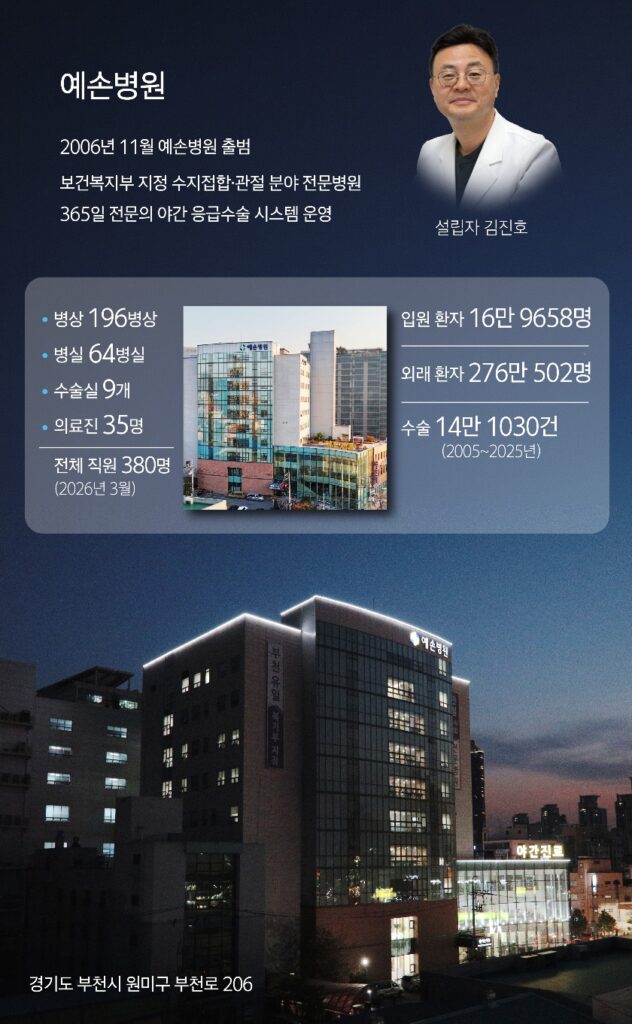
Just 1 year and 10 months after opening, in November 2006, Yeson Clinic was upgraded to a hospital, and established a Spine Center. It expanded further with a Joint Center in 2008 and a Foot and Ankle Center in 2010. To date, after performing surgeries on about 140,000 patients, it has passed the Ministry of Health and Welfare’s “Accredited Medical Institution” evaluation and received specialty-hospital certification.
Designing a Space for the Patient
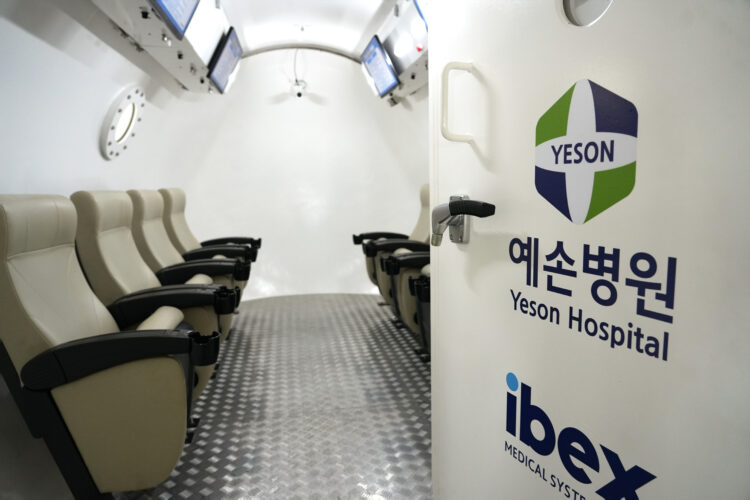
When you visit this hospital, you can feel its patient-first philosophy everywhere. On the first floor, the imaging room is located in the middle of the outpatient clinic area so patients can quickly get X-rays. The width of the ward corridors is 3 meters—much wider than standard hospitals—to allow patients to move freely. In the physical therapy room, the hospital utilizes an expensive multi-chamber hyperbaric oxygen therapy device. In addition to patients covered by insurance, it is also helping the recovery of patients with fractures and postoperative issues. Through this facility, a collaborative care system was established with nearby Bucheon Sejong Hospital. It is a prime example of an “open idea” born from patient-centered care.