The common refrain "you have to eat meat to have strength" reflects a cultural sentiment in Korea that is anything but ordinary. Since the 2000s, meat consumption across the country has risen steadily, while rice consumption has plummeted.
In 2020, the average annual meat consumption per capita—including beef, pork, and chicken—reached 53.7 kg, narrowing the gap with the 57.7 kg of rice consumed per person [1]. By 2022, a significant shift in the Korean diet occurred: meat officially overtook rice as the nation's primary staple. Annual meat consumption climbed to 58.4 kg per person, surpassing the 56.7 kg recorded for rice [2].

Our ancestors relied on heaping bowls of rice for the energy to labor in the fields, giving rise to the saying, "We live on rice power." However, that is now a relic of the past. Korean eating habits have transformed completely, with meat now dominating the plate [3].
Is Meat Consumption Genuinely Beneficial?
The short answer is no; meat is a carcinogen. On October 26, 2015, the World Health Organization (WHO) classified processed meats, such as ham and sausages, as “Group 1 carcinogens.” This category carries a high risk of causing cancer, placing these foods in the same bracket as tobacco. The WHO also classified red meats, including beef and pork, as “Group 2A carcinogens,” noting their carcinogenic potential and citing evidence that their consumption increases the incidence of colorectal, pancreatic, and prostate cancers [4].
The scientific evidence linking meat to cancer is substantial. A 2021 meta-analysis conducted by Harvard University, which reviewed 148 papers, concluded that high consumption of red or processed meat increases the risk of various cancers. Specifically, the study noted increased risk rates for breast cancer (9%), endometrial cancer (25%), colorectal cancer (21%), rectal cancer (26%), lung cancer (20%), kidney cancer (19%), and liver cancer (22%) [5].
Furthermore, a 2020 study by Oxford University followed 4.7 million healthy adults for an average of seven years. Examining 28,000 cancer patients, researchers found that consuming at least 50 g of red meat per day increased the incidence of colorectal cancer by 36%. Processed meat intake of at least 20 g per day saw a 26% increase in rectal cancer. Even poultry—such as chicken and duck—showed a 17% increase in cancers of the lymphatic and blood-forming systems when consumed at levels of at least 30 g per day [6].
Korea’s Record-High Rates of Young-Onset Colorectal Cancer
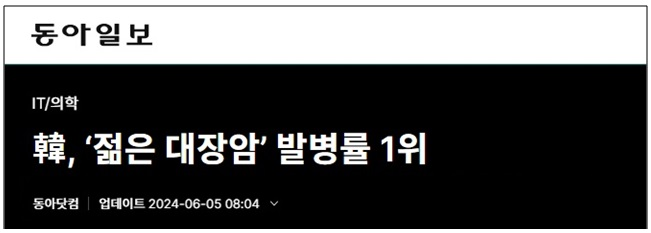
A shocking finding has recently emerged: Korea now has the world’s highest rate of young-onset colorectal cancer. According to a 2022 paper published in The Lancet, the colorectal cancer incidence rate among Koreans aged 20–49 was 12.9 per 100,000 people, the highest among 42 countries studied [7]. This figure surpasses rates in Australia (11.2) and the United States (10). Across all age groups, from young adults to the elderly, Korea ranks first globally in colorectal cancer incidence [8, 9].
Colorectal cancer typically develops after age 50; cases diagnosed before this age are termed “young-onset.” Westernized dietary habits are frequently cited as the primary driver for this increase. Because the disease is closely linked to the consumption of red and processed meats, younger generations who favor these foods face a heightened risk. Furthermore, when diagnosed at a younger age, the cancer recurs up to three times more often and carries a lower survival rate, necessitating extreme caution [10].
The Myth of "Healthy" White Meat and Fish
It is a common misconception that while red meat is harmful, fish and chicken are healthy alternatives. Research suggests otherwise. A report from Loma Linda University—a center renowned for longevity research—found that individuals who ate red meat once a week or more had roughly double the incidence of colorectal cancer compared to those who did not. Interestingly, those who ate fish and chicken once a week or more saw a threefold increase in incidence [11]. In terms of colorectal cancer risk, white meat and fish offer no protection.
The carcinogenic nature of meat stems from several factors. When red meats are cooked at high temperatures or over an open flame, the heme iron in the meat transforms into powerful carcinogenic compounds, such as nitroso compounds and polycyclic aromatic hydrocarbons [12, 13, 14, 15]. Additionally, sodium nitrite—a preservative used in processed meats like ham—converts into nitrosamines, another known carcinogen, upon entering the human body [16].
IGF-1: The Hormonal Link to Cancer
Growth hormones also play a role in cancer development, specifically Insulin-like Growth Factor-1 (IGF-1). Primarily produced by the liver in response to signals from the pituitary gland, IGF-1 promotes the growth of bones, muscles, and nerves, making it vital for children. While levels naturally decrease with age, maintaining a balanced level is generally considered healthy [17].
However, IGF-1 is a "double-edged sword." While it repairs damaged cells, high concentrations help cancer cells proliferate [18]. Protein intake is the primary stimulant for IGF-1 secretion; when protein enters the body, the liver releases IGF-1 as a signal to begin building and growing cells [19].
For adults who are fully grown, excessive protein intake causes the liver to produce surplus IGF-1. This excess promotes the growth of both normal and abnormal cells—including cancer cells [20]. Crucially, the type of protein matters. High IGF-1 levels correlate specifically with animal protein intake, whereas plant proteins show no such relationship [21].
Because the amino-acid profile of animal protein is so similar to that of the human body, it is often labeled "high-quality." Ironically, from a oncological perspective, it is this very "quality" that accelerates the development of cancer. Reducing meat intake is not just a dietary choice; it is the essential first step in cancer prevention.
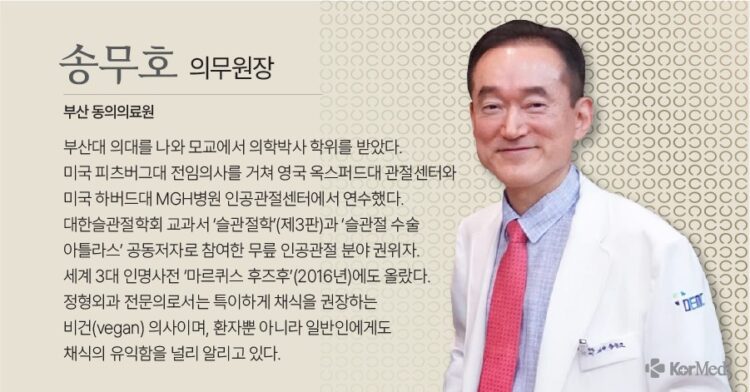
Dr. Song Muho, Orthopedic Surgeon and Specialist in Lifestyle Medicine
References
1. JoongAng Ilbo https://www.joongang.co.kr/article/25067659#home
2. Hankyoreh https://www.hani.co.kr/arti/science/future/1078387.html
3. KBS News https://news.kbs.co.kr/news/pc/view/view.do?ncd=7903768
4. V Bouvard, D Loomis, KZ Guyton, et al. Carcinogenicity of consumption of red and processed meat. The Lancet Oncology 2015;16:1599-1600.
5. MS Farvid, E Sidahmed, ND Spence, et al. Consumption of red meat and processed meat and cancer incidence: a systematic review and meta-analysis of prospective studies. Eur J Epidemiol 2021;36(9):937-951.
6. A Knuppel, K Papier, GK Fensom, et al. Meat intake and cancer risk: prospective analyses in UK Biobank, International Journal of Epidemiology 2020;49(5):1540–1552.
7. SG Patel, JJ Karlitz, T Yen, et al. The rising tide of early-onset colorectal cancer: a comprehensive review of epidemiology, clinical features, biology, risk factors, prevention, and early detection. Lancet Gastroenterol Hepatol 2022;7(3):262-274.
8. Sisa Journal https://www.sisajournal.com/news/articleView.html?idxno=266354
9. Medical Newspaper http://www.bosa.co.kr/news/articleView.html?idxno=2158062
10. KBS News https://news.kbs.co.kr/news/pc/view/view.do?ncd=3284452
11. PN Singh, GE Fraser. Dietary Risk Factors for Colon Cancer in a Low-risk Population. American Journal of Epidemiology 1998;148(8):761-774.
12. AJ Cross, JR Pollock, SA Bingham. Haem, not protein or inorganic iron, is responsible for endogenous intestinal N-nitrosation arising from red meat. Cancer Res 2003;63:2358-60.
13. SMK Gamage, L Dissabandara, AK Lam, V Gopalan. The role of heme iron molecules derived from red and processed meat in the pathogenesis of colorectal carcinoma. Crit Rev Oncol Hematol 2018;126:121-8.
14. M Chiavarini, G Bertarelli, L Minelli, R Fabiani. Dietary intake of meat cooking-related mutagens (HCAs) and risk of colorectal adenoma and cancer: a systematic review and meta-analysis. Nutrients 2017;9:514.
15. A Fonseca-Nunes, P Jakszyn, A Agudo. Iron and cancer risk—a systematic review and meta-analysis of the epidemiological evidence. Cancer epidemiology, biomarkers & prevention 2014;23(1):12-31.
16. RL Santarelli, F Pierre, DE Corpet. Processed meat and colorectal cancer: a review of epidemiologic and experimental evidence. Nutr Cancer 2008;60:131-44.
17. D Le Roith. Insulin-like growth factors. New England Journal of Medicine 1997;336(9):633-640.
18. AH Nwabo Kamdje, PF Seke Etet, MJ Kipanyula, et al. Insulin-like growth factor-1 signaling in the tumor microenvironment: Carcinogenesis, cancer drug resistance, and therapeutic potential. Front Endocrinol (Lausanne) 2022;13:927390.
19. JM Ketelslegers, D Maiter, M Maes, et al. Nutritional regulation of insulin-like growth factor-I. Metabolism 1995;44:50-57.
20. DL Kleinberg, TL Wood, PA Furth, AV Lee. Growth hormone and insulin-like growth factor-I in the transition from normal mammary development to preneoplastic mammary lesions. Endocrine reviews 2009;30(1):51-74.
21. NE Allen, PN Appleby, GK Davey, et al. The associations of diet with serum insulin-like growth factor I and its main binding proteins in 292 women meat-eaters, vegetarians, and vegans. Cancer Epidemiology Biomarkers & Prevention 2002;11(11):1441-1448.