
A large-scale study in South Korea has revealed that alpha-blockers—the most common treatment for benign prostatic hyperplasia (BPH)—significantly increase the risk of acute angle-closure glaucoma. This condition is a medical emergency that, if left untreated, can lead to permanent optic nerve damage and total blindness. The research found that patients using these medications face a 52% higher risk, with the danger nearly tripling for those on long-term prescriptions.
The Link Between Prostate Health and Eye Pressure
Alpha-blockers are typically prescribed as a first-line defense against BPH because they relax the smooth muscles in the prostate to improve urine flow. However, these drugs can also affect the muscles of the iris, leading to pupil dilation. In certain patients, this dilation can suddenly block the eye’s drainage system, causing a rapid and dangerous spike in intraocular pressure—the hallmark of acute angle-closure glaucoma.
The research team, led by Professor Kim Young-guk of Seoul National University Hospital and Professor Baek Seong-wook of Hallym University Sacred Heart Hospital, analyzed a massive dataset from the National Health Insurance Service. Their findings were recently published in the American Journal of Ophthalmology.
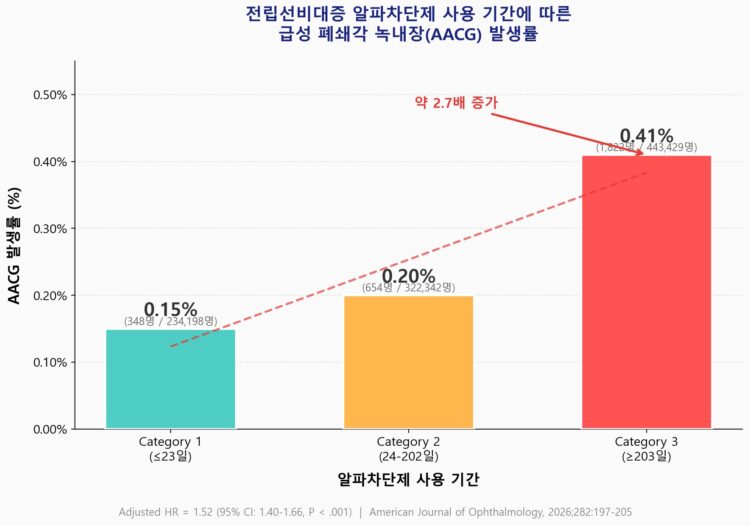
Risk Increases with Treatment Duration
The study utilized data from 2002 to 2022, tracking 30,450 patients. The researchers compared 5,075 individuals who developed acute angle-closure glaucoma against a control group of over 25,000 people, matching them for age, BMI, and underlying health conditions.
The analysis showed a clear "dose-response" relationship, meaning the risk grew the longer a patient remained on the medication:
Short-term users (≤23 days) had an incidence rate of 0.15%.
Long-term users (≥203 days) saw that rate climb to 0.41%, approximately 2.7 times higher than those in the short-term group.
Clinical Recommendations for High-Risk Patients
Given these findings, the research team is urging clinicians to exercise extra caution when prescribing alpha-blockers, particularly to patients with anatomically narrow drainage angles in their eyes.
"This study is highly meaningful in that it demonstrates a nationwide, population-based link between alpha-blockers and acute glaucoma risk," said Professor Kim Young-guk. "For high-risk patients, it is vital to undergo an ophthalmic evaluation before starting BPH therapy or during long-term use."
The team recommends that doctors consider:
Pre-treatment counseling regarding eye health risks.
Prophylactic laser iridotomy (a procedure to improve eye drainage) for long-term users.
Alternative medications, such as 5-alpha reductase inhibitors, for those at the highest risk of vision loss.