

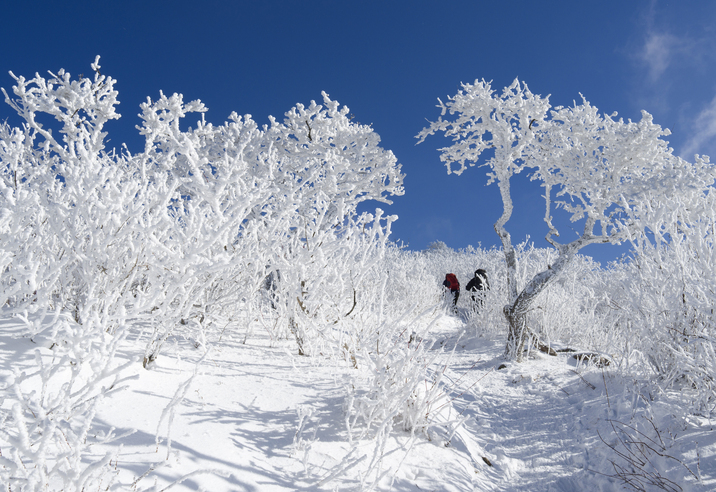
The beautiful snowy scenery is the charm of winter hiking. The 'winter snow flowers' of Daegwallyeong, Hallasan, and Deogyusan reach their peak from mid-January to early February. Winter hiking offers unexpected diet effects. Shivering in the harsh cold itself is a type of exercise that burns energy.
The fact that cold helps with dieting has been scientifically proven. According to previous research from the University of Sydney in Australia, shivering for just 10-15 minutes in temperatures below 15 degrees Celsius can cause hormonal changes similar to cycling for an hour. At this time, the irisin hormone secreted from muscles plays a role in converting white fat, which stores energy, into 'brown fat' that burns energy. The related paper was published long ago in the international journal 《Cell Metabolism》.
Additionally, according to research results from Harvard University published in 《Nature Medicine》 (2021), an analysis of over 50,000 people showed that those with brown fat have a significantly lower risk of obesity or metabolic diseases. The cool energy felt during winter hiking helps activate our body's 'fat-burning factory', brown fat.
The problem arises after the hike when the gathering begins. No matter how many calories were burned in the cold, high-calorie foods and alcohol consumed after descending can instantly nullify the diet effects. Research results published by Professor Herman Poncher's team from Duke University in the international journal 《Science》 (2021) show that when a person's activity level increases, the body activates an 'energy compensation' mechanism that conserves other internal metabolic energy. In other words, just because energy was expended during the hike does not mean that the total daily expenditure increases by that much.
The brain induces a stronger hunger due to the compensation psychology of having exercised. When alcohol is added to this, the situation worsens. According to research results published by the Francis Crick Institute in the international journal 《Nature Communications》 (2017), alcohol directly stimulates the brain's appetite-regulating neurons, leading to binge eating. The makgeolli and soju consumed after descending, along with high-fat side dishes, accumulate as body fat while the body breaks down the alcohol.
It is unrealistic to expect winter hiking to directly help with weight loss. Rather, it is advisable to understand it as a process that increases metabolic efficiency. Hiking can awaken brown fat and increase basal metabolic rate. However, after descending, it is necessary to avoid compensatory food intake and moderately consume high-quality protein and hydration. The moment you let your guard down thinking, "I exercised, so it’s okay to eat a bit," the health benefits of winter hiking become unattainable.
◇ Diet Guide to Prevent Binge Eating and Fat Accumulation Right After Descending
1. Drink warm water and tea before eating= A significant portion of the hunger felt right after descending is likely thirst. Drinking enough warm water or tea before eating can calm false hunger and prevent overeating.
2. Consume high-quality protein with reduced fat= To prevent muscle loss and maintain satiety for a long time, protein is essential. Foods like boiled meat, tofu, and steamed eggs are better than grilled or fried foods. Especially, processed foods like ham and sausages should be avoided.
3. Consume complex carbohydrates rich in dietary fiber= Instead of white rice or flour, it is better to have dishes made with dietary fiber-rich ingredients like wild greens rice and barley rice, accompanied by various mountain vegetables. Dietary fiber prevents rapid spikes in blood sugar, regulates insulin secretion, and inhibits fat accumulation.
[Frequently Asked Questions]
Q1. Is it really more advantageous for dieting to hike in cold weather?
A1. Theoretically, when the body feels slightly cool, brown fat is activated, which is favorable for fat burning. However, if you wear excessively thin clothing and your body temperature drops rapidly, there is a risk of hypothermia, and muscles may contract excessively, leading to injury. It is wise to layer clothing just enough to avoid sweating and maintain an appropriate body temperature during the hike.
Q2. Is it okay to have a glass of makgeolli after hiking?
A2. If it’s simply a matter of calories, one drink may not have a significant impact. However, alcohol can stimulate the brain's appetite center, clouding rational judgment. One drink can lead to two, and ultimately result in binge eating with high-calorie side dishes.
Q3. If I don’t lose weight even with exercise, is there a reason to continue hiking?
A3. While dietary control is good for reducing the numbers on the scale, exercise changes the quality of the body. According to Professor Herman Poncher from Duke University, exercise redirects energy that would be used for bad inflammation in the body to muscle activity. Hiking is essential not for weight loss, but for strengthening the heart and lungs and boosting immunity.











