"Expansion of medical school quotas, collapse of essential care, reform of the reimbursement system.... There are so many problems facing the medical community, but I feel they are actually disconnected from the people who use medical services. In fact, what the public wants is much more intuitive. They want a 'good doctor' to be near where they live. I believe the medical community's concerns should start again from there."
Kormedi.com's journey to find 'how to make good doctors' began earlier this year with concerns expressed by a professor at a university hospital we met. We visited so-called 'advanced medical countries' that had wrestled with similar questions before us and sought answers. We looked at how they select students and educate them to become physicians.
There were slight differences by country, but the premise was similar: only 'good people' can become 'good doctors.' They put in place various mechanisms to help medical students become good people.
The Meaning of Learning: Students Must Realize It Themselves
At Harvard Medical School there is a guideline that "learning how to learn is more important than knowledge itself." This follows the philosophy of former dean Edward Hundert, who pointed out that more than half of the knowledge students study diligently for over four years will be wrong or replaced by the time they graduate.
For this reason, Harvard Medical School's basic teaching method has become small-group discussion and problem solving known as 'case-based collaborative learning.' Class topics often go beyond clinical issues to discuss subjects such as medical ethics, health policy, and geriatric medicine, addressing discourses that extend beyond simply 'overcoming disease.'
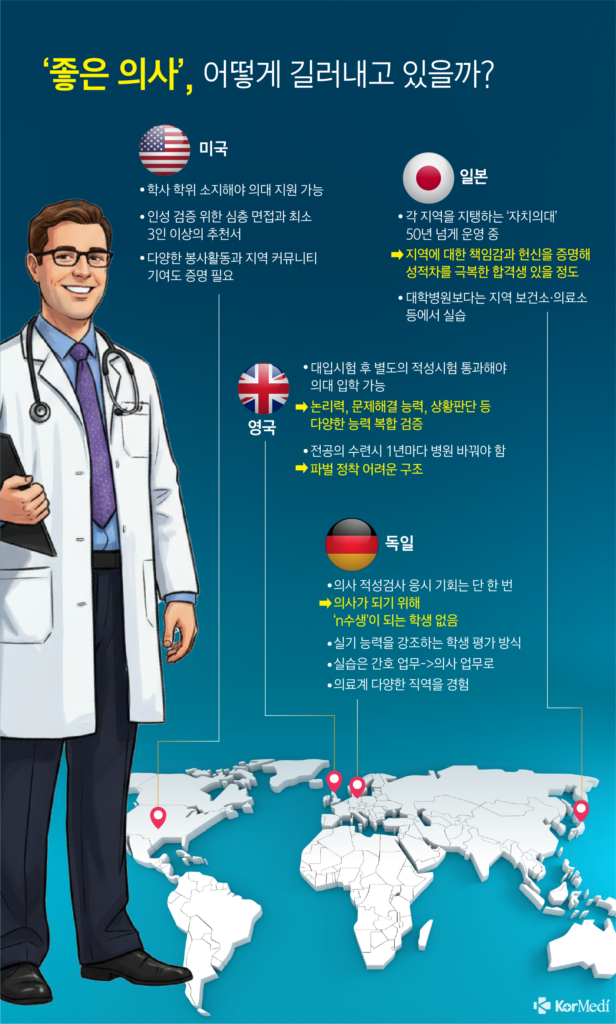
European medical schools use different methods but share a similar essence. In Germany, to obtain a medical license one must pass an oral examination. This system reflects German medical schools' characteristic belief that 'students who can convey knowledge to patients safely and persuasively' are superior to 'students who memorized problem-solving methods.'
British applicants for medical school must also demonstrate a variety of abilities, including volunteer work, job-shadowing experience, and even athletic ability. Grades matter, but interviews carry much more weight. Given that public healthcare dominates the British system, a sense of mission and aptitude for the profession are considered top priorities.
What Will We Gain from the Government's Medical Innovation Blueprint?
Although still in the early stages, signs of change are appearing in domestic medical schools. Seoul National University College of Medicine will, starting with students admitted for the 2027 academic year, reorganize the traditional 2-year premedical + 4-year medical curriculum into an 'integrated 6-year program.' This is interpreted as an effort to secure continuity in education and to grant students more autonomy to take courses in other fields.
Yonsei University College of Medicine, beginning in 2023, restructured its educational content from disease- or discipline-based to a topic-centered approach. Through case-based discussions and role-play, the goal is to cultivate critical thinking and empathy on topics that integrate the humanities and social sciences. Ulsan University College of Medicine decided to adopt absolute grading across all courses to discourage competition among students, and the Catholic University of Korea College of Medicine operates an integrated curriculum focused on case-based learning; both have joined the wave of change.
The government has also proposed a 'Public Medical Academy' to address regional healthcare shortages. Under this structure, the state would support the medical education of certain students, and those students would repay that support by working in regional areas for a fixed period.
A similar system exists in Japan: the Jichi medical school model, which trains doctors to work in medically underserved areas. Under this model, local governments in Japan cover students' tuition, fees, and living expenses entirely as scholarships. In return, graduates commit to working at medical institutions in the local area for nine years. The structure is similar to the government-proposed model.
However, the Jichi medical school model in Japan has shown clear limitations. Because doctors often leave after completing only their mandatory service period, there is a shortage of veteran doctors with more than ten years' experience who would serve as the backbone of regional care. The Korean Medical Association has also pointed out this issue and questioned domestic adoption.
In this context, Professor Son Daisuke, a third-generation Korean resident in Japan who teaches students at a Jichi-style medical school in Tottori Prefecture, offered Kormedi.com an insight.
"Systems that train regional doctors on the basis of mandatory service have obvious drawbacks. But you gain nothing if you don't try. Korea too, by implementing it directly, would gain experience that could be a major asset for regional medical development. The important thing is to think about how to select and manage students who are genuinely committed to regional healthcare, not just those with top grades."
Medical reform, a Public Medical Academy, or changes in medical school curricula will not be a silver bullet for Korea's healthcare problems. What matters is the will to solve problems and the ability to execute. As many advanced medical countries have shown, we must think broadly and experiment. If such efforts ultimately produce many 'good people,' then, as the public hopes, there will be correspondingly more 'good doctors' in our communities.
〈end〉
This series was supported by the Press Promotion Fund established with government advertising fees