
Patients who receive clear Helicobacter pylori test results during routine health screenings may still face an elevated risk of precancerous stomach changes if they have metabolic syndrome, according to a large-scale study.
Seoul National University Hospital (SNUH) Gangnam Center announced on the 10th that metabolic syndrome is significantly associated with moderate atrophic gastritis, a primary precursor to gastric cancer. The study was published in the international medical journal Digestive Diseases and Sciences.
The research team—led by Yang Sun-young of the Division of Gastroenterology at SNUH Gangnam Center, Jung So-yi of the Department of Laboratory Medicine at the Gangnam Center, and Song Eun-young of the Department of Laboratory Medicine at SNUH—analyzed upper endoscopy data from 12,353 individuals who underwent health screenings at the Gangnam Center between 2015 and 2023.
Atrophic gastritis occurs when chronic inflammation thins and degrades the stomach's mucosal lining. It is widely recognized as a representative precancerous lesion that can progress to stomach cancer. While H. pylori infection has long been regarded as the single greatest risk factor, earlier South Korean research indicating that metabolic syndrome increases stomach cancer risk by 26% had not fully adjusted for H. pylori status.
Controlling for H. pylori Variables
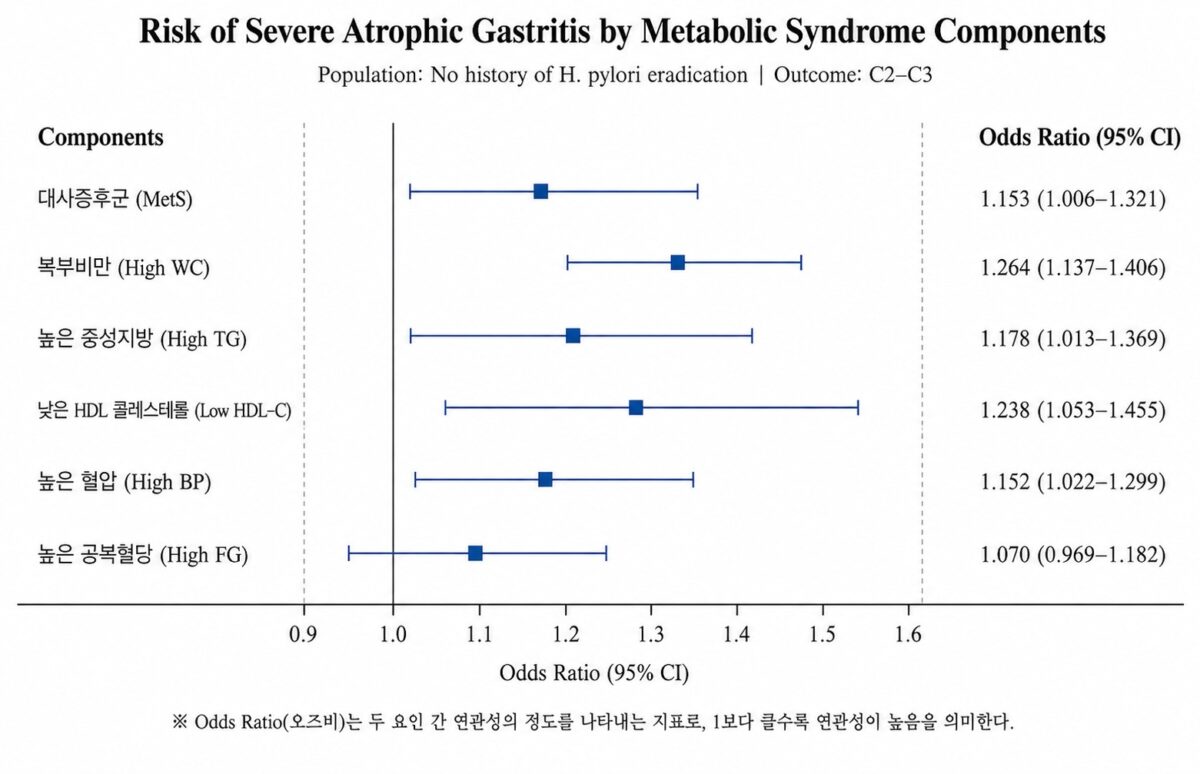
To isolate the impact of metabolic syndrome, researchers utilized propensity score matching (PSM) to balance variables including age, sex, smoking history, alcohol consumption, and H. pylori antibody status. Among participants who had never undergone H. pylori eradication therapy, those with metabolic syndrome demonstrated a statistically significant association with moderate atrophic gastritis, showing an odds ratio of 1.15—indicating a 15% higher risk.
When analyzing individual components of metabolic syndrome, abdominal obesity, elevated triglycerides, low HDL cholesterol, and high blood pressure all showed significant ties to moderate atrophic gastritis. Elevated fasting blood glucose was the sole metabolic marker that did not exhibit a clear correlation.
Notably, the association persisted even when the analysis was restricted exclusively to participants who tested negative for H. pylori antibodies and had no history of eradication treatment. The findings demonstrate that metabolic abnormalities independently influence structural changes in the gastric lining, regardless of H. pylori status.

Implications for Comprehensive Risk Assessment
“This study is meaningful in that it utilized large-scale endoscopy data to confirm that metabolic syndrome and its components are associated with moderate atrophic changes even after accounting for H. pylori, the most critical risk factor,” said Yang Sun-young.
Yang added, “However, as a cross-sectional observational study, these findings do not prove direct causation. Long-term follow-up studies are needed to determine whether managing and improving metabolic health can slow the progression of gastric mucosal atrophy and help prevent stomach cancer.”
The research team expects these findings will provide a foundation for incorporating metabolic indicators—such as body weight, blood pressure, and lipid profiles—alongside H. pylori evaluations when assessing individual stomach cancer risk.