Securing regulatory clearance for a medical device in overseas markets is a major milestone, but it does not guarantee supply contracts with foreign hospitals. Manufacturers still face a daunting array of commercial hurdles, from understanding internal purchasing criteria and identifying key decision-makers to building sustainable distribution networks.
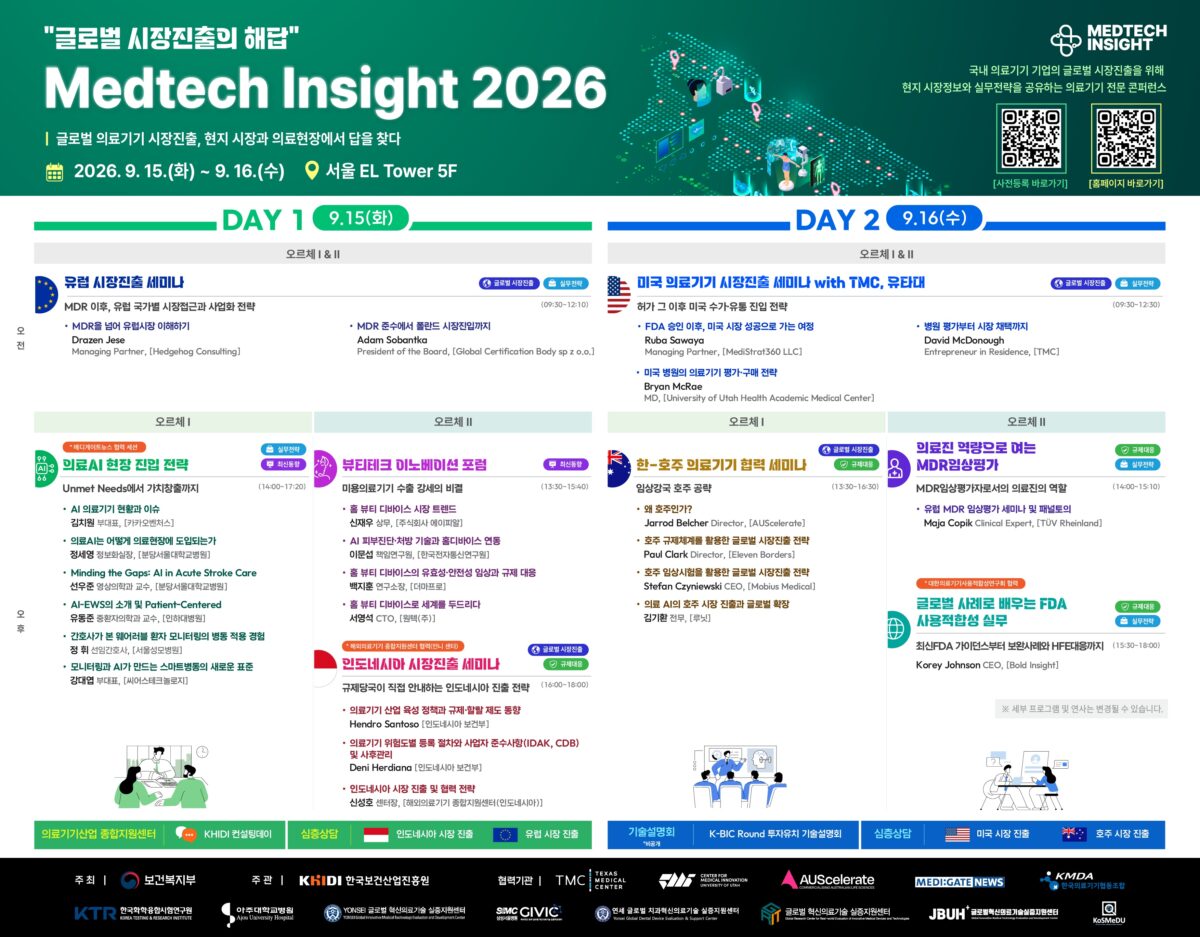
To help domestic medical device makers navigate these challenges, the Korea Health Industry Development Institute (KHIDI) announced on Aug. 31 that it will host "MedTech Insight 2026" on Sept. 15–16 at L Tower in Seoul's Yangjae district.
Now in its third year, MedTech Insight serves as a premier conference providing local market intelligence and practical commercialization strategies for Korean device manufacturers expanding globally. The conference brings together clinicians, industry representatives, regulatory experts, and international trade officials. Last year’s event drew approximately 530 attendees.
This year’s edition expands its focus on the U.S. market and artificial intelligence (AI) medical devices, highlighting real-world hospital procurement and clinical integration. The program also introduces dedicated sessions on entering Europe and Australia, alongside workshops on Indonesia, beauty tech, and global regulatory compliance.
Cracking the U.S. Hospital Supply Chain
Broadening last year’s focus on insurance coverage and distribution, the U.S. market session delves into how American hospitals evaluate new technologies and how products move from clearance to actual procurement.
U.S.-based experts and clinicians—including representatives from the Texas Medical Center (TMC) in Houston, which collaborates with KHIDI—will detail the internal review processes governing hospital purchases. The session will break down the roles of Integrated Delivery Networks (IDNs), Group Purchasing Organizations (GPOs), and hospital Value Analysis Committees (VACs).
Even after gaining U.S. Food and Drug Administration (FDA) clearance, medical device companies must clear these institutional evaluations. IDNs manage integrated hospital systems, GPOs leverage collective buying power to negotiate pricing, and VACs rigorously weigh clinical efficacy against economic value before approving new equipment.
Medical AI: Workflow Integration and Usability
The artificial intelligence sessions transition from technical performance capabilities to real-world clinical utility. Doctors and nurses will share practical user experiences, examining how Korean AI medical devices fit into existing hospital workflows.
Industry experts emphasize that clinical adoption depends less on algorithmic accuracy alone and more on seamless workflow integration and error prevention during operation. The FDA has similarly placed greater weight on real-user environments, recently updating its guidance on human factors engineering (HFE) and medical device usability.
A dedicated session will cover FDA usability evaluations, providing actionable guidance on how companies should approach HFE testing based on recent case studies.
Expanding European Post-MDR and Australian Strategies
A newly added European seminar shifts the conversation from initial Medical Device Regulation (MDR) certification to post-approval commercialization. European industry specialists will outline country-specific market access models, pricing structures, product positioning, and partner selection.
The session will also address compliance under the European Database on Medical Devices (EUDAMED), where key modules—including actor registration, device registration, notified bodies and certificates, and market surveillance—have become mandatory. Expert-led discussions will cover clinical evaluation requirements and strategies for managing MDR reviews.
In another first, a Korea-Australia medical device cooperation seminar will explore Australia's healthcare market and procurement landscape. Australian experts will present opportunities for joint clinical research and product validation, alongside case studies of Korean companies that have entered the market. Presenters will guide attendees through registering products on the Australian Register of Therapeutic Goods (ARTG) via local Australian sponsors.
Global Consultations and Registration Details
The event will also feature strategic sessions on entering Indonesia’s medical device market and emerging trends in beauty tech. On-site one-on-one consultation booths will connect Korean executives directly with international experts. European, AI, beauty tech, and Indonesian market sessions are scheduled for Sept. 15, followed by U.S. procurement, Australian cooperation, European MDR clinical evaluation, and FDA usability sessions on Sept. 16.
"Global medical device markets vary significantly in their healthcare infrastructure, purchasing structures, and clinical evaluation standards," said Hwang Sung-eun, head of KHIDI’s Medical Devices and Cosmetics Industry Division. "We hope this conference enables Korean companies to gain firsthand insights from overseas experts and build customized strategies for international expansion."
Participation in MedTech Insight 2026 is free. Pre-registration is open through Sept. 13 on the event's official website, with on-site registration available depending on venue capacity.