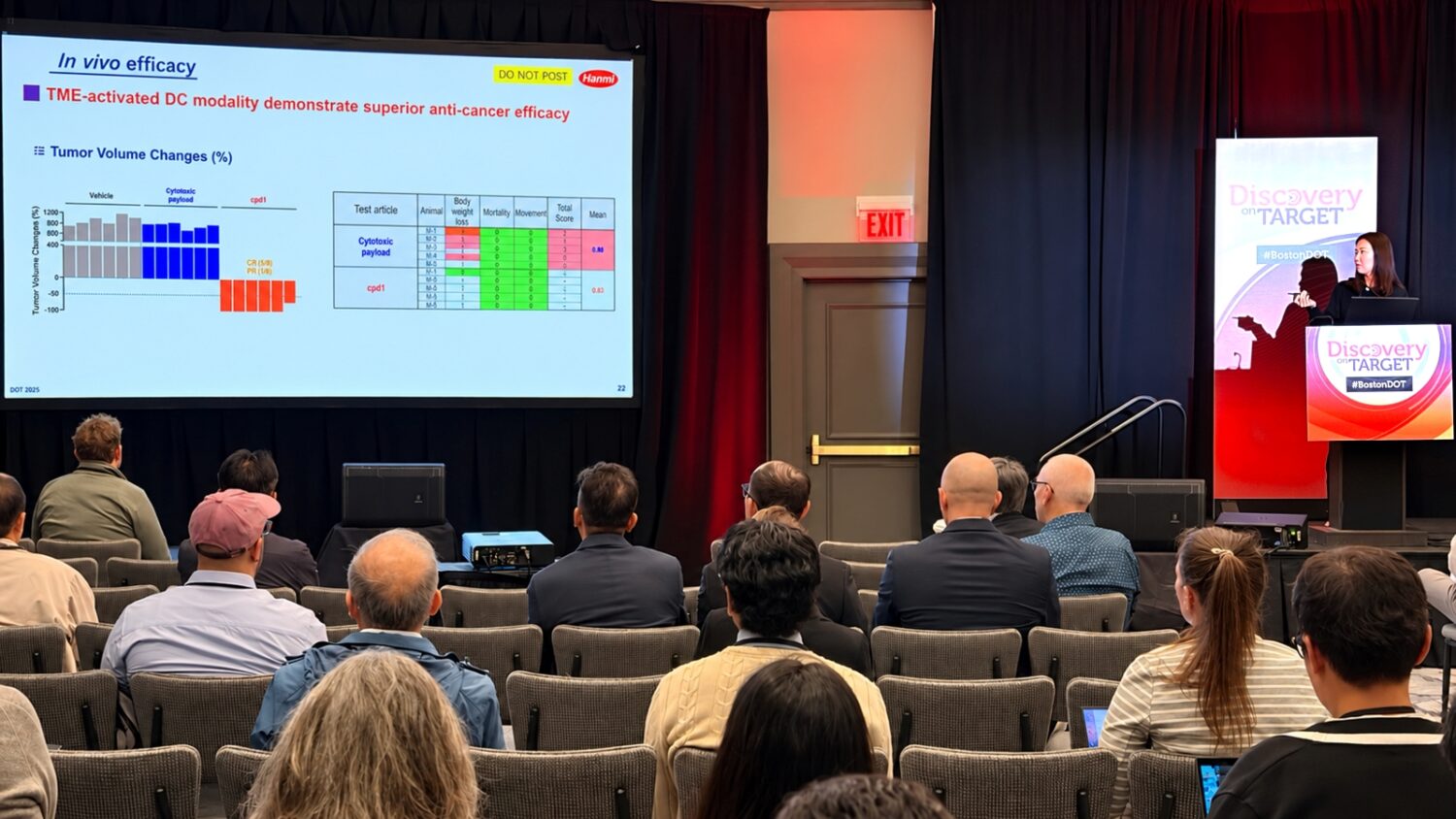
Hanmi Pharmaceutical has unveiled a next-generation cancer technology designed to deliver drugs to the tumor microenvironment surrounding cancer cells rather than to the cancer cells themselves. The approach differs from conventional antibody-drug conjugates (ADCs), which target specific proteins on the surface of cancer cells.
Hanmi Pharmaceutical announced on October 6 that it presented its findings at the global conference "Discovery on Target 2026," held in Boston from September 28 to October 1. The presentation focused on a small-molecule drug conjugate (SMDC) currently in development as a next-generation cancer technology targeting fibroblast activation protein (FAP) in fibroblasts within the tumor microenvironment.
ADCs are a targeted cancer treatment in which an antibody binds to a tumor-associated antigen (TAA)—a specific protein expressed on the surface of cancer cells—to deliver a cytotoxic payload directly into the cell.
While ADCs can selectively attack cancer cells, the large molecular size of antibodies and the dense structure of the tumor microenvironment can prevent drugs from penetrating deep into solid tumors. In particular, where cancer-associated fibroblasts (CAFs) and extracellular matrix (ECM) are packed tightly around a tumor, drug diffusion and cellular access are often severely limited.
To overcome these structural limitations, Hanmi Pharmaceutical turned to SMDCs, which deliver payloads using molecules significantly smaller than traditional antibodies. The company selected FAP as its target to maximize SMDC penetration into solid tumor tissues.
FAP is a protein abundant in CAFs that constitute the tumor microenvironment. While its expression is minimal in healthy adult tissues, FAP is highly expressed in the microenvironment of certain gastrointestinal solid tumors—such as pancreatic and colorectal cancers—that typically respond poorly to ADCs.
Using its proprietary drug discovery platform, DNA-encoded library (DEL) screening technology, Hanmi Pharmaceutical identified a novel small-molecule compound that selectively binds to FAP. The company then developed an SMDC modality by conjugating a cytotoxic payload to this compound via a specialized linker designed to break down specifically within the tumor microenvironment, keeping the drug stable in the bloodstream until it reaches the target site.
At the conference, Hanmi Pharmaceutical presented preclinical animal trial data demonstrating significant anti-cancer efficacy. Tumor growth was suppressed in mouse models implanted with FAP-expressing cells. In an orthotopic pancreatic cancer model—where tumor cells were implanted directly into pancreatic tissue—the treatment demonstrated marked tumor growth inhibition and extended overall survival.
"Unlike conventional ADCs, whose efficacy depends heavily on whether a specific antigen is expressed on individual cancer cells, this SMDC modality targets FAP expressed in CAFs within the tumor microenvironment, which is common across a broad range of cancer types," a Hanmi Pharmaceutical official said.
Hanmi Pharmaceutical is also scheduled to give an oral presentation on these findings at the "Nature Conference - Next Generation Cancer Therapeutics," held October 6–8 at The University of Texas MD Anderson Cancer Center.