Feeling unusually winded when climbing stairs or noticing weaker legs later in life may signal more than simple aging. A major South Korean study reveals that age-related declines in muscle strength and physical function are directly associated with an increased risk of heart disease, stroke, and overall mortality.
The National Institute of Health under the Korea Disease Control and Prevention Agency (KDCA) announced that long-term follow-up data from older Korean adults links physical functional decline to elevated cardiovascular risk and death. The findings were published in the international journal Scientific Reports.
According to KDCA data from the 2022 Korea National Health and Nutrition Examination Survey, sarcopenia affects 7.9% of South Koreans aged 65 and older, climbing to 20.0% among those aged 80 and above—meaning one in five elderly adults suffers from the condition.
Muscle Function as a Key Indicator of Cardiovascular Risk
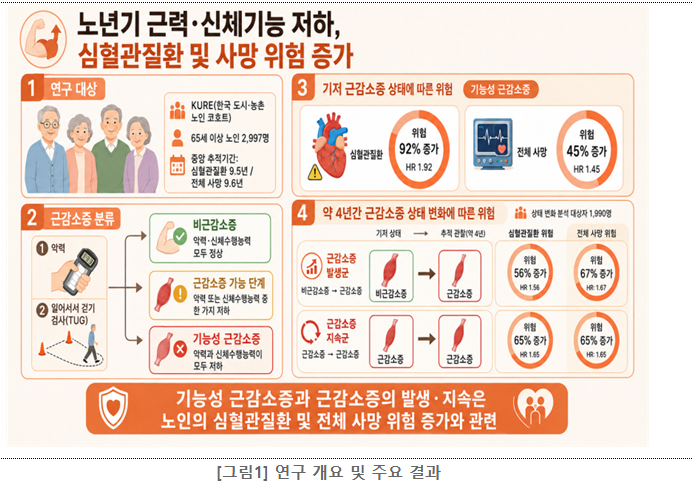
The research team analyzed 2,997 adults aged 65 and older from the KURE cohort—a community-based study established in 2012 by the KDCA and the Ministry of Health and Welfare tracking residents across Seoul and Ganghwa County, Incheon. Researchers linked cohort data with national health records from the National Health Insurance Service and Statistics Korea.
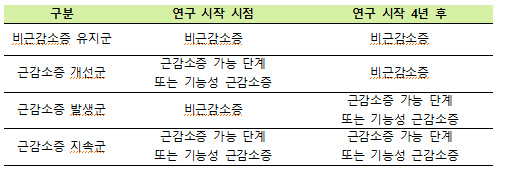
Rather than measuring muscle mass alone, the team evaluated physical function using handgrip strength and the "timed up-and-go" (TUG) test, which measures the seconds required to rise from a chair, walk three meters, turn around, and sit back down. Declines in one metric were classified as "possible sarcopenia," while declines in both signaled "functional sarcopenia."
The analysis revealed that older adults with functional sarcopenia faced a 1.92-times higher risk of developing cardiovascular disease and a 1.45-times higher risk of all-cause mortality compared to those with normal muscle function. The results demonstrate that weaker grip strength or reduced walking ability alone can serve as early warning signs for cardiovascular illness, even without verified loss of muscle mass.
New Onset and Persistent Sarcopenia Amplify Mortality Risks
To examine how changes in muscle function impact long-term health, researchers tracked 1,990 participants over a four-year follow-up survey.
Participants who newly developed sarcopenia over those four years exhibited a 1.56-times higher risk of cardiovascular disease and a 1.67-times higher risk of death compared to individuals who maintained healthy muscle function. Those with persistent sarcopenia faced a 1.65-times higher risk for both cardiovascular disease and mortality. Conversely, participants whose sarcopenia improved showed no clear association with increased risk, though researchers noted that larger sample sizes are required to draw definitive conclusions.
These findings align with international research. A 2024 study analyzing China’s CHARLS cohort similarly reported a 1.30 to 1.42-times increased risk of cardiovascular disease as sarcopenia progressed, while health risks decreased when muscle function improved.
Clinical Implications and Early Screening
The study’s principal investigator, health researcher Kim Min-ju, emphasized the clinical value of assessing physical performance alongside muscle mass. "This study confirms that examining actual muscle function, such as handgrip strength and physical performance, serves as an important indicator for identifying cardiovascular disease risk in older age," Kim Min-ju said. "Given that risks were significantly higher among those with newly developed or persistent sarcopenia, continuous monitoring is essential."
The researchers noted certain limitations, including the reliance on handgrip and mobility tests without direct body composition measurements such as DEXA scans. Nevertheless, health officials stress the importance of preventative care.
"Because declines in muscle strength and mobility in older age are linked to heightened cardiovascular and mortality risks, consistent physical management is critical," said Kim Won-ho, director of the Division of Chronic Disease Convergence Research. "Older adults should regularly engage in strength and balance exercises alongside aerobic activities like walking, while periodically monitoring changes in grip strength and walking speed."