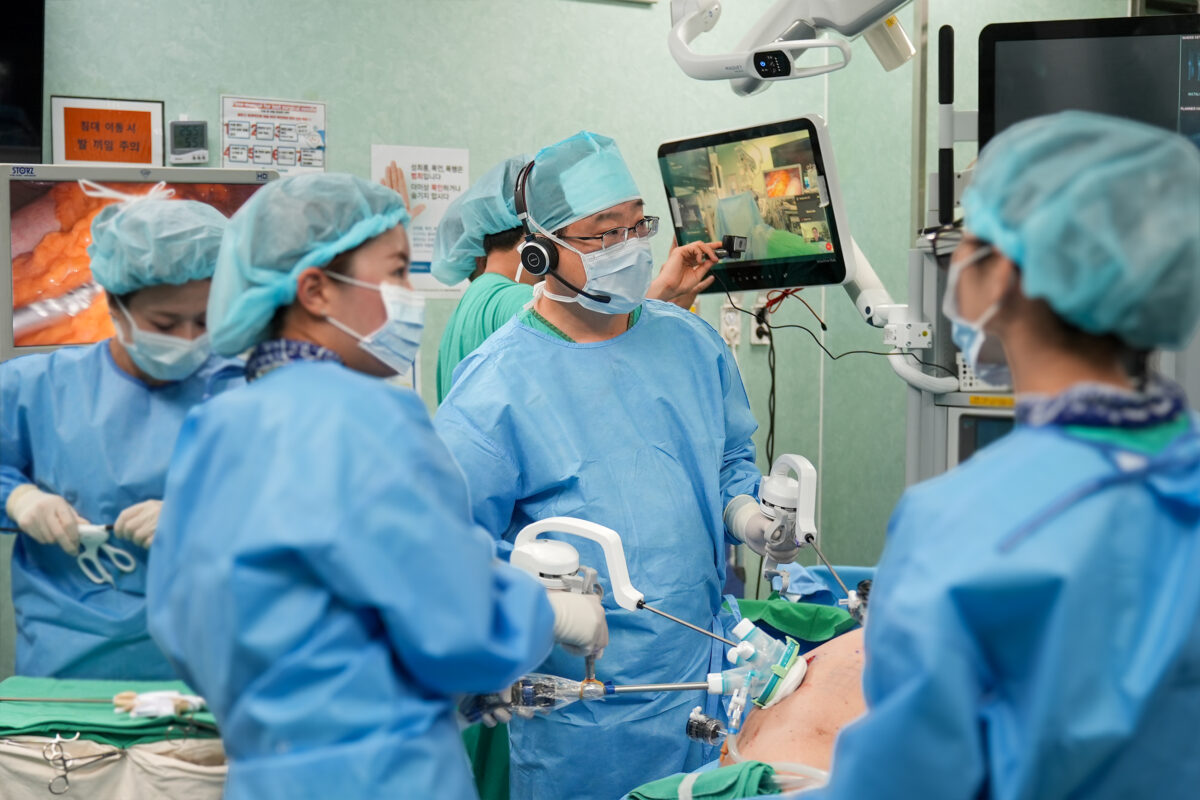
Outside the operating room, a patient’s family waits anxiously. Although the rectal cancer surgery has concluded successfully, an immediate worry remains: What if the reconnected section of the bowel fails to heal properly?
In colorectal surgery, this complication is known as an "anastomotic leak." If a leak occurs, recovery is delayed, and severe cases may require emergency reoperation. To minimize this risk, surgeons face a critical decision before making their first incision: where to tie off the inferior mesenteric artery (IMA), the primary blood vessel supplying the lower bowel.
Surgeons have two options: a "high tie," which ligates the vessel near its origin, or a "low tie," which ligates further downstream at a branch. For decades, surgical teams around the world have debated which approach offers better outcomes.
High Tie vs. Low Tie: A Longstanding Surgical Dilemma
The rationale behind each technique is distinct. Advocates for the high tie argue it allows for a more extensive lymph node dissection, potentially improving cancer staging and control. Conversely, proponents of the low tie emphasize that preserving main arterial branches maintains superior blood flow to the remaining bowel, theoretically lowering the risk of anastomotic leakage.
While both theories are clinically sound, surgeons lacked large-scale, randomized evidence to prove which technique was safer. Consequently, the choice often depended on individual hospital protocols and surgical preferences.
Multi-Center Trial Yields Definite Findings
To resolve the uncertainty, the "K-CROSS" research team launched a comprehensive multi-center investigation. Led by co-corresponding authors Prof. Bae Gi-beom of Inje University Busan Paik Hospital and Prof. Park Jun-seok of Chilgok Kyungpook National University Hospital, alongside first author Prof. Kim Chang-hyun of Hwasun Chonnam National University Hospital, the team brought together colorectal specialists from seven university hospitals across South Korea's Honam, Chungcheong, and Yeongnam regions.
According to Busan Paik Hospital on Aug. 14, the prospective randomized trial enrolled 314 patients with stage 1 to 3 rectal cancer between July 2019 and August 2024, with 293 patients included in the final analysis. Participants were divided into low-tie and high-tie groups, and researchers spent a year tracking outcomes including anastomotic leak rates, postoperative complications, urinary and sexual function, and overall quality of life. The study's findings were published in a recent issue of JAMA Surgery, a premier journal in the field.
The trial's conclusion was clear: there was no statistically significant difference between the high-tie and low-tie methods across any evaluated metric. Both techniques yielded comparable safety profiles, leak rates, and post-surgical functional outcomes.
Advancing Precision Surgery and Regional Leadership
Far from being an anticlimactic result, the finding provides essential clinical clarity. Proving that neither approach is inherently superior allows surgeons to abandon rigid, one-size-fits-all protocols in favor of tailored care.
"Precision surgery requires a comprehensive assessment of each patient's unique vascular anatomy, tumor location, bowel tension, blood supply, and the surgeon's expertise," said Prof. Bae Gi-beom. "Rather than adhering to a single rule, surgeons can now confidently choose the technique that best matches the individual patient."
The study also marks a milestone for regional healthcare in South Korea. Rather than being driven by major hospitals in Seoul, the landmark trial was spearheaded entirely by regional academic medical centers led by Inje University Busan Paik Hospital, Chilgok Kyungpook National University Hospital, and Hwasun Chonnam National University Hospital. By producing high-impact research published in JAMA Surgery, the regional teams demonstrated international research capabilities.
Prof. Bae Gi-beom, who has performed over 690 robotic colorectal cancer surgeries—the highest cumulative total in the Busan-Ulsan-Gyeongnam region—continues to lead live surgical demonstrations and technical training for domestic and international surgeons, including teams in Japan.
Ultimately, confirming that both high-tie and low-tie methods are equally safe in minimally invasive rectal cancer surgery provides reassuring evidence for both clinicians and patients, shifting the surgical focus toward personalized patient care.