
If a dry cough or shortness of breath lingers long after recovering from COVID-19, a patient’s prior allergic history may hold the key. Individuals with a history of allergic rhinitis, atopic dermatitis, or chronic rhinosinusitis face a significantly elevated risk of being newly diagnosed with asthma following a COVID-19 infection, with the risk escalating sharply for those managing multiple allergic conditions.
A joint research team led by Research Professor Choi Yoo-jung of the Seoul National University Hospital (SNUH) Biomedical Research Institute, Clinical Assistant Professor Kim Young-chan of SNUH's Division of Allergy and Clinical Immunology, and Professor Lee Hye-sung of Kangwon National University College of Medicine reported the findings on Aug. 13 after analyzing 3,987,182 confirmed COVID-19 cases. The study, which cross-referenced records from the Korea Disease Control and Prevention Agency (KDCA) and the National Health Insurance Service (NHIS), was published in the peer-reviewed journal Nature Communications.
Tracking healthcare data from 2019 to 2022, the team focused on individuals with no prior diagnosis of asthma before contracting COVID-19. They examined four preexisting conditions: allergic rhinitis, atopic dermatitis, food allergy, and chronic rhinosinusitis. To isolate the effects of these conditions, researchers performed a 1-to-1 propensity score matching for age, sex, region, income, comorbidities, and baseline medications, resulting in two balanced cohorts of 1,563,148 individuals each.
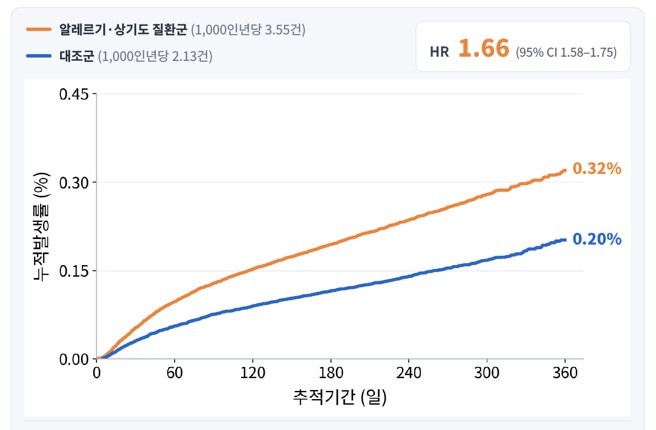
During the follow-up period, 3,808 individuals in the allergy cohort developed new-onset asthma (3.55 cases per 1,000 person-years), compared to 2,300 in the control group (2.13 cases per 1,000 person-years). After adjusting for observation duration, researchers determined that individuals with a history of allergic or upper-airway disease faced a 66% higher overall risk (hazard ratio of 1.66) of developing asthma post-COVID-19.
Compounding Risks Across a Single Connected Airway
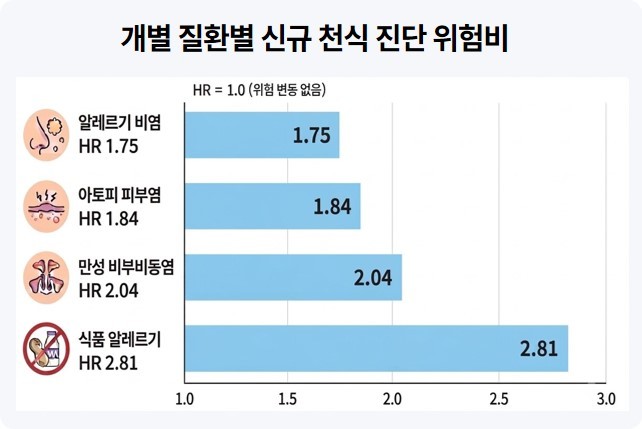
Analyzed individually, each allergic condition consistently correlated with heightened asthma vulnerability. A prior history of allergic rhinitis increased new-onset asthma risk by 1.75 times, atopic dermatitis by 1.84 times, and chronic rhinosinusitis by 2.04 times. While food allergies showed the highest hazard ratio at 2.81 times, researchers noted this figure requires cautious interpretation due to a small sample size of 22 cases.
Crucially, the risk increased in a stepwise manner based on the number of coexisting conditions. Patients with a single allergic condition faced a 1.58-fold higher asthma risk than controls, whereas those with two or more overlapping conditions experienced a 2.44-fold risk increase.
These findings align with the medical concept of the "united airway," which views the entire respiratory tract—from the nasal passages and sinuses down to the bronchi and lungs—as a single continuous mucosal system. Inflammatory and allergic processes in the upper airway can directly influence or predispose the lower airway to hyperreactivity.
Even after researchers adjusted for baseline medical service utilization to account for the possibility that allergy patients simply visit doctors more frequently, the association remained statistically significant, with a hazard ratio of 1.37.

Clinical Evaluation for Lingering Symptoms
As a retrospective observational study, the research does not prove a direct causal mechanism showing that COVID-19 or preexisting allergies directly generate asthma. Rather, it serves as a clinical screening framework to identify high-risk patients following viral infection.
The study also observed that individuals requiring frequent systemic steroid treatments prior to infection faced higher asthma risk (hazard ratios of 1.53 for below-average use and 1.96 for above-average use). Researchers emphasized that this reflects the baseline severity and poor control of the underlying allergic disease rather than a harmful side effect of steroids.
"In nationwide data, we confirmed that all four allergic and upper-airway conditions were associated with an increased risk of new-onset asthma following COVID-19, with the risk rising stepwise alongside the number of overlapping conditions," said Choi Yoo-jung. "Further research incorporating immunologic markers is needed to refine risk stratification."
Kim Young-chan highlighted the practical takeaways for clinicians and patients: "When evaluating patients with persistent coughing or dyspnea after COVID-19, checking for a history of preexisting allergic or upper-airway disease is essential. Patients with multiple coexisting conditions who experience persistent symptoms should undergo diagnostic evaluation, including pulmonary function tests, to rule out asthma."
Classic asthma manifestations extend beyond a dry cough to include wheezing, shortness of breath, and chest tightness. Experts advise that any cough persisting for more than a month following a respiratory infection warrants formal medical assessment.